Galang Taruna
Following Apple’s highly anticipated fall keynote, a select group of media and content creators were granted a brief, controlled opportunity to experience the revolutionary iPhone Duo, the company’s inaugural foldable smartphone. These exclusive hands-on sessions, lasting between thirty minutes and an hour under the watchful eyes of Apple press attachés, have formed the basis of all initial impressions published globally. This synthesis of numerous French and English-language reports aims to dissect what these first encounters reveal about the iPhone Duo’s strengths and weaknesses, offering a crucial early perspective while acknowledging the inherent limitations of such tightly managed previews.
The Genesis of First Impressions: Apple’s Controlled Environment
The process behind these initial reviews is as meticulously orchestrated as Apple’s product launches themselves. Immediately after the keynote presentation at Apple Park, a demonstration zone is opened to a carefully curated selection of journalists and influencers. These individuals, deemed "trusted" by Apple, are afforded limited time with the new device. Reviewers typically spend between 30 to 60 minutes in a controlled lighting environment, prohibited from removing the device from the premises, charging it, conducting drop tests, or comparing it side-by-side with competing models. This strict protocol ensures a consistent narrative but also restricts the depth of testing possible. Engadget, for instance, reported being explicitly asked not to photograph the iPhone Duo alongside a Samsung Galaxy Z Fold 8, highlighting Apple’s desire to control the comparison points. Consequently, these early reports are best understood as "hot impressions" rather than comprehensive reviews, a fact many publications, including Numerama, openly acknowledge in their titles and framing. This context is vital for interpreting the collective feedback.
Unanimous Praise: The Revolutionary Matte Display
The most striking and universally lauded feature, one that largely escaped pre-launch leaks, is the iPhone Duo’s internal display, boasting a nano-textured finish. This innovation marks a significant leap in foldable screen technology. Nicolas Lellouche, writing for Numerama, unequivocally describes it as "by far the most readable screen in the history of foldable smartphones," evoking the sensation of "holding a color e-reader." He reported being unable to discern the crease, even after actively trying, though he conceded it might become visible under certain lighting conditions. JB from TheiCollection, also present at the event, emphasized that the demo units had been subjected to repeated opening and closing cycles for hours without the crease becoming apparent. While acknowledging a slight tactile presence of the crease, he noted it was "much less" pronounced than on offerings from Samsung, Huawei, or Xiaomi.
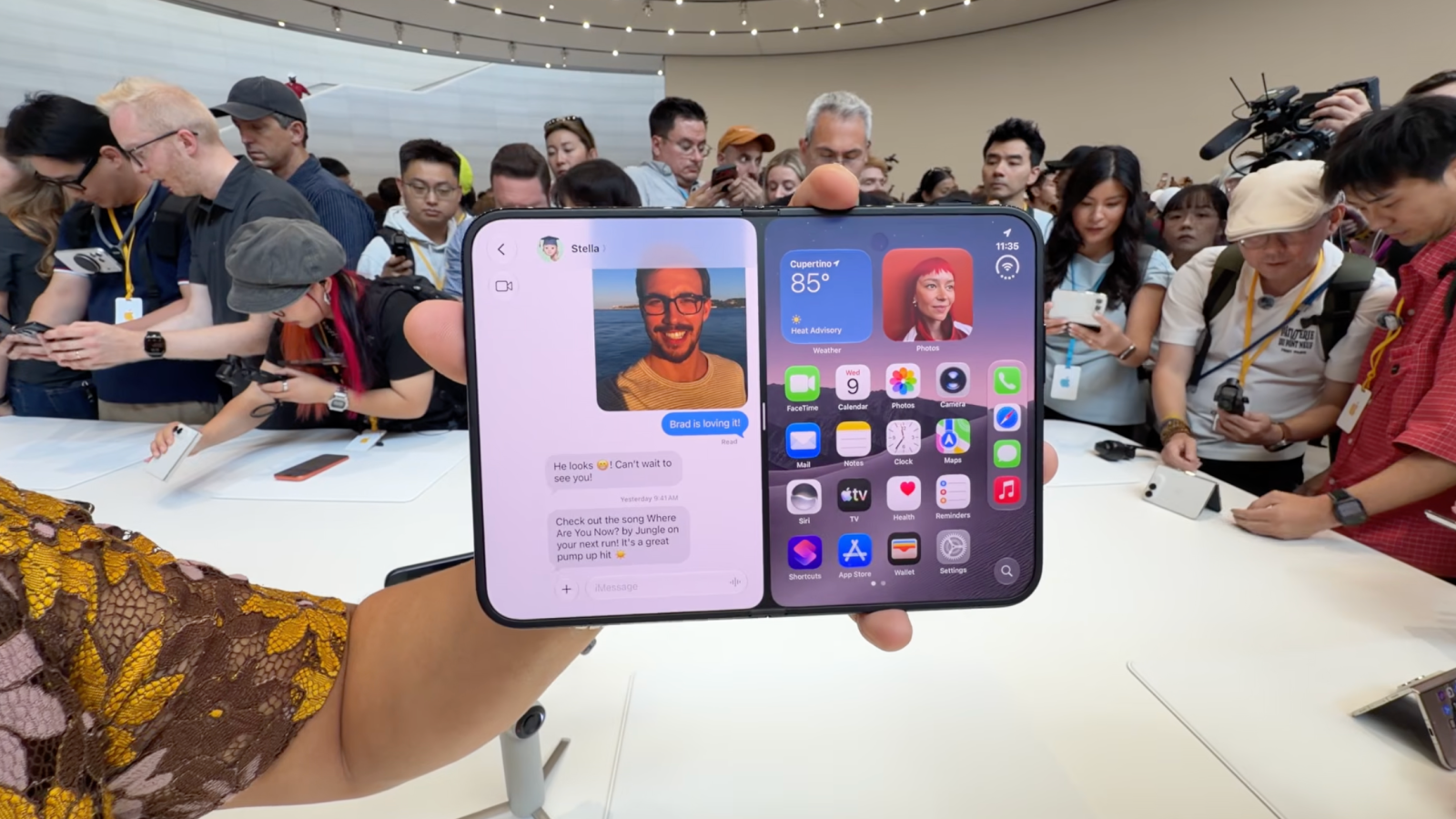
English-speaking reviewers echoed this sentiment. Allison Johnson and Dominic Preston of The Verge noted the crease was nearly imperceptible to the touch, and the display admirably managed the glare from the demonstration room’s skylights. Sam Rutherford at Engadget confirmed a subtle central depression, "easier to feel with a finger than to see with the eyes." Abrar Al-Heeti of CNET went further, finding the crease even less visible than on the Galaxy Z Fold 8, which itself features an anti-reflective treatment. This consensus suggests Apple has genuinely addressed one of the most persistent criticisms of foldable technology.
However, two minor reservations emerged. Tom Honeyands of The Tech Chap cautioned that nano-texture finishes, as seen on MacBook Pro and Studio Display screens, can visibly reduce contrast, potentially making video content appear less "punchy" than on glossy screens. Judner Aura of UrAvgConsumer observed demonstrators frequently wiping the screens, predicting the matte display might be prone to collecting fingerprints. These are crucial points that only extended, real-world usage under varying conditions, including bright sunlight, will definitively answer.
Engineering Marvels: Under-Display Camera and Seamless Software Transitions
The second point of broad agreement concerns the internal under-display FaceTime camera. Samsung had attempted this on the Z Fold 3 in 2021 before reverting to a punch-hole design, highlighting the technical challenges involved. Numerama described Apple’s attempt as "daring" and deemed the quality "decent," though expressing concern about performance in low-light environments. UrAvgConsumer, after taking a photo with it, found the result "not bad," albeit slightly soft with some accentuation. Engadget noted that the camera zone was only discernible by actively searching for bright pixels above the sensor on the otherwise matte display. SuperSaf, who was able to test the sensors, estimated a resolution of approximately 4 megapixels, reminding viewers that Apple consistently refers to it as a FaceTime camera, not a primary photography sensor. Crucially, no reviewer could test the camera in low-light conditions, precisely where Samsung’s earlier attempts had faltered.
The third area drawing widespread acclaim is the iPhone Duo’s software experience, particularly the transition between the external and internal displays. The animation, featuring a progressive blur and focus effect upon opening, was hailed as an "artwork" by Engadget and "magnificent" by TheiCollection, who claimed it looked even better in person than in videos. CNET highlighted a practical advantage: content almost instantly transitions upon opening the Duo, whereas the Fold 8 reportedly waits until it’s halfway open. Numerama found the repositioned status bar and dock on the right side "thumb-accessible" but questioned if Apple had gone "too far" and if these choices would endure future updates. UrAvgConsumer, conversely, expressed regret that the side bar couldn’t be moved to the left and that it occupied a significant portion of the screen real estate. The "table mode," where the device is half-folded with controls at the bottom, was frequently mentioned, with Numerama noting Samsung’s abandonment of this feature on the Fold 8 while Apple brings it back.
Regarding multitasking, CNET pointed out a limitation: the Duo supports two apps side-by-side, compared to three on the Fold 8, though the reviewer admitted to typically using only two. The Tech Chap ironically commented on Apple’s enthusiasm for "Split View," a feature available on other smartphones for some time. Engadget, however, lauded the fluid drag-and-drop functionality between applications and the ability to save app pairs, concluding that the software alone justifies Apple’s seven-year wait to enter the foldable market. For a detailed comparison of compromises, readers were directed to an article contrasting the Duo with the iPhone 18 Pro.

The Elephant in the Room: The iPhone Duo’s Weight and Dimensions
One point of unanimous criticism emerged swiftly, explaining Apple’s omission of weight and thickness figures during the keynote: the iPhone Duo’s substantial heft. The Tech Chap identified this as his "biggest problem so far," citing a weight of 254 grams. This is over 50 grams heavier than a Galaxy Fold 8, which he described as a "chunky monkey" when closed. Engadget found it "noticeably heavier and thicker" than the Fold 8 (201 grams, 9.7 mm closed), with the Duo measuring 11.3 mm when folded. SuperSaf performed the same calculation, noting the Duo weighs approximately as much as an iPhone 18 Pro Max. CNET was the sole outlier, optimistically describing the titanium construction as keeping it "light," a claim that, at 254 grams, verges on Californian cheerfulness.
Numerama raised a pertinent question stemming from the titanium frame: heat management. An integral metallic chassis conducts heat more efficiently, and reviewers could not test sustained gaming sessions. TheiCollection and The Tech Chap also noted that the polished mirror-finish titanium, like on the iPhone Air, was prone to fingerprints. On the positive side, all reviewers praised the IP68 water and dust resistance, a feature still absent from Samsung’s foldables, and the robust, stable hinge. The Verge described the hinge as "fluid," while CNET spoke of a "silky" sensation during repeated opening and closing. On the critical question of long-term durability, a general admission of uncertainty prevailed: The Tech Chap wondered about the matte screen’s scratch resistance, and Numerama pondered whether the crease would appear over time. None of the eight reviewers had the answers, underscoring the limitations of a brief hands-on. The weight was explicitly listed as one of the "seven sacrifices" Apple made with the Duo, suggesting a potential area for improvement in a second generation.
Camera System: A Strategic Compromise?
The absence of a telephoto lens on the iPhone Duo came as no surprise, having been anticipated by leaks for months. However, the broader camera setup proved somewhat disappointing for some. Numerama had hoped the two 48-megapixel sensors would incorporate "the features of the iPhone 18 Pro" but found them lacking "variable aperture, pro mode, or new cinematic effects." The conclusion was clear: Apple has designed two distinct phones for two distinct audiences – the 18 Pro for photography and battery life, and the Duo for its unique screen and style. TheiCollection put it more bluntly, calling two sensors "limited for an iPhone at this price," referencing Xiaomi’s foldable, which features three cameras. Engadget primarily regretted the absence of a true zoom akin to the Z Fold 8 Ultra but appreciated that the camera module, spanning the entire width of the back, allowed the phone to lie flat without wobbling. SuperSaf tentatively attributed an aperture of f/1.6 to the main sensor, a detail Apple did not officially publish.
One point highlighted the potential for confusion in a rapid hands-on environment: SuperSaf mentioned "manual controls" in the Camera app, while Apple’s official specifications reserve "Pro" controls for the iPhone 18 Pro models. Such discrepancies are understandable given the limited time and the simultaneous presence of multiple new devices. Despite these technical limitations, the Duo’s exclusive camera features garnered unanimous praise. "Duo Preview" displays the camera feed on the external screen, "Smart Take" automatically triggers a shot when everyone is posing, "Kid Cue" offers engaging Peanuts animations, and "Duo FaceTime" facilitates three-way calls. Both TheiCollection and CNET noted that Android foldables have offered similar functionalities for years, with CNET citing the Pixel Fold’s "Made You Look" feature. The only truly novel argument put forward was the local processing power of the A20 Pro chip for features like Smart Take.

Pricing and Market Positioning: A Calculated Gamble
At $1,999 in the United States, American media found the iPhone Duo less expensive than feared. Engadget calculated it to be $100 less than a Z Fold 8 Ultra and $100 more than a Fold 8, describing it as a "truly compelling package." The Tech Chap tempered this enthusiasm with the familiar argument heard since 2019: for the same price, an iPhone 18 Pro and an iPad Air offer a superior phone and tablet experience.
The pricing perspective shifts in France, where Numerama found "the pill harder to swallow" at €2,339 for the 256 GB model, wishing for double the storage at that price point. TheiCollection initially quoted €2,239 in his video, which was later corrected, as Apple’s official French pricing indeed starts at €2,339. CNET added a market perspective, citing IDC projections of over 17 million foldable iPhones shipped by 2027, representing nearly 40% of the segment, suggesting the Duo could single-handedly elevate foldables beyond their current niche status.
Early Verdicts and Unanswered Questions
The initial verdicts, as expected for one-hour hands-on sessions, reflected excitement tempered by caution. Engadget boldly titled its report "Apple’s most exciting device in a decade." Numerama called it "its most innovative smartphone in a decade" while refusing to "celebrate too quickly." The Tech Chap admitted to being "more tempted than expected" but remained undecided between the Duo and the 18 Pro. CNET remained the most reserved, preferring the squarer design of the Fold 8 for now and requesting more time to assess the daily impact of the new animations.
Crucially, none of the eight reviewers could test critical aspects like battery life, low-light photography, heat management during intensive use, Apple Pencil compatibility (the Pencil was absent from the demo room, Engadget noted), or the new Siri AI, which will not be available in France at launch.

Broader Implications and Apple’s Strategy
What emerges clearly from these collective first impressions is a nuanced picture. Apple has evidently tackled and, by many accounts, resolved the long-standing issues of a visible crease and screen glare – challenges that have plagued competitors for seven years – using a method seemingly unique to them. The company has also delivered a software transition experience described with unanimous superlatives, showcasing its renowned integration capabilities. However, these triumphs come with notable compromises: the iPhone Duo is the heaviest "passport-style" foldable on the market, features a camera module akin to an iPhone 17 (or even 17e), and an internal camera whose exact specifications remain undisclosed.
The true test of the iPhone Duo will unfold outside the confines of Apple Park, requiring extensive testing with production units, over prolonged periods, and under diverse, uncontrolled lighting and usage conditions. Meanwhile, Apple also unveiled the iPhone 18 Pro models, which feature innovations like variable aperture – a technology notably absent from the Duo – and simultaneously increased prices for all older iPhone models. The iPhone Duo represents a significant, albeit calculated, gamble for Apple, positioning itself as a premium, innovative offering that addresses core foldable challenges while introducing new trade-offs. Its success will hinge on whether its unique advantages outweigh its perceived shortcomings in the eyes of consumers.