Clarissa Hana
Microsoft has issued a stark warning to its enterprise customers regarding a significant escalation in attacks orchestrated by the ACR Stealer malware. This sophisticated information-stealing program has been actively exploiting vulnerabilities to pilfer sensitive data, including browser-stored passwords, authentication tokens, and critical business documents. The surge in activity, observed between late April and mid-June of this year, highlights a persistent and evolving threat landscape for organizations worldwide. Threat actors have been employing a multi-pronged approach, leveraging social engineering tactics, compromised WebDAV servers, and the Microsoft HTML Application Host (MSHTA) utility to deliver the malicious payload. ACR Stealer is recognized as a malware-as-a-service (MaaS) operation, and security researchers believe it to be a rebranded iteration of the previously identified Amatera Stealer malware, indicating a pattern of adaptation and obfuscation by malicious actors.
The Evolving Tactics of ACR Stealer
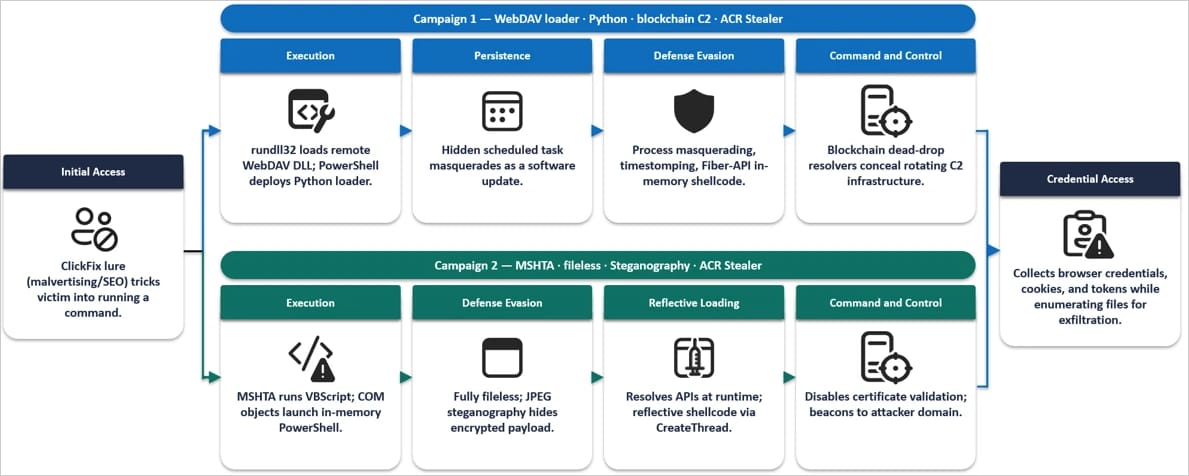
Microsoft’s security researchers have identified two primary intrusion chains as the most prevalent methods employed by threat actors utilizing ACR Stealer. These campaigns demonstrate a calculated approach to infiltration, aiming to bypass security measures and maximize data exfiltration.
The first observed campaign commences with a social engineering lure, often disguised as a "ClickFix" notification. This deceptive tactic prompts users to execute a command that, unbeknownst to them, triggers the execution of a malicious Dynamic Link Library (DLL) file. This DLL is hosted on a remote WebDAV (Web Distributed Authoring and Versioning) share and is launched using the legitimate Windows utility rundll32.exe. The abuse of WebDAV servers is not a new tactic; it has been a recurring method for delivering various malware families, including Bumblebee and Voldemort, in previous attack campaigns. Threat actors frequently exploit WebDAV due to its accessibility and the often-overlooked security configurations associated with it.
In their detailed report, Microsoft highlights the strategic use of GUID-based directory structures and filenames within the WebDAV paths. This technique is employed to meticulously mimic legitimate resources, such as seemingly innocuous domains like "google.ct." By adopting these familiar naming conventions, attackers aim to camouflage their malicious infrastructure, making it blend seamlessly with expected network traffic and evade immediate detection by security analysts.

Following the initial compromise, the malware establishes communication with a command-and-control (C2) infrastructure. This connection is then used to execute a heavily obfuscated PowerShell script. This script is designed to launch a malware installer and, crucially, establish persistence within the compromised system. Persistence mechanisms are vital for attackers as they ensure continued access to the victim’s network even after reboots or initial security countermeasures. The routine typically involves installing a bundled Python loader, creating a scheduled task that is deliberately masked as a legitimate software update to avoid suspicion, manipulating file timestamps to obscure malicious activity, clearing PowerShell execution history to remove traces, and finally, injecting the ultimate payload into a running system process for in-memory execution. This in-memory execution is a stealthy technique that avoids writing the malware directly to disk, making it harder for traditional antivirus solutions to detect.
A particularly noteworthy aspect of some ACR Stealer variants is their innovative use of public blockchain services. These services are employed as "dead-drop resolvers" – a method to obtain updated payload locations or C2 addresses. This technique, often referred to as "EtherHiding" or similar, involves embedding malicious scripts or pointers within legitimate blockchain transactions or smart contracts. This allows the malware to retrieve crucial command-and-control information in a highly decentralized and often anonymized manner, making it exceptionally difficult to disrupt the attackers’ infrastructure. This mirrors a popular technique previously observed in campaigns by North Korean hackers and others who leverage platforms like Binance Smart Chain contracts to store malicious scripts.
The second prominent delivery chain identified by Microsoft also begins with the ClickFix lure, but instead of directly executing a DLL, it leverages MSHTA. This utility retrieves malicious content from an attacker-controlled server and executes an obfuscated PowerShell downloader. This downloader then proceeds to extract an encrypted payload. This payload is cleverly concealed within a publicly hosted JPEG image that utilizes steganography – the art of hiding information within other non-sensitive data. The extracted payload is then executed directly in memory, again bypassing traditional file-based detection mechanisms.
The Objective: Comprehensive Data Exfiltration
Despite the variations in delivery methods, the ultimate objective of ACR Stealer remains consistent: the comprehensive theft of sensitive data. The malware is designed to systematically collect a wide array of critical information from compromised systems. This includes:
- Browser Credentials: This encompasses usernames, passwords, and cookies stored by popular web browsers, granting attackers access to online accounts.
- Authentication Tokens: These are digital keys that allow users to remain logged into services without repeatedly entering their credentials. Their compromise can lead to unauthorized access to sensitive applications and platforms.
- Sensitive Documents: The malware actively scans for and targets various types of sensitive files, including financial records, confidential corporate documents, personal identifiable information (PII), and intellectual property.
Once collected, all this sensitive data is meticulously archived and prepared for exfiltration to the attacker’s infrastructure. This process ensures that the attackers can maximize their gains from each successful intrusion.

A Broader Threat Landscape and Mitigation Strategies
Microsoft’s “Defender Experts” have identified these two campaigns as representing the most prevalent ACR Stealer delivery methods observed. However, the company cautions that this is not an exhaustive list, and additional execution chains are highly likely to exist. The dynamic nature of cyber threats necessitates continuous vigilance and adaptation of defensive strategies.
To counter the pervasive threat of ClickFix-based attacks, Microsoft strongly advises users to exercise extreme caution when encountering prompts that require copying and executing instructions within command interpreters. This is particularly true for messages that claim to be fixing an error or verifying human identity, as these are common social engineering ploys.
For organizations, Microsoft recommends a multi-layered approach to reduce their exposure to web-based delivery chains. Key recommendations include:
- Enforcing Content Filters: Implementing robust content filtering solutions can block access to malicious websites and downloads.
- Blocking Low-Reputation or New Domains: Proactively blocking domains that have a low reputation score or are newly registered can prevent access to known malicious infrastructure.
- Restricting Access to Unnecessary Online Resources: Limiting user access to only those online resources that are essential for business operations can significantly reduce the attack surface.
Furthermore, the implementation of application control rules is crucial. These rules can effectively restrict the launching of content from remote resources by potentially dangerous tools such as PowerShell, Python, mshta.exe, or rundll32.exe. This restriction should be especially stringent when these tools attempt to operate from user-writeable directories, which are often targeted by malware for persistence and execution.
Microsoft’s detailed report provides an extensive list of recommended mitigations, alongside a comprehensive set of indicators of compromise (IoCs) specifically tailored to the observed ACR Stealer activity. These IoCs can be used by security teams to detect and respond to ongoing or past ACR Stealer intrusions within their networks.
The Implications for Businesses and the Future of Cybercrime
The escalating activity of ACR Stealer underscores a critical trend in the cybercrime landscape: the increasing sophistication and accessibility of malware-as-a-service operations. For businesses, this means that even smaller organizations with limited security resources can become targets of advanced threats. The ability of ACR Stealer to masquerade as legitimate services, leverage blockchain technology, and employ in-memory execution techniques presents a formidable challenge for traditional security defenses.
The implications of successful ACR Stealer attacks are far-reaching. Beyond the immediate financial losses due to data theft and potential ransomware demands, businesses can suffer severe reputational damage, loss of customer trust, and significant operational disruptions. The exfiltration of intellectual property can also lead to a loss of competitive advantage.
The observed use of blockchain for C2 infrastructure highlights the ongoing arms race between cybercriminals and cybersecurity professionals. As defenders develop new detection and mitigation strategies, attackers are quick to adapt and exploit emerging technologies to maintain their anonymity and operational effectiveness. This necessitates a proactive and adaptive security posture, where organizations continuously assess and enhance their defenses against the latest threats.
The continuous evolution of malware like ACR Stealer serves as a stark reminder that cybersecurity is not a static state but an ongoing process. Organizations must invest in robust security solutions, implement comprehensive security awareness training for their employees, and stay informed about the latest threat intelligence to effectively protect their critical assets in an increasingly hostile digital environment. The battle against sophisticated malware operations requires a commitment to continuous improvement, advanced threat detection capabilities, and a proactive approach to vulnerability management.