Sonny Valindra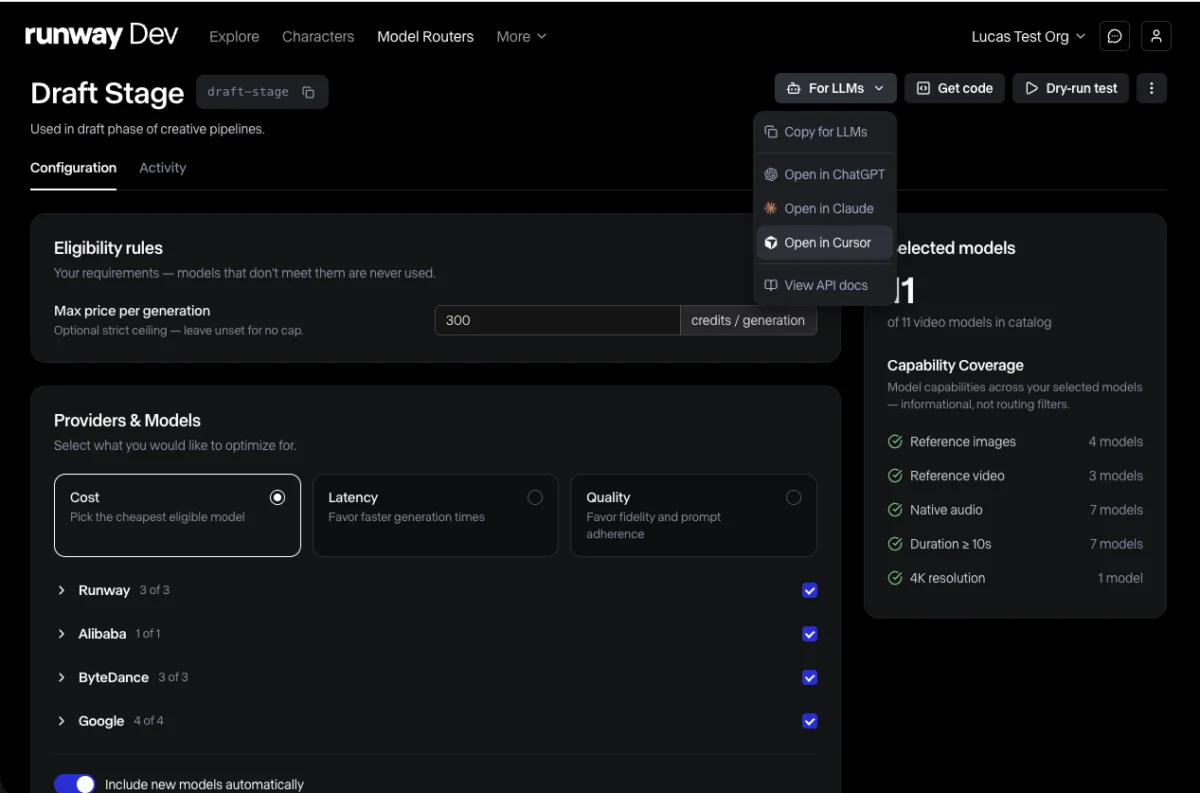
Runway, a company that has rapidly ascended the ranks of generative AI, is strategically shifting its focus from being solely an AI model developer to becoming a foundational infrastructure provider for the burgeoning generative media ecosystem. This ambitious pivot was underscored by the recent launch of the Runway Media Router, a sophisticated tool designed to automate the selection of optimal generative AI models for developers building with images, video, and audio. The introduction of this router, available through Runway Dev, the company’s newly unveiled developer platform, signals Runway’s intent to empower businesses to integrate advanced generative media capabilities directly into their own products, thereby bypassing the need to direct users to external platforms.
The significance of the Media Router lies in its ability to dynamically assess and select the most suitable generative AI model for a given task based on developer-defined priorities such as output quality, processing speed, or cost efficiency. While similar "model routers" have gained traction in the realm of large language models (LLMs), Runway asserts that its Media Router is the first of its kind specifically engineered for the complexities of generative media. This development arrives at a critical juncture for the industry, characterized by an explosive proliferation of generative media models, making it increasingly challenging and resource-intensive for developers to evaluate and adopt the latest advancements.
A New Era of Generative Media Integration
Anthony Maggio, Runway’s Chief Product Officer, articulated the company’s vision, stating, "The routing really fits into that overall promise of being the easiest one-stop shop for developers to integrate with any type of generative media model." This sentiment highlights Runway’s aspiration to simplify the integration process for businesses, offering a unified gateway to a diverse and rapidly evolving landscape of AI models.
The Runway Dev platform, launched earlier this month, provides developers with API access to a curated and expanding selection of third-party image, video, and audio generation models, in addition to Runway’s proprietary offerings. This initiative has already garnered significant interest from prominent industry players, including Adobe, Cloudflare, ElevenLabs, Expedia, Shutterstock, and Quora. These collaborators are leveraging Runway Dev to embed generative media functionalities directly into their own product suites, a move that signifies a broader trend towards commoditizing AI capabilities as foundational building blocks for digital services.
The exponential growth in the number of generative media models available has created a significant bottleneck for developers. Evaluating the distinct capabilities, strengths, and weaknesses of each new release across various media formats—video, image, and audio—demands considerable time and expertise. Runway’s Media Router aims to alleviate this burden by providing an intelligent layer that automates this evaluation process.
"Most developers are not spending the time to really understand the capabilities of each of these models and where they excel or differ based on various types of outputs across video, video, and audio," Maggio explained. "The unique proposition we’re bringing to the table is all of that intelligence around what the best model is for each different use case, and meshing that with preference you apply around the context of your business."
Navigating Model Diversity and Developer Preferences
The generative media landscape is not only diverse but also subject to geopolitical considerations and evolving regulatory frameworks. Maggio pointed to the growing prominence of generative media models originating from China. However, he noted that many businesses, particularly those in Western markets, may harbor reservations about integrating models from certain jurisdictions due to potential concerns about data privacy, intellectual property, or compliance with evolving international trade policies. The recent actions by the U.S. Treasury department, which has explored sanctions against Chinese open AI models, further underscore the potential for such geopolitical factors to influence model selection.
In this context, the Runway Media Router offers developers the flexibility to set explicit preferences, such as prioritizing models from American providers over those from China, aligning with their business strategies and risk appetites. This capability extends beyond geographical considerations, allowing for nuanced control over model selection.
While geographical preferences are a notable feature, Maggio indicated that the primary drivers for developers are typically related to token pricing and output quality. The escalating costs associated with large language models, particularly for enterprises heavily reliant on agentic AI, have brought token economics into sharp focus throughout 2026. The substantial "token bills" incurred by some companies have spurred a scramble to optimize AI usage and manage costs. Consequently, model routing strategies that prioritize cost efficiency have become commonplace in the LLM sphere, making the extension of this logic to generative media a natural progression. The launch of the Media Router follows closely on the heels of Runway’s own shift from unlimited subscription plans to token-based pricing, a decision that, while drawing criticism from some users, aligns with the broader industry trend toward usage-based cost models.
The Intelligence Behind the Router
On the quality front, discerning the "best" model for a specific generative media task is inherently more complex than with language models. The Media Router’s intelligence layer is a critical differentiator in this regard. It is built upon the deep expertise cultivated by Runway’s in-house creative team, who have extensive experience in evaluating output across a wide spectrum of media types. This evaluation encompasses nuanced aspects such as how video models handle motion, the compositional prowess of image models, and the fidelity of lip-syncing in voice generation.
This sophisticated intelligence layer is not entirely new to Runway. The company had previously developed similar routing technology for its own "agent" product, a conversational AI creative partner launched in May 2026. This agent assists users in transforming text prompts into fully realized, multi-shot video productions and marketing campaigns. The Runway Media Router essentially packages this proprietary routing technology, making it accessible to external developers.
Strategic Pivot Amidst Market Competition
Runway’s current strategic trajectory reflects the highly fragmented and intensely competitive nature of the generative media landscape. To maintain its competitive edge, the company has recognized the necessity of expanding its offerings and adapting its business model. In December 2025, Runway’s Gen 4.5 video model achieved top rankings on leaderboards, outperforming comparable models from established giants like Google. That same month, Runway also introduced its inaugural "world model."
However, since then, the pace of breakthrough frontier video model releases from Runway has moderated. While an upgrade to its video editing model, Aleph 2.0, was released in May 2026 and currently ranks among leading video editing solutions according to Artificial Analysis, Runway’s text-to-video and image-to-video models no longer hold the top positions. Competitors such as Google, along with Chinese tech giants ByteDance and Alibaba, now feature prominently in the top 20 model rankings.
The Media Router’s design anticipates this dynamic evolution. Instead of encouraging developers to place their bets on a single, potentially fleetingly dominant model, the router operates on the premise that the optimal model will constantly shift. This approach ensures that Runway remains a central player in the generative media ecosystem, not necessarily as the provider of the single best model, but as the indispensable orchestration layer that connects developers to the best available tools.
Anastasis Germanidis, Runway’s co-founder and co-CEO, acknowledged the company’s historical perception as primarily an "end-user piece" provider. He emphasized that achieving this position necessitated the construction of a comprehensive technology stack, encompassing a developer platform, a suite of creative tools, and the underlying inference layer. Germanidis highlighted the growing demand from enterprises for Runway’s solutions to span across all facets of this stack.
"You need great models underneath, but the orchestration increasingly matters a lot because people are building entire campaigns with those models, or they’re building entire finished multi-scene generations out of those models," Germanidis told TechCrunch. "It’s something that we increasingly had to build – that intelligence layer that comes on top of the pure pixel models. The router is one way in which the benefits of that come to users."
This strategic recalibration positions Runway to capitalize on the increasing complexity and sophistication of generative media applications. As businesses move beyond single-prompt generation to developing intricate multi-scene narratives and complex creative workflows, the need for intelligent, adaptable, and integrated AI infrastructure becomes paramount.
A Legacy of Research and Forward-Thinking Development
Reflecting on Runway’s journey since its inception in 2018, Maggio summarized the company’s core ethos: "If you zoom out at the one thing Runway has been doing since 2018, it’s that we’re deeply focused on research, while building for where we think the space is going at the same time." This dual focus on fundamental research and practical application development has enabled Runway to remain at the forefront of generative AI, anticipating industry shifts and proactively building the tools and infrastructure required to support them. The launch of the Media Router is a testament to this forward-looking strategy, aiming to solidify Runway’s position not just as an innovator in AI models, but as a critical enabler of the entire generative media industry.
The implications of this strategic pivot are far-reaching. By offering a robust infrastructure layer, Runway empowers a wider range of companies, from startups to large enterprises, to leverage cutting-edge generative media technology without the prohibitive overhead of in-house AI model development and management. This democratization of advanced AI capabilities is likely to accelerate innovation across numerous sectors, from entertainment and marketing to design and education. As the generative media landscape continues its rapid evolution, Runway’s focus on providing intelligent orchestration and seamless integration appears to be a prescient move, positioning the company as a vital partner for businesses navigating this dynamic frontier.