 Sisilia Frederika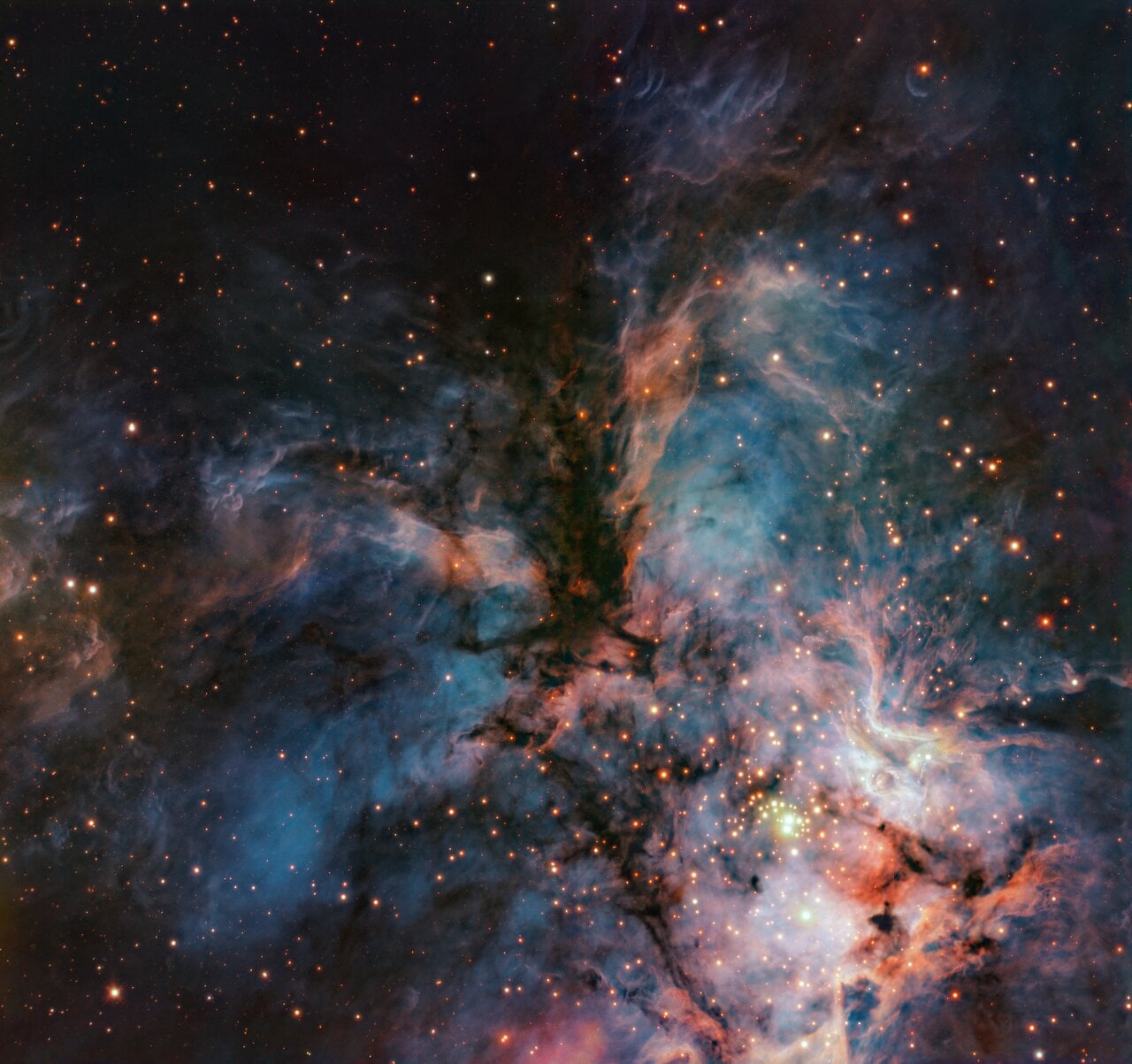
The European Southern Observatory (ESO) has officially released a captivating new image of the RCW 36 nebula, a vibrant star-forming region located approximately 2,300 light-years from Earth. Captured by the Very Large Telescope (VLT) at the Paranal Observatory in the Atacama Desert of Chile, the image provides an unprecedented look at the complex interplay between massive young stars and the interstellar medium. To the casual observer, the nebula bears a striking resemblance to a cosmic hawk in mid-flight, with its wings outstretched across the vacuum of space. This visual phenomenon is created by dense filaments of gas and dust that extend from a central core, where the "head" and "body" of the hawk are formed by dark, opaque clouds. Beyond its aesthetic appeal, the data gathered during this observation represents a significant milestone in the study of substellar objects, specifically brown dwarfs, which occupy the evolutionary gap between the largest planets and the smallest stars.
The Technical Prowess of the HAWK-I Instrument
The image was acquired using the High Acuity Wide-field K-band Imager-1 (HAWK-I), a sophisticated near-infrared instrument mounted on the VLT. HAWK-I is designed to observe the universe in the K-band of the electromagnetic spectrum, which allows it to peer through the thick veils of cosmic dust that typically obscure star-forming regions in visible light. Because infrared radiation has longer wavelengths than visible light, it can bypass the small particles of soot and silicates that make up interstellar dust, revealing the "nursery" hidden within the nebula.
One of the defining features of HAWK-I is its integration with the GRAAL adaptive optics module. Ground-based astronomy is often hindered by the Earth’s atmosphere, which causes light to twinkle and blur—a phenomenon known as "seeing." Adaptive optics technology utilizes a deformable mirror that adjusts its shape hundreds of times per second to compensate for atmospheric turbulence. This results in images that rival the clarity of space-based observatories. In the case of RCW 36, this high resolution was essential for identifying individual faint objects nestled within the luminous gas, allowing astronomers to distinguish between massive, bright stars and the much dimmer substellar population.
Astronomical Context: The Vela Molecular Ridge
RCW 36 is situated within the Vela Constellation, specifically as part of the Vela Molecular Ridge. This region is one of the most active star-forming complexes in the solar neighborhood. The nebula itself is a HII region, an area of ionized atomic hydrogen that has been energized by the ultraviolet radiation emitted from massive, hot stars. In the released image, the interplay of blue, red, and white hues represents different chemical compositions and physical states of the gas. The blue areas often indicate reflected starlight or specific ionization states, while the reddish glows typically signify the presence of hydrogen-alpha emissions.
The central cluster of RCW 36 is home to several dozen massive stars, some of which are hundreds of times more luminous than the Sun. These stellar giants exert a powerful influence on their environment through stellar winds and intense radiation pressure. This process, known as "stellar feedback," carves out cavities in the surrounding molecular cloud and triggers the collapse of nearby gas pockets, potentially leading to subsequent generations of star formation. The "wings" of the hawk are essentially the remnants of the original molecular cloud being pushed outward by this relentless energy.
The Search for Brown Dwarfs and Substellar Evolution
While the massive stars provide the illumination for the nebula, the primary scientific objective of the team led by the Instituto de Astrofísica e Ciências do Espaço (IA) in Lisbon was to survey the substellar population of the cluster. Brown dwarfs, often colloquially referred to as "failed stars," are objects that possess a mass between approximately 13 and 80 times that of Jupiter. Unlike true stars, brown dwarfs do not have enough gravitational pressure at their cores to sustain the stable nuclear fusion of hydrogen into helium.
The study of brown dwarfs is crucial for understanding the "Initial Mass Function" (IMF)—an empirical function that describes the initial distribution of masses for a population of stars. By determining how many brown dwarfs are formed relative to massive stars in a cluster like RCW 36, astronomers can refine their models of star formation efficiency. The high sensitivity of HAWK-I allowed the international research team to detect these elusive objects, which are exceptionally faint and emit most of their energy in the infrared.
The findings of this research were detailed in a peer-reviewed paper titled "Substellar population of the young massive cluster RCW 36 in Vela," published in the journal Astronomy & Astrophysics. The study provides a comprehensive census of the cluster’s members, offering new insights into how the environment of a massive star-forming region influences the birth of low-mass objects.
Chronology of the Observation and Research
The path to this discovery involved several years of technical preparation and data analysis. The VLT, which began operations in the late 1990s, has undergone continuous upgrades to its instrument suite. HAWK-I was commissioned in 2007, but the addition of the Adaptive Optics Facility (AOF) in more recent years significantly enhanced its capabilities for projects of this nature.
- Observation Phase: The raw data for the RCW 36 study was collected during specific "seeing" windows where atmospheric conditions were optimal for adaptive optics.
- Data Processing: Following the observations, the team at IA Lisbon utilized advanced algorithms to filter out noise and correct for instrumental artifacts. This process is particularly grueling for infrared data, as the telescope and the Earth’s atmosphere themselves emit infrared radiation that must be subtracted.
- Analysis and Identification: Astronomers cross-referenced the HAWK-I data with existing catalogs to identify known stars and flag new candidates for brown dwarfs based on their color-magnitude diagrams.
- Publication: The finalized study was submitted to Astronomy & Astrophysics, where it underwent rigorous peer review before being accepted and subsequently featured as an ESO "Photo of the Week."
Perspectives from the Research Team
Afonso do Brito do Vale, a PhD student at the IA and the lead author of the study, highlighted the poetic nature of the scientific data. He noted that the image depicts massive stars "pushing" away the clouds of gas and dust around them. He likened this process to an animal breaking through its eggshell for the first time—a metaphor that aligns perfectly with the "hawk" appearance of the nebula. In this context, the dark filaments are not just wings, but the protective shell of the nursery from which these new celestial bodies are emerging.
This perspective emphasizes the dynamic and often violent nature of star formation. Rather than a static image, the RCW 36 nebula is a snapshot of a transitional phase. Over the next several million years, the radiation from the central stars will eventually disperse the nebula entirely, leaving behind a young open cluster of stars and brown dwarfs that will slowly drift apart into the Milky Way.
Broader Implications for Modern Astrophysics
The release of this image and the accompanying research has broader implications for the global astronomical community. First, it demonstrates the continued relevance of ground-based 8-meter class telescopes in the era of the James Webb Space Telescope (JWST). While JWST provides unparalleled sensitivity in the mid-infrared, the VLT’s HAWK-I offers a wide-field perspective that is essential for surveying entire stellar clusters in a single footprint.
Furthermore, the data contributes to our understanding of planetary habitability. Because brown dwarfs share many characteristics with giant exoplanets, studying their formation and atmospheres helps scientists predict the conditions on large planets orbiting other stars. The census of RCW 36 suggests that substellar objects are a common byproduct of the star formation process, even in the harsh, radiation-filled environments surrounding massive stars.
The ESO’s commitment to sharing these "Photos of the Week" serves a dual purpose: it provides the public with a visual gateway into the wonders of the cosmos while highlighting the rigorous academic work being performed by international consortia. As the ESO prepares for the next generation of observations with the Extremely Large Telescope (ELT)—currently under construction in Chile—images like that of RCW 36 serve as a benchmark for the resolution and depth that future instruments will strive to surpass.
In conclusion, the "cosmic hawk" of RCW 36 is more than a celestial curiosity. It is a laboratory for stellar physics, a testament to the power of adaptive optics, and a window into the hidden population of the galaxy. As new stars continue to "hatch" from this interstellar nest, the data provided by HAWK-I will remain a foundational resource for astronomers seeking to decode the mysteries of how the universe builds its most diverse inhabitants, from the smallest brown dwarfs to the most massive stars.