Vera Intan Clara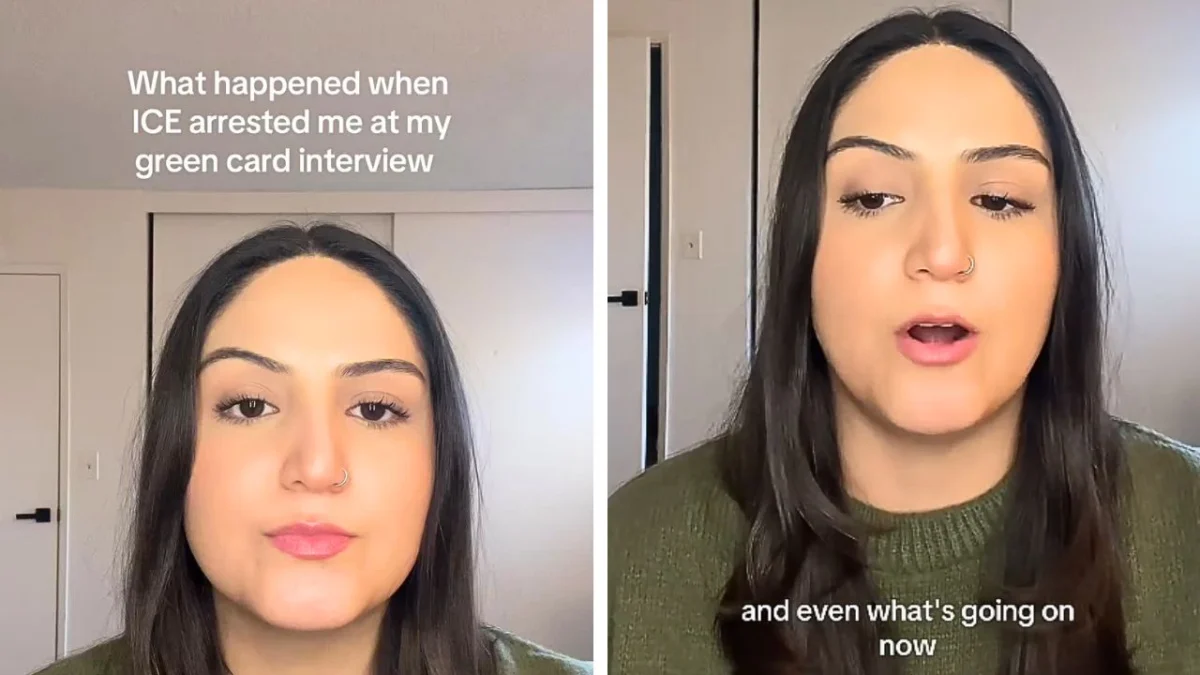
A TikTok user, known as Mila, has ignited a fervent public discussion regarding U.S. immigration enforcement after she claimed she was detained by U.S. Immigration and Customs Enforcement (ICE) agents during what she believed was a routine green card interview at the U.S. Citizenship and Immigration Services (USCIS) office in San Diego. Her video, posted on January 14, 2026, quickly amassed more than 614,000 views, triggering a contentious debate among viewers about the legality and ethics of arresting individuals actively pursuing legal immigration status. The incident has cast a spotlight on the complexities of the U.S. immigration system, the discretion of enforcement agencies, and the anxieties faced by those navigating pathways to legal residency.
The Incident Unfolds: A Green Card Interview Turns into Detention
Mila’s detailed account, shared with her substantial online following, describes a sequence of events that began with the hope of finally regularizing her long-term presence in the United States. According to her narrative, she arrived at the San Diego USCIS office at 8 a.m., accompanied by her U.S. citizen husband and their attorney, underscoring her commitment to following legal procedures. Her personal history, as she recounted, included living in the United States since the tender age of four and a prolonged effort to resolve her immigration status, which had been ongoing since her teenage years. This background set the stage for an interview she expected to be a pivotal step towards securing lawful permanent residency.
The initial phase of the interview reportedly proceeded as anticipated. Mila and her husband faced questions typical of a spousal petition, designed to ascertain the bona fides of their marriage—details about their relationship’s inception, development, and the circumstances leading to their wedding. This routine line of questioning suggested a standard review of their Form I-130, Petition for Alien Relative, which is the foundational document filed by a U.S. citizen or lawful permanent resident to sponsor a qualifying family member for immigration. Mila expressed that the USCIS officer conducting their interview conveyed a positive assessment, remarking on the strength of their presented evidence and explicitly stating approval of their Form I-130 petition. This moment, often a significant hurdle for applicants, should have been a cause for relief and celebration, signaling a successful advance in their immigration journey.
However, the tone of the interview abruptly shifted. Mila recounted that immediately after approving their I-130 petition, the USCIS officer offered an apology and informed the couple that "others were waiting outside to speak with her." This seemingly innocuous statement quickly materialized into the presence of ICE agents. Mila described one agent explicitly stating that he knew she was not a criminal but was "just following orders," a phrase that has historically carried significant weight in discussions of bureaucratic enforcement. Despite this acknowledgment, the agents proceeded with her detention. She was permitted a brief moment to entrust her belongings to her husband and bid him farewell before being handcuffed and placed in ankle restraints. Mila was then transported to a federal building, where she was held for approximately 24 hours. Her observation of a "list of names" on a bulletin board during her detention led her to believe that her arrest had been premeditated. She was subsequently released, though her video did not elaborate on the specific reasons for either her arrest or her release, leaving many questions unanswered for her audience and legal observers.
Mila’s Background and Clarifications: Navigating the Immigration Labyrinth
Mila’s journey through the U.S. immigration system is not uncommon, reflecting the experiences of millions who have spent the majority of their lives in the United States without a definitive legal status. Her statement about living in the U.S. since age four suggests an upbringing entirely within American society, culturally assimilated and deeply rooted in its communities. The attempt to resolve her status since her teenage years further illustrates the protracted and often arduous nature of navigating complex immigration laws. For many like Mila, who may have entered the country legally but overstayed a visa, or who arrived as minors with parents, the path to legal residency often involves multiple applications, extensive documentation, and a deep understanding of intricate legal pathways.
In her viral TikTok post, Mila took care to clarify crucial aspects of her situation, particularly addressing potential underlying reasons for her detention. She explicitly stated that she possessed no criminal record, had not received prior removal notices, nor was she involved in any ongoing deportation proceedings. Furthermore, she specified that the warrant leading to her arrest was "administrative," not "judicial." This distinction is significant in immigration law. An administrative warrant is issued by an immigration official, typically ICE, and does not require review or approval by a judge, unlike a judicial warrant which is issued by a court. This clarification suggests that her detention stemmed from an alleged immigration violation rather than criminal charges, potentially related to her past immigration history or status. Her insistence that she was "trying to do things the legal way" resonated deeply with many viewers, highlighting a perceived paradox where individuals engaging with official processes are apprehended.
A Complex Legal Framework: I-130 Approval vs. Admissibility
The incident involving Mila underscores a critical distinction within U.S. immigration law: the difference between the approval of a Form I-130 petition and the final grant of lawful permanent residency (a green card). As USCIS guidance clearly explains, the approval of an I-130 petition, such as Mila’s, signifies that the agency acknowledges a qualifying family relationship between the petitioner (her U.S. citizen husband) and the beneficiary (Mila). It is a necessary first step in the family-based immigration process. However, this approval does not automatically confer a green card or establish that the beneficiary is admissible to the United States.
Admissibility is a separate, comprehensive evaluation. To be granted a green card, an applicant must not only have an approved petition but also meet all other eligibility requirements for lawful permanent residence. This includes passing background checks, undergoing medical examinations, and demonstrating that they are not subject to any "grounds of inadmissibility" under U.S. immigration law. These grounds can be numerous and varied, encompassing issues such as certain criminal convictions, past immigration violations (e.g., unlawful presence, misrepresentation, prior deportations), public charge concerns, or health-related grounds. Even individuals with an approved I-130 petition who are seeking to adjust their status from within the United States can be deemed inadmissible if they have, for example, accrued significant periods of unlawful presence.
Furthermore, USCIS explicitly states that the approval of a family petition does not provide immunity from immigration enforcement. ICE, as the primary enforcement arm of the Department of Homeland Security, retains the authority to detain individuals when there is probable cause to believe they are deportable, provided proper procedures are followed. This means that an individual, even while actively pursuing a legal pathway to status, may still be subject to detention if their prior immigration history or current circumstances align with grounds for removal. The location of detention—a USCIS office, typically seen as a place for processing legal applications—has particularly fueled public concern, raising questions about whether such locations should be considered "sensitive locations" where enforcement actions are generally avoided, similar to schools or hospitals.
Public Reaction and Digital Debate: A Divided Forum
Mila’s video quickly became a flashpoint for public discourse on social media, reflecting deep divisions in perspectives on immigration policy and enforcement. The comments section of her TikTok video, and subsequent discussions across various platforms, showcased a spectrum of reactions.
A significant portion of viewers expressed outrage and solidarity with Mila, interpreting her detention as a profound injustice. These commenters often echoed sentiments such as "THEY ARE ARRESTING AND DEPORTING PEOPLE WHO ARE DOING IT THE RIGHT WAY," suggesting a betrayal of trust by the government towards individuals attempting to regularize their status through established legal channels. Many viewed the incident as a "setup," arguing that scheduling an interview only to detain the applicant undermines the very purpose of offering legal pathways. This perspective often emphasizes humanitarian concerns, due process, and the principle that engagement with the legal system should not expose individuals to heightened risk of enforcement, especially when they have deep ties to the U.S. and no criminal record. Immigration advocacy groups frequently highlight concerns regarding due process and transparency in enforcement actions, particularly when individuals are detained during routine appointments with immigration authorities. They argue that such actions can create a chilling effect, deterring other immigrants from pursuing legal avenues out of fear of similar repercussions.
Conversely, another segment of commenters questioned the circumstances of Mila’s arrest, positing that applying for a green card does not automatically absolve individuals of prior immigration violations. This viewpoint often underscores the principle of rule of law, asserting that immigration laws, like any others, must be enforced. These commenters implied that there might be unstated details regarding Mila’s immigration history that led to the administrative warrant, arguing that ICE’s actions, while perhaps harsh, were within their legal mandate. This perspective highlights the complexities of immigration law, where an individual’s past actions, even if seemingly minor or unintentional, can have significant consequences for their admissibility and eligibility for relief. The debate encapsulates the broader national discussion on immigration, pitting arguments for compassionate pathways against calls for strict enforcement.
Broader Implications for Immigration Pathways and Trust
The incident involving Mila extends beyond her personal experience, carrying broader implications for the immigrant community and the integrity of the U.S. immigration system. Such high-profile detentions during what are perceived as steps toward legalization can erode trust in government institutions. When individuals fear that engaging with USCIS for an interview could lead to detention by ICE, it can deter others from coming forward, potentially driving more people underground and complicating efforts to manage immigration effectively. This can create an environment of fear and uncertainty, even for those who are diligently working through legal processes.
The distinction between administrative and judicial warrants, highlighted by Mila, also brings attention to the significant power vested in immigration enforcement agencies. While administrative warrants are a legitimate tool for ICE, their issuance and execution without judicial oversight can be a source of concern for civil liberties advocates who emphasize the importance of judicial review in matters affecting personal liberty. The ongoing debate about the scope of ICE’s enforcement discretion, especially in non-criminal cases or within "sensitive locations" like USCIS offices, is a perennial one, often influenced by shifting policy priorities of different administrations.
Moreover, Mila’s story exemplifies the increasing role of social media in amplifying individual narratives and shaping public perception of complex issues. Her video transformed a personal ordeal into a national conversation, demonstrating how platforms like TikTok can mobilize public opinion, bring scrutiny to government actions, and provide a voice to those navigating intricate legal challenges. The widespread attention to her case underscores the public’s keen interest in immigration issues and the diverse perspectives that define the ongoing dialogue.
Conclusion: A Continuing Dialogue on Enforcement and Humanity
While the Daily Dot was unable to independently verify the full details of Mila’s account, including the specific circumstances of her detention, the exact nature of the administrative warrant, or the reasons for her subsequent release, her narrative as shared on TikTok by @milathekilla has undeniably sparked a vital discussion. It serves as a stark reminder of the intricate and often unforgiving nature of the U.S. immigration system, where the pursuit of legal status can intersect with enforcement actions in unexpected and impactful ways. The incident continues to fuel a critical dialogue on the balance between immigration law enforcement and the humanitarian considerations, due process rights, and the trust necessary for a functional legal immigration system. As millions continue to seek legal residency in the United States, cases like Mila’s will undoubtedly remain central to the ongoing national conversation about who we are as a nation and how we choose to define our borders and our welcome.