Sisilia Frederika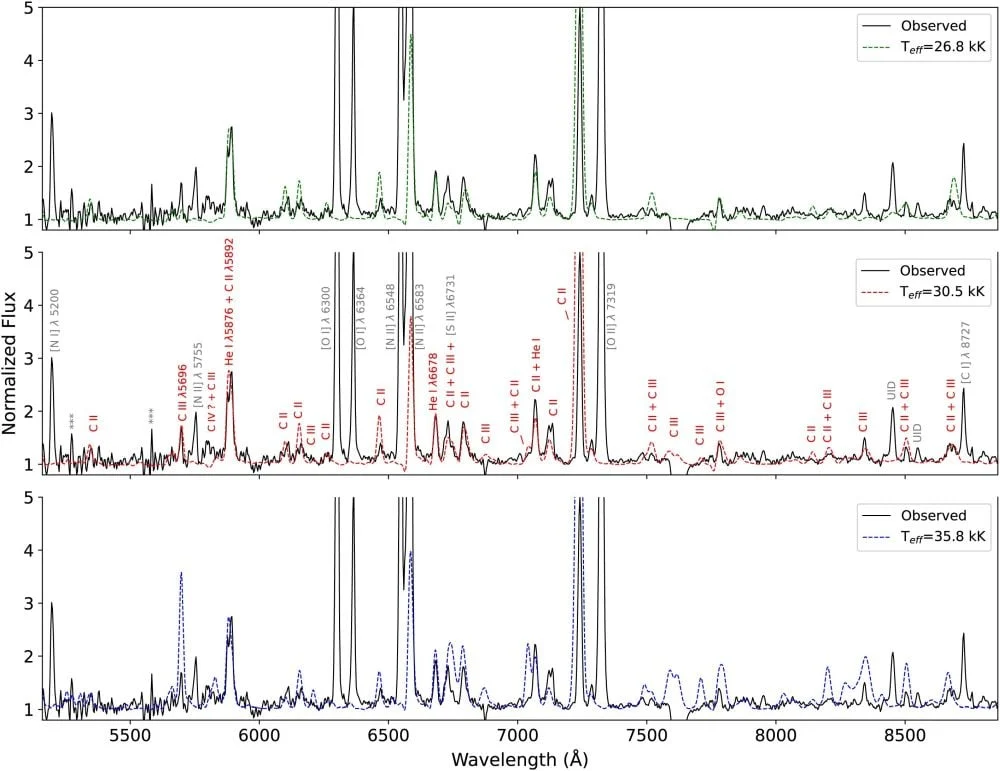
The latest findings, published in the Monthly Notices of the Royal Astronomical Society by a team led by W. Marcolino of the Observatorio do Valongo in Rio de Janeiro, indicate that the star has entered a new and critical phase of its "re-evolution." By utilizing the advanced capabilities of the Very Large Telescope (VLT) in Chile, researchers have identified specific spectral signatures that confirm the emergence of a [WC]—a low-mass Wolf-Rayet—identity. This discovery not only provides a real-time laboratory for stellar physics but also challenges existing theoretical models regarding the speed and nature of post-asymptotic giant branch (AGB) evolution.
The Discovery and Chronology of V4334 Sagittarii
The history of Sakurai’s Object is a chronicle of rapid and unexpected change. For most of its existence, the star followed the standard evolutionary path of a Sun-like entity. It exhausted its hydrogen fuel, expanded into a red giant, and eventually shed its outer layers to become a white dwarf—a dense, cooling core no longer capable of nuclear fusion. In this state, it was essentially a "zombie star," radiating only its residual heat into the vacuum of space.
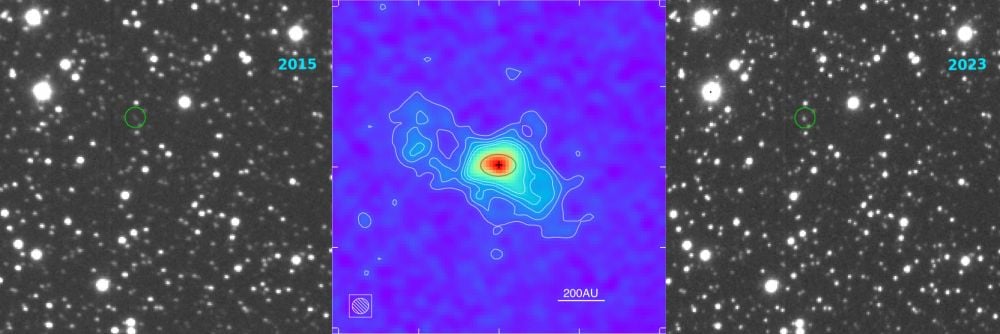
However, in February 1996, Japanese amateur astronomer Yukio Sakurai observed a sudden and dramatic brightening of an object in the constellation Sagittarius. What Sakurai had witnessed was a "Very Late Thermal Pulse" (VLTP), a phenomenon where a final shell of helium surrounding the degenerate carbon-oxygen core suddenly ignites. This "helium shell flash" provided a fresh burst of energy, causing the star to expand rapidly and "re-born" as a yellow giant.
Following the initial flash in 1996, the star’s behavior remained volatile. By the late 1990s, the star began to produce vast quantities of carbon dust, which effectively shrouded it from optical view. This "smoke screen" made observations difficult for several years, but it also signaled that the star was undergoing profound chemical changes. By the early 2000s, observations in the infrared spectrum revealed that the star was beginning to contract and reheat. In the last 30 years, the surface temperature of Sakurai’s Object has increased sixfold, an unprecedented rate of change that has allowed astronomers to track its progress year by year.
Understanding the "Born-Again" Mechanism
The "born-again" scenario is one of the most elusive events in astrophysics. It occurs in only a small percentage of stars—estimated at roughly 10% to 20% of post-AGB stars. The process is driven by the ignition of a thin layer of helium that remains on the surface of the white dwarf. When this layer reaches a critical pressure and temperature, it undergoes a thermonuclear runaway.
This flash forces the star to expand back to giant dimensions, temporarily reversing its path toward the white dwarf "graveyard." During this phase, the star’s interior is thoroughly mixed, bringing internal products of nucleosynthesis—such as carbon and oxygen—to the surface. This explains why Sakurai’s Object is so rich in carbon. The current research highlights that the star is now shedding its outer, hydrogen-deficient layers, revealing the hotter, helium-burning layers beneath. This transition is what has led to its current classification as a [Wolf-Rayet] type object.
The Emergence of the [Wolf-Rayet] Classification
The recent study led by Marcolino focuses on the specific spectral features of Sakurai’s Object. Using the FOcal Reducer/low dispersion Spectrograph 2 (FORS2) on the VLT, the team identified emission lines that are characteristic of Wolf-Rayet (WR) stars. However, the researchers are careful to use brackets—[WR]—to distinguish this object from "true" Wolf-Rayet stars.
True Wolf-Rayet stars are massive, short-lived stars, often 20 times the mass of the Sun or more, which eventually end their lives in spectacular supernova explosions. In contrast, Sakurai’s Object is a low-mass star, currently estimated at approximately 0.6 solar masses. Despite the massive difference in scale and origin, both types of stars share a similar spectral appearance: they are hot, hydrogen-deficient, and possess powerful stellar winds that drive mass loss.
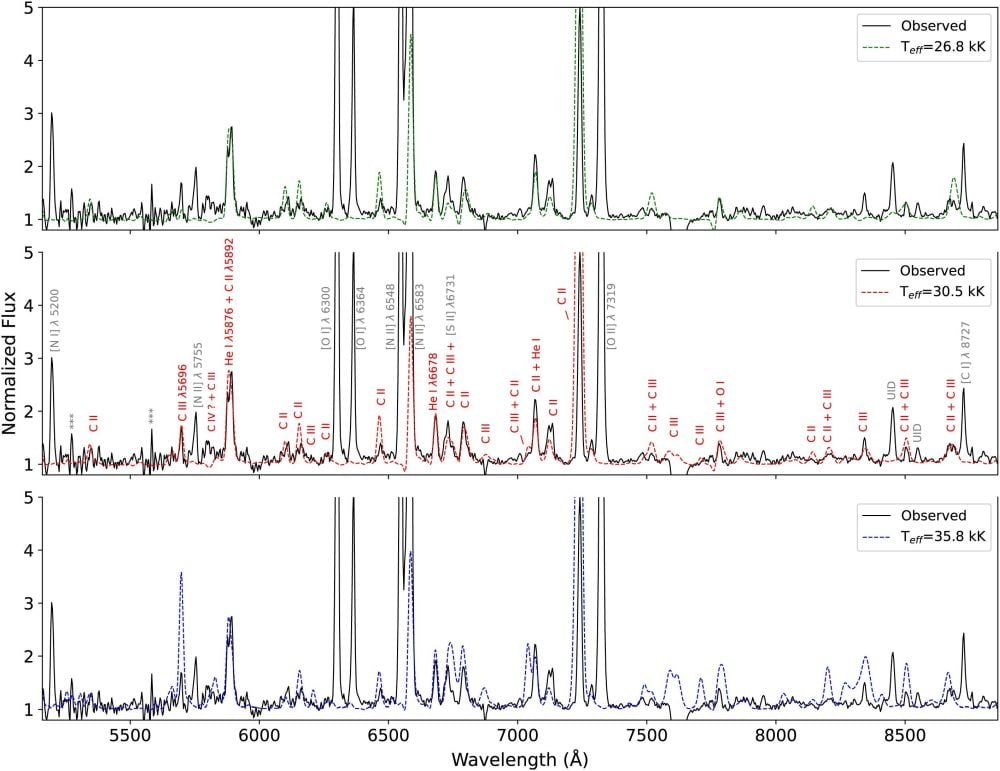
The researchers classified Sakurai’s Object specifically as a [WCL] star. The "C" denotes that the spectrum is dominated by carbon lines, while the "L" stands for "late-type," indicating that the star is still at the cooler end of the Wolf-Rayet temperature scale. The spectral analysis revealed strong lines of doubly-ionized carbon (C III) and neutral helium (He I). By fitting these observations to synthetic stellar atmosphere models, the team determined that the star’s current temperature lies between 27,000 and 36,000 Kelvin.
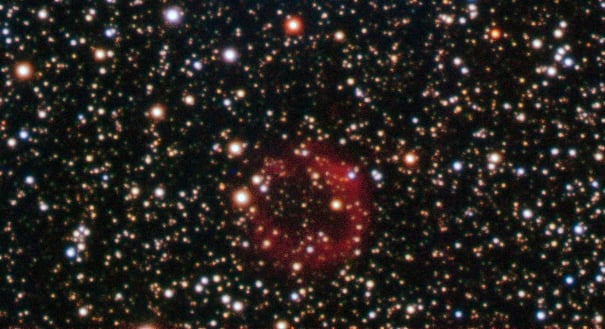
Scientific Methodology and Modeling
The identification of the [WCL] phase was made possible through a combination of high-resolution spectroscopy and complex computational modeling. The researchers at the Observatorio do Valongo and the University of Manchester compared the observed light from the VLT with various synthetic spectra. These models simulate different temperatures, wind speeds, and chemical compositions.
"Our fits rule out temperatures above 36 kK and below 27 kK," the authors noted in their report. The data showed that the doubly-ionized carbon lines become significantly stronger at higher temperatures, providing a precise "thermometer" for the star’s current state. This reheating process is the result of the star contracting after its initial post-flash expansion. As it shrinks, its surface temperature must rise to maintain hydrostatic equilibrium, a process that is now occurring in real-time.
Professor Albert Zijlstra, a co-author of the study from the Jodrell Bank Centre for Astrophysics, emphasized the importance of this real-time data. "Most stars evolve so slowly that major changes take place over timescales far longer than a human lifetime," Zijlstra explained. "Sakurai’s Object offers something far rarer… the opportunity to watch stellar evolution unfold in real time."
Implications for Stellar Evolution Theory
The rapid reheating of Sakurai’s Object provides a vital stress test for current astrophysical theories. Traditional models of stellar evolution are built on "snapshots"—observations of many different stars at different stages of their lives, which are then pieced together to form a coherent timeline. Sakurai’s Object allows scientists to check if the "movie" of stellar evolution actually matches the "stills."
One of the most significant findings of the Marcolino study is that Sakurai’s Object is reheating more slowly than some earlier theoretical models predicted. This discrepancy suggests that the physics of helium shell flashes and the subsequent mixing of stellar layers may be more complex than previously thought. The slower reheating rate could imply that the mass loss through stellar winds is more efficient, or that the internal energy transport mechanisms are behaving differently under these extreme, "born-again" conditions.
Furthermore, the study of Sakurai’s Object helps astronomers understand the origin of hydrogen-deficient stars and the formation of carbon-rich planetary nebulae. As the star continues to heat up, it will eventually ionize the material it shed during its red giant and born-again phases, creating a glowing shroud of gas.
Future Outlook and Continued Monitoring
The spectacle of Sakurai’s Object is far from over. Astronomers expect the star to continue its contraction and reheating over the coming decades. Eventually, the helium fuel will be exhausted once again, and the star will return to its white dwarf state. However, the path it takes to get there remains a subject of intense interest.
There is a possibility of further instabilities. Some models suggest that "born-again" stars can experience multiple, smaller pulses before finally settling down. Whether Sakurai’s Object will follow a steady trajectory toward becoming a white dwarf or if it has more surprises in store is a question that can only be answered through continued observation.
The research team has called for ongoing spectroscopic monitoring of the object. "Born-again objects provide a rare opportunity to observe stellar evolution in real time and place unique constraints on Very Late Thermal Pulse evolution," the study concludes. By watching Sakurai’s Object, scientists are not just looking at one anomalous star; they are refining the fundamental rules that govern the lives and deaths of stars across the universe.
As Sakurai’s Object continues to heat and evolve, it will likely become a classic example of a [WCE] (early-type) star before eventually fading into a cooling white dwarf. For now, it remains one of the most dynamic and scientifically valuable objects in the night sky, a testament to the fact that even in the seemingly eternal heavens, change can happen in the blink of a human eye. The insights gained from this "born-again" star will resonate through the field of astrophysics for years to come, providing a clearer picture of the final, frantic moments of stellar life.