George Chandra Eka
Google has introduced a significant pivot for its experimental artificial intelligence offering, "CC," transforming it into a specialized AI agent designed to streamline organization and coordination for families and small groups. This revamped platform, accessible through its own dedicated Google account, enables up to six family members to selectively share information, manage schedules, and delegate administrative tasks, all while maintaining granular control over their personal data. The strategic reorientation of CC underscores Google’s ongoing commitment to developing agentic AI solutions that offer practical, proactive assistance in daily life, addressing a clear demand for more sophisticated digital tools in household management.
The announcement marks a crucial evolution for the project, which initially debuted last December as a broader experimental AI tool. Following an initial phase and subsequent rebranding as a "Daily Briefing" feature earlier this year, Google’s development team observed a distinct pattern in user feedback: a strong inclination among early testers to utilize the tool primarily for family-centric organizational tasks. This insight prompted the current strategic pivot, refocusing CC’s capabilities to serve as a dedicated coordinator for domestic and group logistics, moving beyond a general briefing service to a more interactive and action-oriented agent.
The Evolution of Google’s AI Strategy and the Genesis of CC
Google’s journey into sophisticated AI agents is part of a broader, multi-year strategic initiative to integrate artificial intelligence more deeply into its ecosystem of products and services. With significant investments in AI research and development, epitomized by projects like Gemini, the company has consistently pushed the boundaries of what digital assistants can achieve. The initial iteration of CC, launched under the Google Labs umbrella, was conceptualized as a personal AI assistant capable of digesting information and presenting concise summaries. It aimed to alleviate information overload by sifting through digital communications and providing users with relevant daily updates, a concept that eventually led to its temporary rebranding as "Daily Briefing."
However, the real-world usage patterns observed during this experimental phase revealed an unmet need in the market: a dedicated, intelligent system to manage the increasingly complex logistics of modern family life. Families often juggle multiple calendars, email chains, messaging apps, and physical notes to coordinate schedules, chores, appointments, and administrative tasks. This fragmentation frequently leads to missed deadlines, double bookings, and communication breakdowns. Recognizing this gap, Google leveraged the agentic capabilities it had been developing within CC and repurposed them to directly address these challenges, culminating in the current family-centric organizer. This iterative development process, heavily informed by user feedback, is a hallmark of Google Labs, where innovative concepts are tested, refined, and sometimes completely re-envisioned based on practical application.
Core Functionality and Design Principles of the Revamped CC
The revamped CC is designed to function as a central digital hub for family coordination. At its core, it operates as an independent Google account that family members can "invite" into their digital lives. This design choice is fundamental, as it allows CC to interact with other Google services like Calendar, Gmail, and Drive in a structured, permission-based manner, rather than requiring deep, pervasive access to individual user accounts. Up to six family members can be part of a single CC group, creating a collaborative environment.
One of the most critical features is its ability to handle email information. Users can choose to share specific emails with the CC agent in two ways: either by forwarding individual messages on an as-needed basis for specific tasks (e.g., an email confirming a school event or a doctor’s appointment), or by designating specific email addresses whose correspondence should always be sent to the CC account (e.g., school newsletters, utility bills, sports club updates). This granular control over information sharing is a deliberate design decision, directly addressing common user concerns about privacy and data exposure to AI systems.
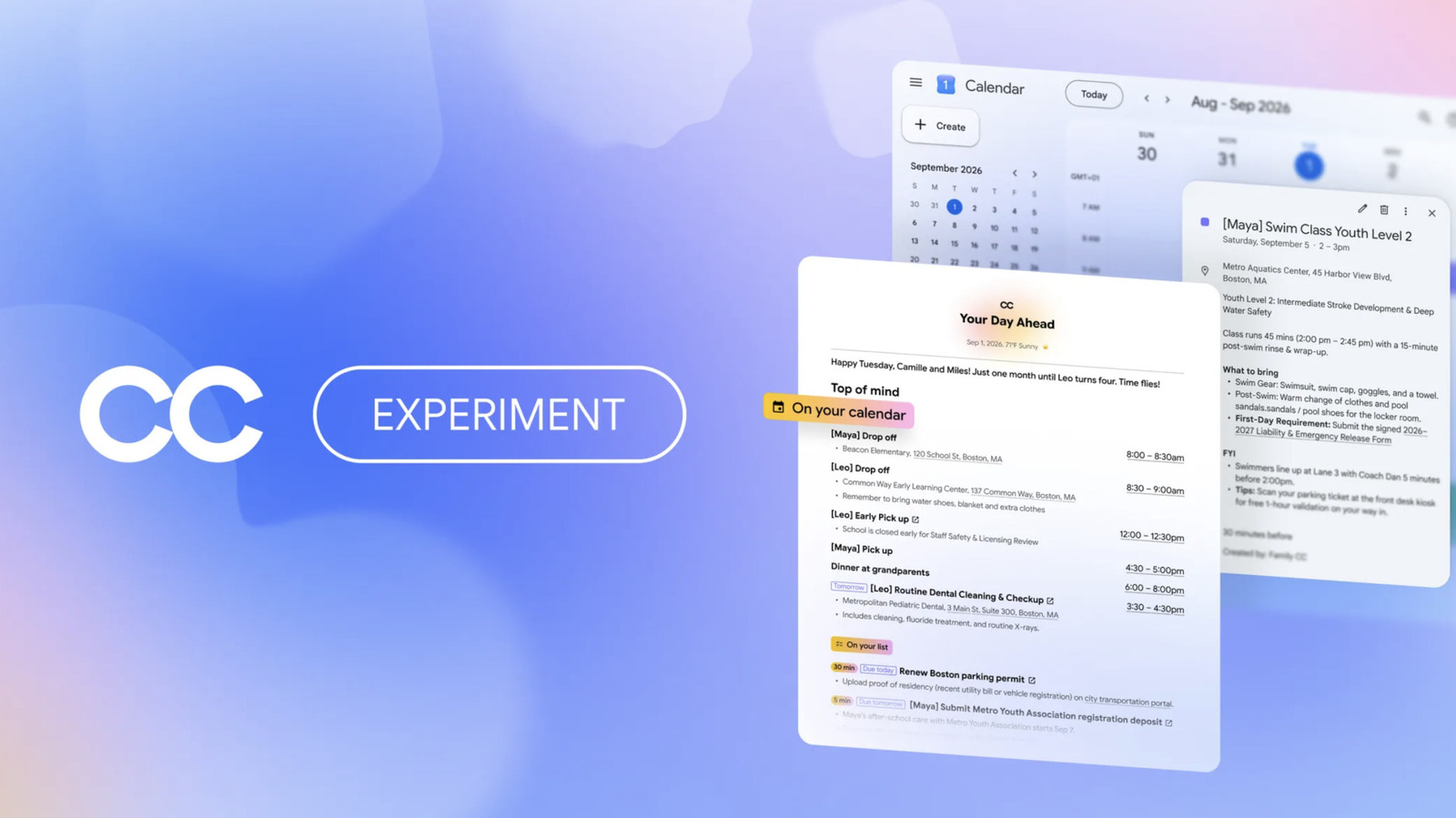
Beyond email, CC automatically establishes a shared calendar and a communal task list, which all group members can view and contribute to. This synchronized view of upcoming events and responsibilities aims to eliminate the common problem of conflicting schedules and forgotten duties. Each day, the agent compiles and sends a "daily briefing" to all participants, summarizing immediately upcoming events, outstanding tasks, and any relevant new information it has processed. This proactive communication ensures that all family members are kept abreast of the household’s dynamic schedule without needing to constantly check multiple apps.
The platform also introduces more advanced "agentic" capabilities, allowing CC to perform proactive tasks that typically consume significant administrative time. For instance, it can assist in filing paperwork, such as organizing digital documents shared to a designated Drive folder. More impressively, CC is engineered to handle logistics like filling out registration forms for school activities, sports leagues, or even travel arrangements, and generating practical lists such as grocery lists based on meal plans or household needs. Critically, Google emphasizes that all such proactive actions taken by CC are designed to first seek and obtain explicit user permission before execution. This "human-in-the-loop" approach is vital for building user trust and preventing unwanted or erroneous automated actions.
Addressing Privacy and Security Concerns: A Foundation of Trust
In an era of heightened awareness surrounding digital privacy, Google has meticulously outlined the privacy framework for CC, addressing potential user anxieties upfront. The company’s official FAQ for CC explicitly details the agent’s limitations, which are designed to safeguard individual user data and autonomy. For instance, CC is restricted from adding or removing family members from its group, ensuring that only designated individuals can control group composition. Furthermore, and perhaps most importantly, the agent cannot access or search individual members’ private inboxes. Its interaction with emails is strictly limited to messages that users explicitly forward or from addresses they designate for sharing.
This focus on explicit consent and delineated boundaries is crucial for the adoption of agentic AI. Google understands that for users to entrust an AI with sensitive family information and proactive tasks, there must be absolute clarity and robust safeguards regarding data handling. The creation of CC as a separate Google account reinforces this; it’s an entity that users choose to interact with and share information with, rather than an omnipresent AI monitoring all personal data. This model stands in contrast to more intrusive data collection practices seen in other areas of the digital landscape. By making privacy a cornerstone of CC’s design, Google aims to foster user confidence and distinguish its offering in a market where AI utility is often weighed against privacy implications. The company’s public commitment to these limitations serves as a crucial trust-building measure, recognizing that the perceived security of shared family data is paramount.
The Agentic AI Paradigm Shift and Its Implications
The revamped CC is a prime example of the nascent but rapidly accelerating "agentic AI" paradigm. Unlike traditional digital assistants that primarily respond to direct commands (e.g., "Set a timer," "What’s the weather?"), agentic AI is designed to understand goals, plan multi-step actions, and proactively execute tasks on behalf of a user, often interacting with various digital services and systems autonomously. CC’s ability to process emails, update calendars, generate lists, and even fill out forms—all with user permission—positions it firmly within this evolving category.
The potential benefits of agentic AI for family management are substantial. It promises to offload a significant portion of the cognitive load associated with household logistics, freeing up time and mental energy for family members. By centralizing information and automating routine administrative tasks, CC could significantly reduce digital friction, minimize miscommunications, and improve overall household efficiency. For busy parents, this could mean less time spent on scheduling and more time engaged with their children. For groups, it could mean smoother project coordination or event planning.
However, this paradigm shift also introduces new considerations. User trust remains paramount; individuals must feel confident that an AI agent is acting reliably and ethically on their behalf. There is also the potential for over-reliance, where critical thinking and personal responsibility might be inadvertently outsourced to the AI. Furthermore, the security implications of an AI agent having access to, even limited, personal and financial information require continuous vigilance and robust cybersecurity measures from the developer. Google’s measured approach, starting with a waitlist and emphasizing user consent, suggests an awareness of these complexities.
Market Context and Competitive Landscape
The launch of CC enters a crowded but fragmented market for digital assistance and organizational tools. Existing smart home assistants like Amazon Alexa, Apple Siri, and the standard Google Assistant offer some level of calendar management and task listing, but their capabilities are largely reactive and lack the proactive, agentic depth envisioned for CC. They are primarily voice interfaces for individual queries or simple smart home controls, not comprehensive, data-integrating organizational agents.
Dedicated productivity and family management apps, such as Trello, Asana, Cozi, and various shared calendar applications, provide specific solutions but often require manual input and constant oversight. CC aims to differentiate itself by integrating these functionalities and automating many of the manual steps, leveraging AI to bridge the gaps between disparate information sources and take action. This proactive integration could provide a significant competitive edge, positioning CC as a more holistic and less labor-intensive solution.
The market for personalized AI assistants is projected to grow substantially in the coming years. Recent data indicates a rising consumer demand for digital tools that simplify daily life, particularly among busy households. A 2023 survey by Statista revealed that over 60% of internet users globally are interested in using AI for personal organization and productivity. Furthermore, the smart home market, which often includes digital assistants, continues its robust expansion, with global revenues expected to reach over $200 billion by 2026. CC’s focus on family and group management taps directly into this burgeoning demand for intelligent, integrated digital assistance within the household ecosystem. Google’s deep integration with Gmail, Calendar, and Drive also provides a formidable advantage, as many households are already entrenched in the Google ecosystem, reducing friction for adoption.
The Future of Digital Assistants and Family Management
The revamped CC project, incubated within Google Labs, represents more than just a new feature; it signals a potential blueprint for the future of digital assistance. By focusing on a specific, high-value problem—family and group organization—Google is testing the waters for more broadly capable agentic AIs. If successful, CC could pave the way for similar AI agents tailored to other specific domains, such as small business management, personal finance, or travel planning.
The iterative development model of Google Labs allows for continuous refinement based on real-world usage. As more users join the waitlist and begin interacting with CC, Google will gather invaluable data on user preferences, pain points, and emerging needs. This feedback loop will be critical in shaping the agent’s evolution, potentially leading to new features, deeper integrations, and even more sophisticated agentic capabilities.
The long-term implications of such agents are profound. They raise questions about the nature of human-computer interaction, the boundaries of AI autonomy, and the ethical responsibilities of developers. As AI becomes more embedded in personal decision-making and task execution, societal discussions around transparency, accountability, and digital literacy will become increasingly important. Google’s current emphasis on user permission and clear privacy limitations suggests a cautious and responsible approach to these emerging challenges. The success of CC could ultimately redefine our expectations for digital assistants, transforming them from mere information providers into indispensable, proactive partners in managing the complexities of modern life.
Existing users of the previous CC iteration will receive a prompt from Google to upgrade their accounts and explore the new family-centric tools. For new users eager to experience this agentic approach to outsourced planning and organization, Google has established a waitlist, reflecting a controlled rollout strategy typical for experimental projects of this nature. This phased introduction allows Google to scale the service responsibly, gather essential feedback, and ensure the stability and security of the platform as it navigates the intricate landscape of personalized AI assistance.