Clarissa Hana
On Thursday, the official Microsoft account on X, boasting over 13 million followers, fell victim to a sophisticated cyberattack, appearing to be a well-orchestrated pump-and-dump scheme aimed at promoting a cryptocurrency token. The incident, which saw unauthorized posts appear on the tech giant’s verified account, has sparked widespread concern and prompted an immediate investigation by Microsoft, highlighting the persistent vulnerabilities of major social media platforms to malicious actors.
The breach commenced when the compromised Microsoft account (@Microsoft) began following and reposting content from another X account, identified as @clippymsftcto. This impersonating account, which has since been suspended by X, purported to represent Microsoft’s iconic Clippy virtual assistant. The Verge was the first to report on the initial stages of the attack. While @clippymsftcto is no longer active, a separate X account, @ClippyMSFT, continues to promote a cryptocurrency token bearing the ticker symbol $Clippy. This account has explicitly claimed that the $Clippy token possesses a liquidity pool directly paired with the $MSFT stock, a representation that carries significant implications given Microsoft’s substantial market capitalization.
Microsoft has since taken swift action to secure its X account, removing the illicit posts and issuing a confirmation of the unauthorized access. A spokesperson for Microsoft stated, "We have confirmed unauthorized access to our account on X, including posts that did not come from Microsoft. The account has been secured and the unauthorized posts have been removed, and we are continuing to investigate the circumstances." This official statement underscores the seriousness with which the company is treating the incident.
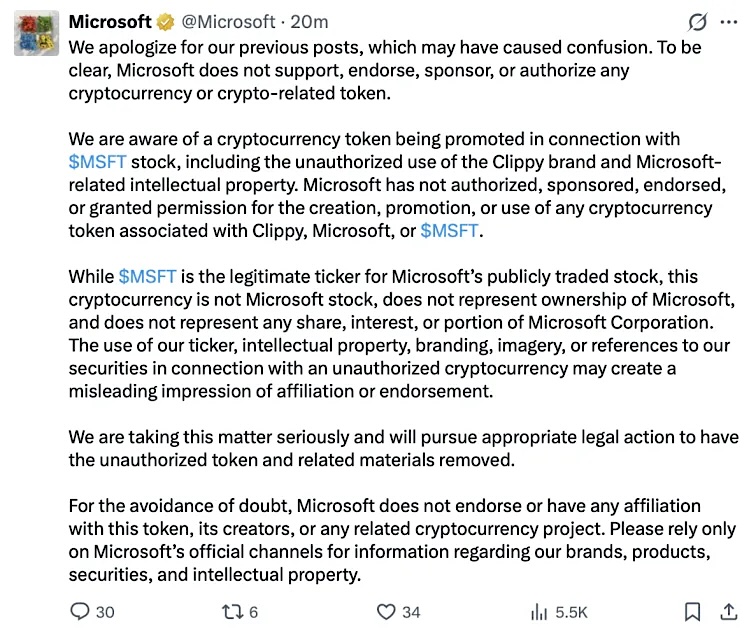
Further compounding the issue, Microsoft had, in a now-deleted tweet, issued an apology for the unauthorized content and unequivocally stated its non-endorsement of any cryptocurrency or related tokens. The company also vowed to pursue legal action. "We are aware of a cryptocurrency token being promoted in connection with $MSFT stock, including the unauthorized use of the Clippy brand and Microsoft-related intellectual property," the company’s statement read. "Microsoft has not authorized, sponsored, endorsed, or granted permission for the creation, promotion, or use of any cryptocurrency token associated with Clippy, Microsoft, or $MSFT." The statement concluded with a firm declaration of intent: "We are taking this matter seriously and will pursue appropriate legal action to have the unauthorized token and related materials removed. For the avoidance of doubt, Microsoft does not endorse or have any affiliation with this token, its creators, or any related cryptocurrency project."
This incident is not an isolated event for Microsoft’s social media presence. In June 2024, the official Microsoft India X account (@MicrosoftIndia), with a following exceeding 211,000 users, was also compromised. In that instance, attackers impersonated "Roaring Kitty," the widely recognized handle of meme stock trader Keith Gill, to perpetrate a crypto scam. The compromised Microsoft India account was used to lure unsuspecting followers into downloading cryptocurrency wallet drainer malware. The attackers actively engaged with tweets, directing Microsoft India’s followers and other X users to a malicious website (presaIe-roaringkitty[.]com) that falsely advertised a presale of GameStop (GME) crypto. Victims who connected their cryptocurrency wallets to this fraudulent site and authorized transactions unwittingly had their digital assets siphoned off by the drainer service.
A Growing Trend of Social Media Account Hijacking for Crypto Scams
The hijacking of Microsoft’s official X account is part of a disturbing and escalating pattern of cyberattacks targeting prominent social media accounts, particularly on X, to execute cryptocurrency-related scams. Verified organizations and high-profile individuals have increasingly become targets for malicious actors seeking to exploit their reach and credibility for financial gain. These attacks often involve the promotion of fraudulent cryptocurrency tokens, phishing schemes, and the deployment of sophisticated malware designed to drain user wallets.
The financial scale of these operations is staggering. In December 2023, blockchain threat analysts at ScamSniffer reported that cybercriminals had managed to steal approximately $59 million worth of cryptocurrency from an estimated 63,000 individuals. This immense sum was accumulated through a single advertising push on X between March and November of the same year, primarily utilizing a wallet drainer tool known as "MS Drainer." The effectiveness of these campaigns underscores the lucrative nature of these illicit activities and the constant arms race between cybercriminals and security professionals.
Historical Precedents and High-Profile Targets
The vulnerabilities exposed by the Microsoft hack are not unique. In January 2024, the official X account of the U.S. Securities and Exchange Commission (@SECGov) was compromised in a SIM-swapping attack. The attackers leveraged the hijacked account to disseminate a false announcement regarding the approval of Bitcoin exchange-traded funds (ETFs) on major security exchanges. This fabricated news, disseminated on January 9, 2024, caused a temporary but significant surge in Bitcoin’s price, illustrating the potential for social media manipulation to impact global financial markets. The hacker responsible for the @SECGov hijack, Eric Council Jr., subsequently pleaded guilty in February 2025 and was sentenced to 14 months in prison for his role in a conspiracy that manipulated Bitcoin’s value through the compromised account. This case highlights the severe legal consequences for individuals involved in such sophisticated cybercrimes.
The recurring nature of these attacks, even against a tech giant like Microsoft, suggests systemic issues with platform security and the ongoing sophistication of threat actors. The attackers’ ability to not only gain unauthorized access but also to leverage familiar brand elements like Clippy for their malicious purposes indicates a deep understanding of social engineering tactics and platform vulnerabilities.
Analysis of the Microsoft X Account Attack
The specific tactics employed in the Microsoft X account hijacking reveal a calculated approach. By impersonating Clippy, a beloved and recognizable Microsoft mascot, the attackers aimed to foster a sense of familiarity and trust among the account’s followers. This psychological manipulation is a common tactic in social engineering, designed to lower the guard of potential victims. The subsequent promotion of a $Clippy token, explicitly linked to the $MSFT stock, was a clear attempt to capitalize on the credibility and market recognition associated with Microsoft.
The "pump-and-dump" scheme is a well-established fraudulent practice in financial markets, particularly prevalent in the cryptocurrency space. It involves artificially inflating the price of an asset through deceptive promotions and coordinated buying, only to sell off the holdings at the inflated price, leaving other investors with worthless assets. In this instance, the attackers likely intended to create a surge in demand for the $Clippy token by associating it with Microsoft’s brand and stock.
Microsoft’s Response and Future Implications
Microsoft’s swift response in securing its account and removing the unauthorized posts is a critical first step. However, the incident raises broader questions about the security measures in place for high-profile social media accounts and the platform’s own role in preventing such breaches. X, formerly Twitter, has faced scrutiny regarding its security protocols and its ability to combat the proliferation of scams and misinformation on its platform. The company’s recent policy changes and the deactivation of certain security features have been cited by some cybersecurity experts as potentially contributing factors to the increased vulnerability of accounts.
The legal action threatened by Microsoft signifies a commitment to holding perpetrators accountable. However, tracing and apprehending the individuals or groups behind such sophisticated international cybercrimes can be an arduous and complex process. The potential financial losses incurred by individuals who fell victim to the $Clippy token promotion could be significant, and legal recourse for such victims may be limited.
The broader implications of this attack extend beyond Microsoft and its followers. It serves as a stark reminder to all social media users, especially those managing corporate or public accounts, of the pervasive threat posed by cybercriminals. The ease with which even the most established entities can be compromised underscores the need for:
- Enhanced Platform Security: X and other social media platforms must continuously invest in robust security measures, including advanced threat detection, multi-factor authentication protocols, and proactive monitoring for suspicious account activity.
- User Vigilance: Social media users must exercise extreme caution when encountering unsolicited financial offers, especially those involving cryptocurrency. Verifying the legitimacy of accounts and investment opportunities is paramount.
- Corporate Cybersecurity Practices: Companies must implement stringent cybersecurity protocols for their social media accounts, including regular security audits, employee training on social engineering tactics, and rapid incident response plans.
- Regulatory Oversight: Given the scale of cryptocurrency scams, there is an ongoing debate about the need for increased regulatory oversight to protect consumers and curb illicit activities within the digital asset space.
The Evolving Landscape of Cyber Threats
The Microsoft X account hijacking is emblematic of the evolving landscape of cyber threats. Attackers are no longer solely focused on traditional network intrusions; they are increasingly targeting the human element and the trust inherent in established brands and online communities. The ability to impersonate influential entities like Microsoft and leverage their credibility for fraudulent purposes poses a significant challenge to cybersecurity professionals and regulatory bodies worldwide. As technology advances, so too do the methods employed by malicious actors, necessitating a constant adaptation of defensive strategies and a heightened sense of awareness across the digital ecosystem. The incident serves as a critical case study, underscoring the ongoing need for collaboration between tech giants, security researchers, and law enforcement agencies to combat these sophisticated and financially motivated cybercrimes.