Sisilia Frederika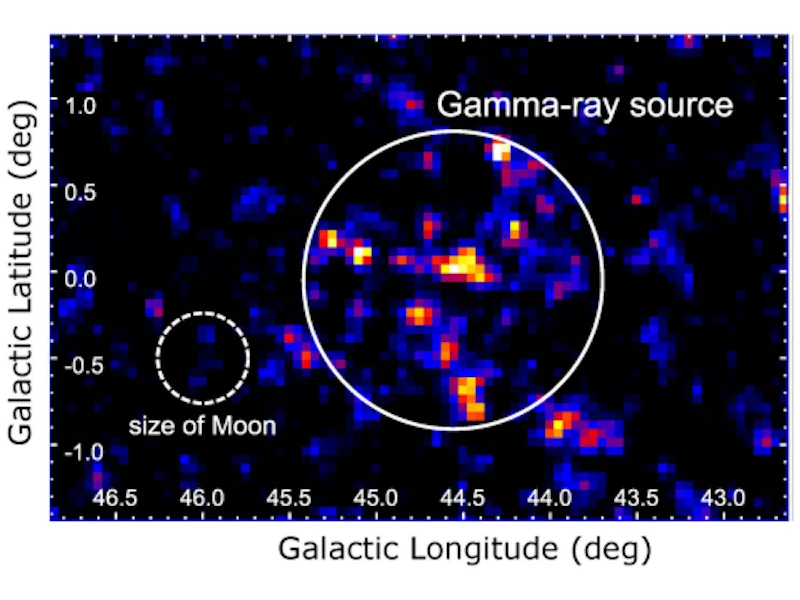
In the vast expanse of the Milky Way, near the bright star Altair in the constellation Aquila, researchers have identified a natural phenomenon that dwarfs the technological capabilities of humankind. An international team of astronomers, utilizing a sophisticated multi-instrument approach, has confirmed that the celestial object known as LHAASO J1912+1014u is a "PeVatron"—a cosmic accelerator capable of propelling protons to energies exceeding a peta-electron volt (PeV). This discovery, led by researchers at Hiroshima University, marks a significant milestone in the century-long quest to identify the origins of the most energetic particles in our galaxy.
The Enigma of Cosmic Rays and the PeVatron Threshold
Cosmic rays are not rays in the traditional sense, but rather subatomic particles—primarily protons—that travel through space at nearly the speed of light. Since their discovery by Victor Hess in 1912, these particles have presented a persistent mystery: where do they come from, and what mechanism provides them with such staggering kinetic energy? While the sun and other typical stars produce low-energy cosmic rays, the galaxy is permeated by particles with energies far beyond what any stellar fusion process could generate.
The benchmark for the most powerful of these accelerators is the PeV scale. One PeV is equal to $10^15$ electron volts, which is approximately 1,000 times more energetic than the particles produced by the Large Hadron Collider (LHC) at CERN, the world’s most advanced man-made accelerator. Scientists have long theorized that certain extreme environments, such as the shockwaves of supernova remnants or the intense magnetic fields of young star clusters, act as "PeVatrons." However, proving that a specific object is accelerating protons—and not just electrons—to these energies has proven notoriously difficult.
The Discovery of LHAASO J1912+1014u
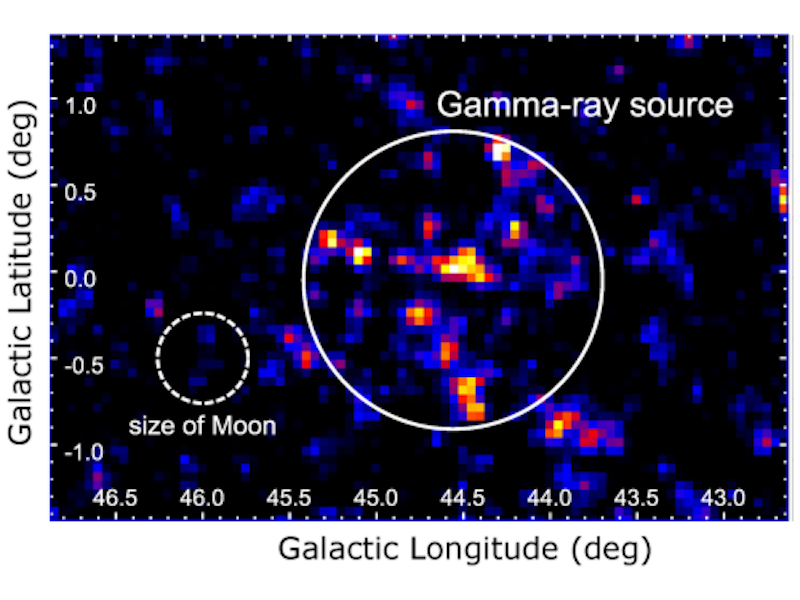
The investigation into LHAASO J1912+1014u began in earnest following data released by the Large High Altitude Air Shower Observatory (LHAASO) in Tibet. In 2024, LHAASO identified several sources of ultra-high-energy (UHE) gamma rays. Gamma rays are the highest-energy form of electromagnetic radiation and serve as crucial indicators of particle acceleration. When high-speed particles collide with surrounding interstellar gas or photons, they produce gamma rays as a secondary byproduct. These gamma rays typically carry about 10% of the energy of the parent particle. Therefore, the detection of 100 TeV gamma rays strongly suggests the presence of 1 PeV particles nearby.
LHAASO J1912+1014u stood out due to its intense emission, but the initial detection left a critical question unanswered. In astrophysics, high-energy gamma rays can be produced via two primary channels: the "hadronic" process and the "leptonic" process. In the hadronic scenario, ultra-relativistic protons collide with ambient gas, creating neutral pions that decay into gamma rays. In the leptonic scenario, high-energy electrons interact with low-energy background photons (such as the Cosmic Microwave Background) through a process called Inverse Compton Scattering, boosting the photons to gamma-ray energies.
To confirm the existence of a true PeVatron, astronomers must prove the emission is hadronic, meaning it originates from protons. Because protons are the primary component of cosmic rays, identifying a proton accelerator is the "Holy Grail" of cosmic ray research.
The Three-Arrow Methodology: A Multi-Wavelength Solution
To resolve the ambiguity surrounding LHAASO J1912+1014u, Tsunefumi Mizuno of the Hiroshima Astrophysical Science Center at Hiroshima University spearheaded a collaborative study. Mizuno employed a strategy inspired by a famous Japanese proverb attributed to the warlord Mori Motonari: "One arrow is easily broken, but three arrows bundled together are strong."
By combining data from three distinct observational platforms, the team was able to construct a comprehensive profile of the object that no single telescope could achieve alone.
1. The Fermi Gamma-ray Space Telescope (The First Arrow)
The team utilized data from NASA’s Fermi Large Area Telescope (LAT) to analyze the lower-energy end of the gamma-ray spectrum. While LHAASO detects ultra-high energies, Fermi-LAT is sensitive to "gigaelectron-volt" (GeV) energies. By mapping the spectrum from GeV to TeV levels, the researchers could observe the "shape" of the energy distribution. The smooth, continuous power-law spectrum observed across this vast range was highly characteristic of proton-gas interactions and inconsistent with the typical energy "cutoff" seen in electron-based emissions.
2. The FUGIN Radio Survey (The Second Arrow)
To support the hadronic theory, there must be a "target" for the protons to hit. The FOREST Unbiased Galactic Plane Imaging survey (FUGIN), conducted using the Nobeyama 45-meter Radio Telescope in Japan, provided high-resolution maps of molecular gas in the Milky Way. The researchers found a remarkable spatial correlation: the regions of highest gamma-ray intensity perfectly overlapped with dense clouds of interstellar gas. This alignment provided strong circumstantial evidence that protons were streaming out of the accelerator and slamming into these clouds to produce the observed gamma-ray glow.
3. The Chandra X-ray Observatory (The Third Arrow)
The final piece of the puzzle came from NASA’s Chandra X-ray Observatory. High-energy electrons typically emit X-rays through a process called synchrotron radiation as they spiral through magnetic fields. If LHAASO J1912+1014u were an electron-driven source, Chandra should have detected a diffuse X-ray glow. However, the X-ray observations showed a distinct lack of such emission. The absence of significant X-ray activity effectively ruled out electrons as the primary drivers of the high-energy gamma rays, leaving protons as the only viable explanation.
Chronology of the Investigation
The timeline of this discovery reflects the rapid evolution of high-energy astrophysics over the last decade:
- 2012–2021: Early detections by the Milagro and HAWC observatories hint at UHE sources in the Galactic Plane, but resolution is insufficient for confirmation.
- 2021: The LHAASO facility begins full operations, identifying 12 PeVatron candidates in its initial survey, revolutionizing the field of UHE gamma-ray astronomy.
- 2024 (Early): LHAASO J1912+1014u is officially cataloged as a source of gamma rays exceeding 100 TeV, located in the Aquila region.
- 2024 (Mid): The Hiroshima University-led team begins cross-referencing LHAASO data with archival data from the Fermi-LAT and the FUGIN radio survey.
- 2024 (Late): Targeted X-ray analysis from the Chandra Observatory is integrated into the study, confirming the lack of synchrotron emission.
- 2024 (Present): The findings are published, providing a definitive confirmation of the hadronic nature of the accelerator.
Technical Analysis: Why This Matters for Science
The confirmation of LHAASO J1912+1014u as a proton accelerator is more than just the identification of a single object; it validates the "standard model" of cosmic ray origin. For decades, the leading theory has been that supernova remnants (the expanding shells of gas from exploded stars) act as the primary accelerators of Galactic cosmic rays through a process known as Diffusive Shock Acceleration.
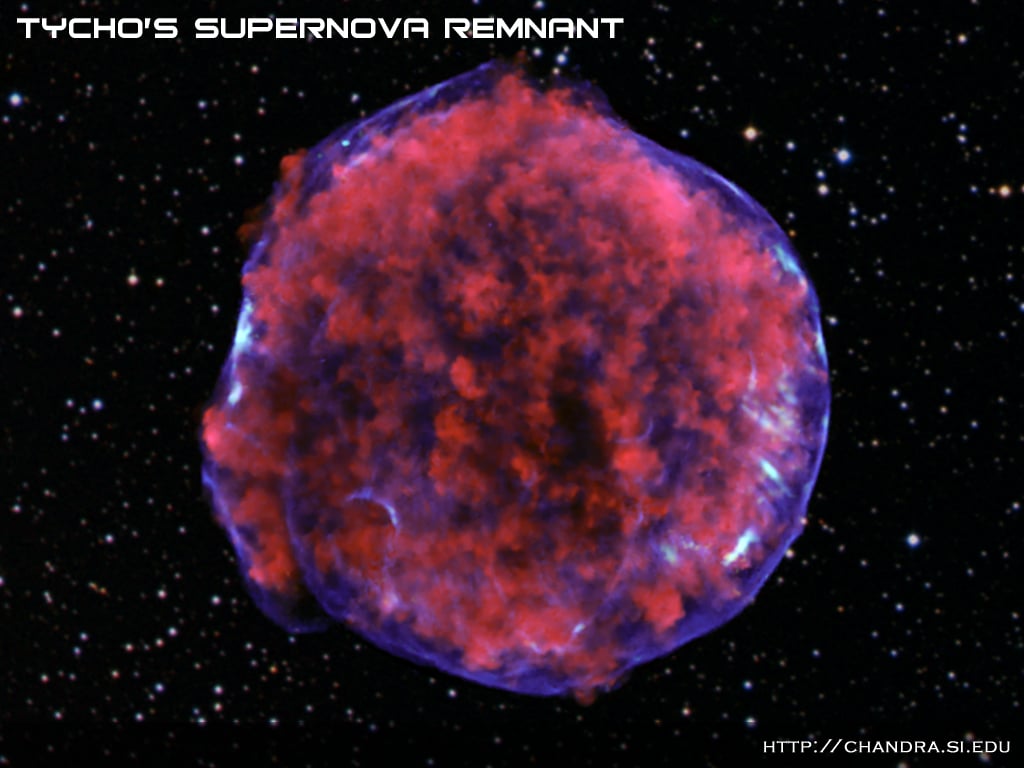
In this process, particles are trapped between the magnetic fields of a supernova’s shock front and the surrounding interstellar medium. They bounce back and forth across the shock wave, gaining a small amount of energy with each passage, eventually reaching PeV levels before escaping into the wider galaxy.
The data for LHAASO J1912+1014u aligns perfectly with this model. The object appears to be a supernova remnant interacting with a dense molecular cloud. By proving that this specific environment can indeed reach the PeV threshold, astronomers have confirmed that the Milky Way is capable of producing the high-energy cosmic ray flux measured by detectors on Earth.
Broader Implications and Future Research
The success of the "three arrows" approach has profound implications for the future of the field. Currently, there are dozens of PeVatron candidates identified by LHAASO and the High Altitude Water Cherenkov (HAWC) Observatory that remain unconfirmed. The methodology established by Mizuno and his colleagues provides a blueprint for vetting these candidates.
"Our result demonstrates that by combining gamma-ray, X-ray, and radio data, we can finally distinguish between the two main theories of cosmic ray production," the team noted in their analysis. This multi-messenger approach is expected to become the standard as new facilities, such as the Cherenkov Telescope Array (CTA), come online in the coming years.
Furthermore, understanding PeVatrons helps scientists map the "magnetic architecture" of our galaxy. As these high-energy protons escape their source, their paths are bent by the Milky Way’s magnetic fields. By identifying the exact sources of these particles, researchers can better track their journey across the cosmos, leading to a deeper understanding of the interstellar medium and the evolution of our galactic neighborhood.
As astronomers continue to peer into the high-energy sky, LHAASO J1912+1014u stands as a testament to the power of collaborative, multi-wavelength science. It is no longer just a "candidate" on a list; it is a proven powerhouse of the Milky Way, a natural laboratory that continues to push the boundaries of physics far beyond the reach of human technology.