Clarissa Hana
A significant lawsuit has been filed against technology giant Apple Inc. by three individuals who claim they collectively lost approximately $1.8 million in Bitcoin due to a fraudulent cryptocurrency wallet application downloaded from the company’s App Store. The complaint, lodged on July 24th in California, asserts that Apple neglected its responsibility to adequately vet and monitor applications distributed through its digital marketplace, despite consistently promoting it as a secure and trustworthy platform for software downloads. The plaintiffs, identified as James Ramirez, Christopher Ellis, and Jalen Delgado, allege that a malicious application, designed to mimic the legitimate Sparrow Bitcoin wallet, deceived them into divulging their crucial seed phrases, the master keys to their cryptocurrency holdings. Upon entering these sensitive recovery credentials, the victims reportedly witnessed their valuable Bitcoin being siphoned off to cryptocurrency wallets controlled by the perpetrators of this elaborate scam.
The core of the legal action hinges on Apple’s alleged negligence in its App Store review and moderation processes. The plaintiffs contend that Apple’s failure to identify and remove the fraudulent application allowed it to remain accessible to unsuspecting users, leading to substantial financial losses. The complaint highlights that the legitimate Sparrow Wallet is exclusively a desktop application, available for Windows, macOS, and Linux operating systems, and crucially, does not offer an official iOS version. This fact underscores the deceptive nature of the fraudulent app, which exploited the trust users place in the official Apple App Store.
A Pattern of Deception: Early Warnings Ignored
The lawsuit reveals a troubling pattern of the fraudulent Sparrow Wallet application being available on the App Store, with evidence suggesting that Apple had been alerted to its presence well in advance of the plaintiffs’ losses. The complaint details the financial devastation experienced by each individual:

- Jalen Delgado: On or around May 1, 2025, Delgado downloaded the deceptive application. After entering his seed phrase, he discovered that 1.05033242 Bitcoin, then valued at approximately $120,000, had been illicitly transferred.
- James Ramirez: Ramirez’s unfortunate experience occurred on July 25, 2025, when he downloaded the fraudulent app. He reportedly lost 7.4 Bitcoin, a sum estimated at $875,000 at the time. Crucially, the complaint states that Ramirez immediately reported both the fraudulent app and the theft to Apple on the same day. However, he alleges that Apple never followed up with him regarding this report or any subsequent communications.
- Christopher Ellis: Just over a week later, on or around August 3, 2025, Ellis also fell victim to the scam. After installing the fake Sparrow app from the App Store and entering his seed phrase, he discovered that approximately $840,000 worth of cryptocurrency had been transferred to a scammer. Like Ramirez, Ellis promptly reported the app and the theft to Apple.
Beyond merely listing the fraudulent app, the complaint further alleges that Apple actively promoted it. The plaintiffs claim that the fraudulent Sparrow app was not only ranked highly but was also included in curated cryptocurrency app collections, effectively endorsing it alongside legitimate financial applications. This inclusion, the lawsuit suggests, lent an unwarranted air of legitimacy to the scam.
Developer’s Persistent Efforts and Apple’s Response
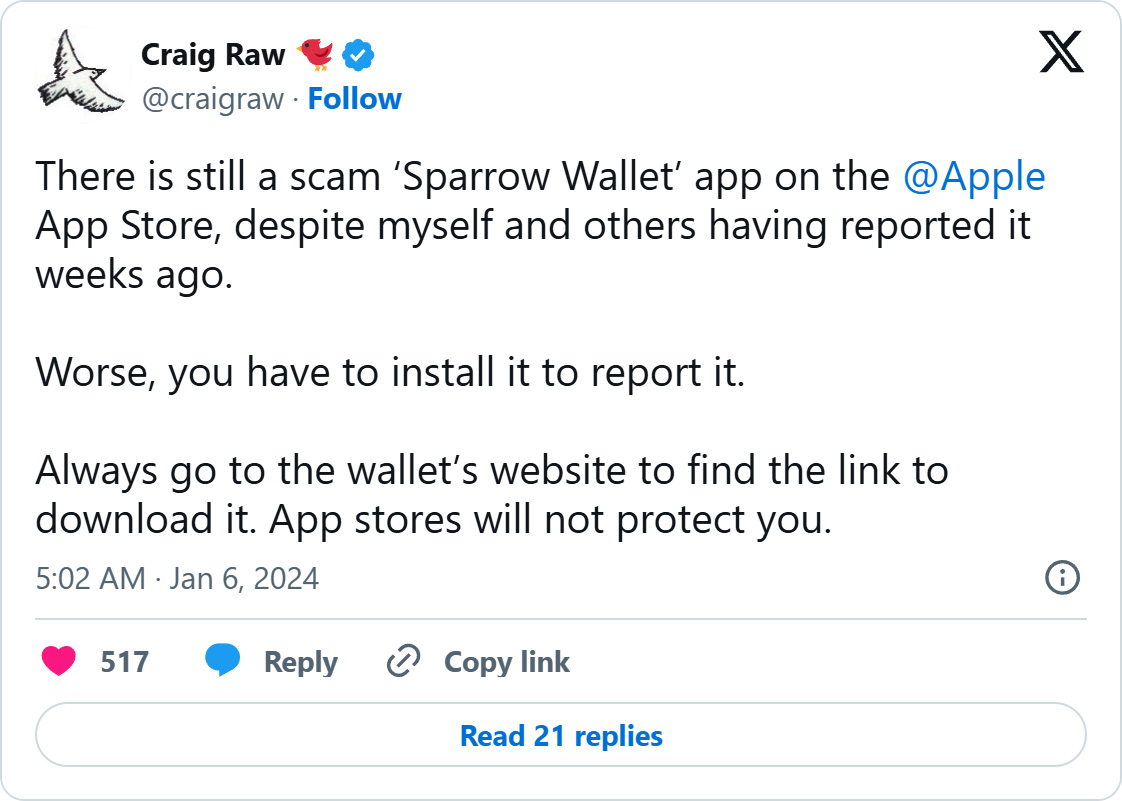
The developer of the legitimate Sparrow Wallet, Craig Raw, has been vocal about the repeated instances of fake applications impersonating his software appearing on the Apple App Store. The complaint references a post made by Raw on January 6, 2024, where he expressed frustration that a fraudulent Sparrow Wallet app remained available on the App Store despite him and others having reported it weeks prior. In this post, Raw explicitly warned users to obtain Sparrow Wallet exclusively through its official website, emphasizing that mere presence on an app store did not guarantee authenticity.
Further evidence of Raw’s ongoing efforts to protect users comes from a more recent attempt to flag the fraudulent applications. According to reports, Raw submitted an unpublished placeholder app to the Apple App Store that explicitly stated that any mobile applications using the "Sparrow Wallet" name were fraudulent. This proactive measure, however, reportedly led to Apple initially flagging Raw’s developer account for termination due to alleged dishonest activity, a decision that was later reversed.
In response to inquiries from BleepingComputer, Apple stated that it took prompt action to remove applications impersonating Sparrow Wallet and terminated the developer accounts associated with them. The company also highlighted its established dispute resolution process for developers whose intellectual property rights are allegedly infringed upon, directing them to submit disputes to Apple’s legal department. Furthermore, Apple reiterated its existing "Report a Problem" service for customers to report suspected App Store scams and fraud, asserting that it takes immediate action against applications found to be in violation of its guidelines.

Legal Ramifications and Broader Implications
The lawsuit seeks substantial reparations for the victims, including reimbursement for their stolen cryptocurrency, compensatory and punitive damages, restitution, attorneys’ fees, and other associated costs. Beyond financial compensation, the plaintiffs are also petitioning the court to mandate significant changes in Apple’s operational procedures. They are asking for Apple to improve and publicly disclose its methods for detecting and removing fraudulent applications. Additionally, they seek the introduction of explicit warnings within the App Store concerning the inherent risks associated with cryptocurrency-related applications.
This legal challenge raises critical questions about the responsibilities of major technology platforms in safeguarding users from financial scams facilitated through their ecosystems. The App Store, with its billions of downloads and reputation for curated content, is often perceived as a bastion of security. When this trust is reportedly breached, leading to significant financial losses, it can have far-reaching implications for user confidence and the broader digital economy.
The case also shines a light on the ongoing battle against sophisticated cryptocurrency scams. These scams often exploit the rapid growth and evolving nature of digital assets, preying on users’ enthusiasm and sometimes, their lack of in-depth technical knowledge. The tactic of impersonating legitimate and trusted applications is a common modus operandi, and the lawsuit suggests that even a company as large and resourced as Apple may face challenges in consistently thwarting such malicious activities.
A Timeline of Alleged Failures and Losses:
To fully understand the scope of the plaintiffs’ claims, a chronological overview of key events as presented in the complaint is instructive:
- January 6, 2024: Craig Raw, developer of the legitimate Sparrow Wallet, publicly warns about a fraudulent Sparrow Wallet app on the Apple App Store, stating it was reported weeks earlier but remained available.
- On or around May 1, 2025: Jalen Delgado downloads the fraudulent Sparrow Wallet app, enters his seed phrase, and loses approximately $120,000 in Bitcoin.
- July 24, 2025: The lawsuit is filed in California.
- July 25, 2025: James Ramirez downloads the fraudulent Sparrow Wallet app, enters his seed phrase, and loses approximately $875,000 in Bitcoin. He reportedly reports the incident to Apple on the same day.
- On or around August 3, 2025: Christopher Ellis downloads the fraudulent Sparrow Wallet app, enters his seed phrase, and loses approximately $840,000 in cryptocurrency. He also reports the incident to Apple.
- Recent Past (unspecified date): Craig Raw reportedly attempts to submit a placeholder app warning users about fake Sparrow Wallet apps, leading to his developer account being temporarily flagged by Apple.
The plaintiffs’ legal team is likely to present this timeline as evidence of Apple’s alleged inaction and the continued availability of the fraudulent application despite repeated warnings and reports from both users and the legitimate developer. The success of their case may hinge on demonstrating that Apple’s review processes were demonstrably negligent and that this negligence directly led to the financial ruin of the plaintiffs. The outcome of this lawsuit could set a significant precedent for the accountability of app store operators in protecting consumers from digital fraud.