Sisilia Frederika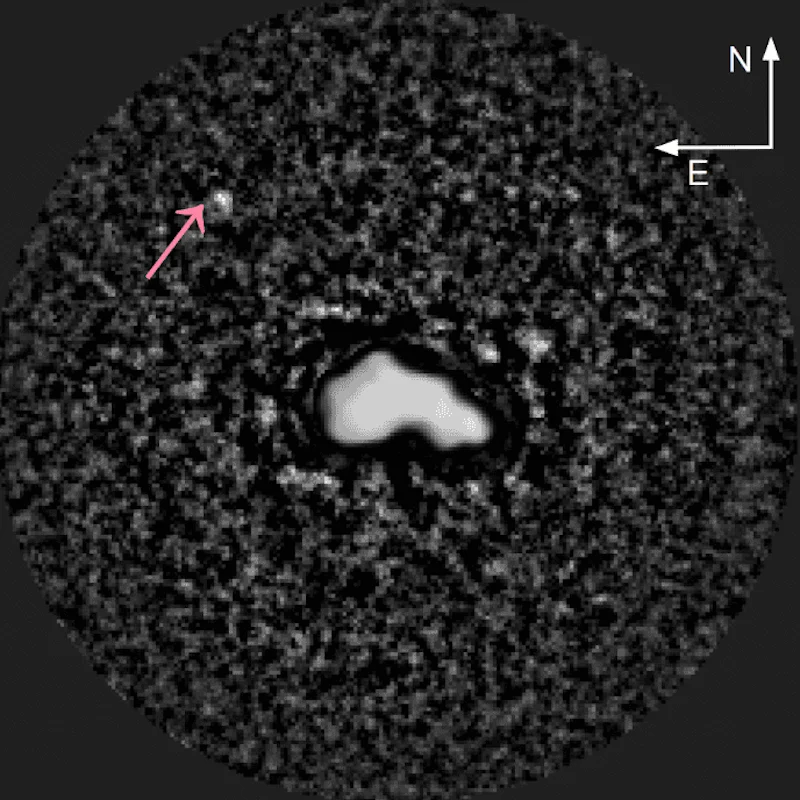
Ground-based astronomical observations have reached a historic milestone with the detailed imaging of (44) Nysa, a prominent inhabitant of the inner main asteroid belt. An international research initiative, led by Kate Minker of the Lowell Observatory, has utilized the world’s most advanced adaptive optics and high-contrast imaging systems to resolve the long-standing mystery regarding the physical structure of this celestial body. The findings, derived from data collected by the Large Binocular Telescope (LBT) in Arizona and the Very Large Telescope (VLT) in Chile, suggest that Nysa is not merely an elongated rock, but likely a "contact trinary"—a complex configuration consisting of three distinct lobes fused together through low-velocity collisions.
For over 160 years, (44) Nysa has intrigued astronomers due to its exceptional brightness and its classification as an E-type asteroid. While most asteroids are dark, carbon-rich bodies, E-types possess surfaces rich in enstatite, a magnesium-rich pyroxene mineral that gives them a high albedo, or reflectivity. Despite its proximity and brightness, Nysa’s true shape remained elusive, with previous light-curve data suggesting an irregular, perhaps bi-lobed shape. The new high-resolution images have finally pierced the "atmospheric veil," revealing a structure that Minker describes as approaching the quality of images captured by deep-space probes, despite being photographed from the Earth’s surface.
Technological Sophistication in Ground-Based Imaging
The achievement was made possible through the deployment of two of the most powerful instruments currently available to the astronomical community: SHARK-VIS, mounted on the Large Binocular Telescope, and SPHERE/ZIMPOL, situated on the Very Large Telescope. These instruments represent the pinnacle of high-contrast imaging, a field traditionally reserved for the search for exoplanets orbiting distant stars.
To overcome the blurring effects of Earth’s atmosphere—a phenomenon known as atmospheric scintillation or "seeing"—the team utilized advanced adaptive optics (AO). AO systems work by using deformable mirrors that adjust their shape thousands of times per second to counteract the turbulence of the air. When combined with purpose-built image processing algorithms designed to deconvolve and sharpen the resulting data, the team was able to resolve surface features on Nysa that were previously invisible.
The SHARK-VIS instrument (Simple High Angular Resolution Kit for the Visible), in particular, has proven to be a game-changer for asteroid science. By operating in visible light rather than the infrared spectrum used by many other AO systems, it provides a higher theoretical resolution, allowing astronomers to see smaller details on the surfaces of relatively small solar system bodies. This technological leap allows for the study of asteroids with a level of detail that previously required billion-dollar satellite missions.
The Contact Trinary Hypothesis and Structural Analysis
The most striking revelation from the new images is the presence of two deep, prominent valleys that wrap around the circumference of the asteroid. The research team interprets these features as "necks"—the points of contact where separate celestial bodies have drifted together and joined. This suggests that Nysa is a contact trinary, formed by three individual lobes that collided at speeds slow enough to allow them to stick together rather than shatter upon impact.
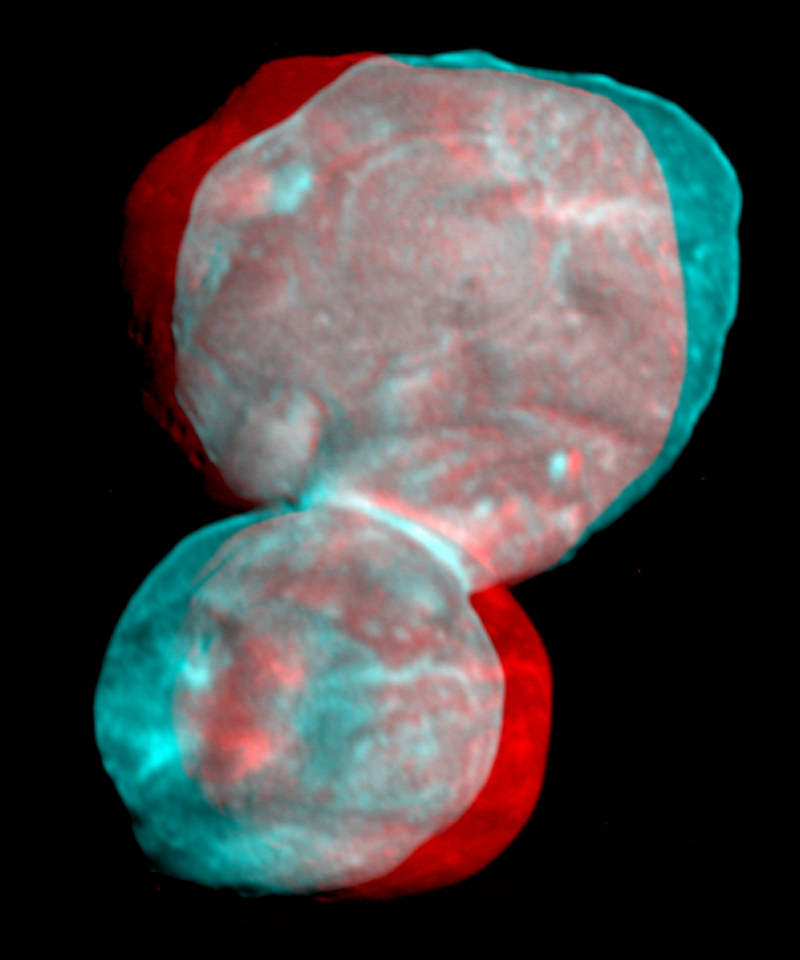
This formation process, known as "gentle accretion," has been observed in other solar system objects, but usually only in pairs. For example, the Kuiper Belt object Arrokoth, visited by the New Horizons spacecraft in 2019, famously resembles a "flattened snowman" made of two lobes. Similarly, Comet 67P/Churyumov–Gerasimenko, studied by the Rosetta mission, exhibits a bi-lobed "rubber duck" shape. Nysa, however, appears to be the first documented case of this phenomenon occurring in triplicate.
While the contact trinary theory is the leading explanation, the research team remains cautious, noting an alternative possibility. It is conceivable that Nysa is a single, coherent body that has been so severely battered by impacts over billions of years that it has developed deep indentations mimicking the appearance of three lobes. However, the team notes that if this were the case, Nysa would still be a unique object, as no other known asteroid displays such extreme, symmetrical cratering or deformation.
The Discovery of Satellite S/2026 (44) 1
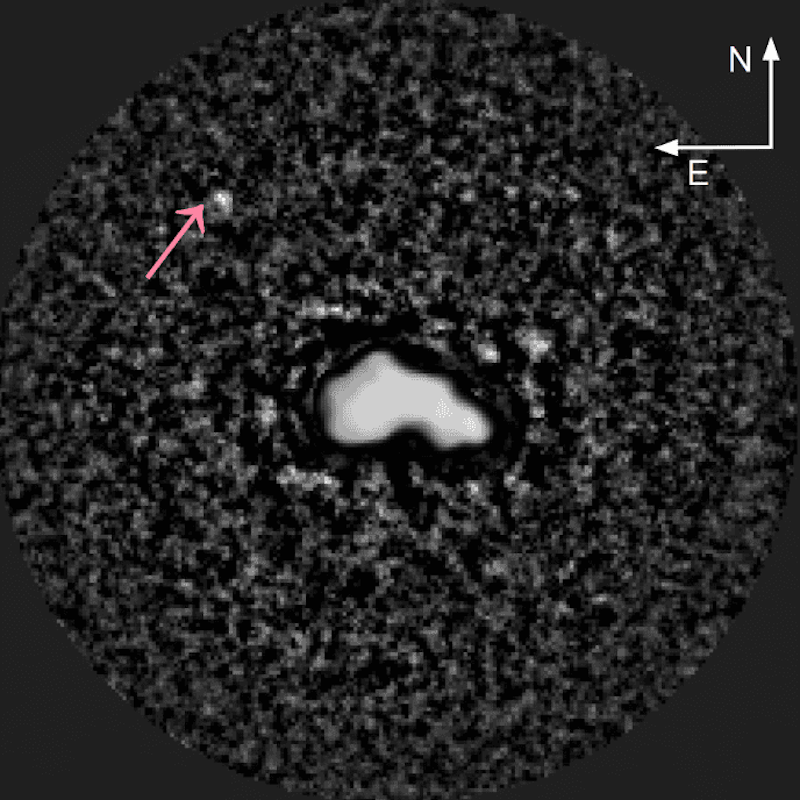
A secondary but equally significant discovery emerged during the imaging campaign: the identification of a small moon orbiting (44) Nysa. Using high-contrast techniques originally developed to find faint planets near bright stars, the team isolated a small speck of light moving in tandem with the primary asteroid. This satellite, now officially designated S/2026 (44) 1, is estimated to be approximately one kilometer in diameter.
The moon orbits Nysa at a distance of at least 170 kilometers. Its discovery was confirmed through independent sightings in two separate observing runs, ensuring the validity of the find. The presence of a moon provides a vital "gravitational probe" for scientists. By tracking the orbital period and distance of S/2026 (44) 1, researchers can apply Kepler’s laws of planetary motion to calculate the precise mass of Nysa.
Determining the mass is the final piece of the puzzle in understanding Nysa’s internal structure. By combining the mass with the volume estimates derived from the new 3D images, scientists can calculate the asteroid’s bulk density. This metric is essential for distinguishing between a "rubble pile" asteroid—a loose collection of debris held together by gravity—and a solid, monolithic rock. If Nysa has a low density, it would strongly support the theory that it is a collection of three distinct bodies that have loosely assembled over time.
Historical Context and the E-Type Mystery
(44) Nysa was first discovered on July 27, 1857, by the German-French astronomer Hermann Goldschmidt. Since then, it has been recognized as the largest and brightest member of the Nysa asteroid family, a group of asteroids that share similar orbital characteristics and are believed to be the fragments of a larger parent body that was destroyed in a massive collision long ago.
The E-type classification of Nysa places it in a rare category. These asteroids are thought to be the remnants of the crusts of differentiated bodies—larger protoplanets that once had a molten interior, allowing heavier metals to sink to the core while lighter minerals like enstatite rose to the surface. Understanding the shape and composition of Nysa provides a window into the early, chaotic stages of the solar system when the building blocks of planets were being formed, smashed apart, and reassembled.
The high albedo of Nysa (roughly 0.5) makes it one of the most reflective objects in the asteroid belt. This reflectivity is a direct result of its enstatite-rich surface. The fact that such a bright, well-studied object could hide its true shape for over a century underscores the limitations of previous telescopic technology and the magnitude of the current breakthrough.
Scientific Reactions and Broader Implications
The broader scientific community has reacted to the findings with significant interest, as the discovery of a potential contact trinary challenges existing models of asteroid accretion. Most collision models in the asteroid belt focus on high-velocity impacts that lead to fragmentation. The existence of a three-lobed contact body suggests that low-velocity "gentle" encounters may be more common in certain regions of the belt than previously suspected.
"The ability to resolve these shapes from the ground is a testament to how far adaptive optics have come," noted one independent researcher. "We are essentially doing geology at a distance of hundreds of millions of kilometers."
The discovery also has implications for future space missions. Asteroids with complex shapes and moons are prime targets for robotic exploration, as they offer multiple points of interest for sampling and structural analysis. Nysa’s unique geometry would present both a challenge and an opportunity for a landing mission, as the gravitational field around a three-lobed body would be highly non-uniform.
Chronology of the Discovery
The path to this discovery involved several key stages over the last few years:
- Pre-2020: Nysa is identified as a high-priority target for shape modeling due to its unusual light curves, which showed significant variations in brightness as it rotated.
- 2022-2024: The international team, led by Minker, secures observing time on the LBT and VLT, timing the observations to coincide with Nysa’s closest approaches to Earth.
- Early 2026: Initial data from the SHARK-VIS and SPHERE instruments reveals the three-lobed structure. Subsequent analysis of the "glare" around the asteroid leads to the first detection of the moon.
- Mid-2026: Independent verification of the moon is achieved during a second observing run, confirming the orbit and allowing for preliminary mass estimations.
- Present: The team releases the first high-resolution images and the "contact trinary" hypothesis, sparking a new round of theoretical modeling regarding Nysa’s origins.
Conclusion and Future Research
The study of (44) Nysa is far from over. The next phase of research will involve long-term monitoring of the moon S/2026 (44) 1 to refine Nysa’s mass and density. Additionally, spectroscopic analysis will be conducted to see if the three lobes have identical compositions. If the lobes show slight differences in mineralogy, it would be definitive proof that they originated as separate bodies before joining.
Nysa stands as a reminder that the solar system still holds surprises, even among its most famous and well-observed residents. By bridging the gap between ground-based observations and spacecraft exploration, Kate Minker and her team have opened a new chapter in planetary science, one where the "oddness" of an asteroid is no longer a source of frustration, but a key to unlocking the history of the planets themselves. As imaging technology continues to evolve, the distinction between a point of light in the sky and a world with a complex history continues to vanish.