Sisilia Frederika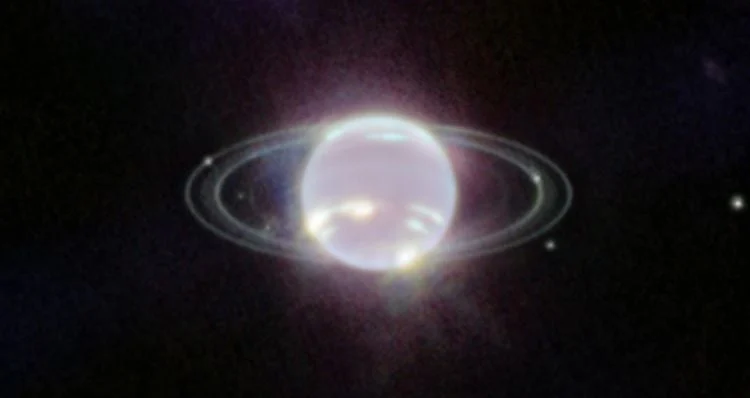
A new study led by researchers at the California Institute of Technology (Caltech) has provided groundbreaking evidence that the inner moons and rings of Neptune are not original fixtures of the planet’s formation, but are instead the "second-generation" debris of a catastrophic cosmic collision. By utilizing the advanced infrared capabilities of the James Webb Space Telescope (JWST), the team has identified chemical signatures that suggest these small worlds were once the interior components of much larger planetary bodies, which were obliterated during the chaotic capture of Neptune’s largest moon, Triton.
The research, recently published in the journal Science Advances, fundamentally alters the scientific understanding of how the Neptunian system evolved. For decades, astronomers have puzzled over the lopsided nature of Neptune’s satellite system. Unlike Jupiter or Saturn, which possess orderly systems of moons that likely formed alongside the planets themselves, Neptune is dominated by Triton, a massive, retrograde-orbiting moon that accounts for more than 99.5 percent of the total mass orbiting the eighth planet. The new data suggests that Triton acted as a gravitational wrecking ball, destroying a pre-existing moon system and leaving behind a field of rubble that eventually coalesced into the rings and small inner moons observed today.
The Triton Intrusion: A System-Wide Catastrophe
To understand the current state of Neptune’s moons, scientists must look back billions of years to the early history of the solar system. Triton is widely believed to be a captured object from the Kuiper Belt, a region of icy bodies beyond the orbit of Neptune. Unlike the "regular" moons of other gas giants, which orbit in the same direction as their parent planet’s rotation, Triton orbits in a retrograde (reverse) direction. This orbital anomaly is the primary evidence for its capture.
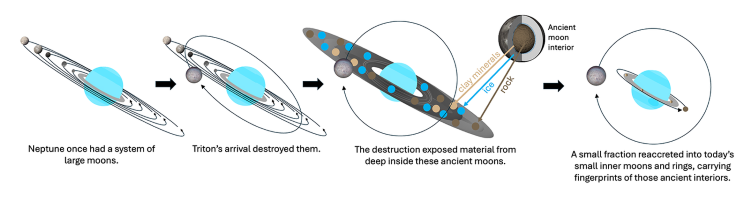
When Triton was pulled into Neptune’s gravitational influence, its initial orbit would have been highly eccentric and elongated. As it moved through the system, its massive gravity would have intersected the orbits of Neptune’s original, prograde moons. According to Dr. Ryleigh Davis, who led the study during his doctoral work at Caltech, this process would have been utterly destructive. "If Neptune once had a system of moons that looked something like what we see at Uranus today, we expect it would’ve been completely destroyed by the process of Triton getting captured," Davis stated.
The resulting collisions would have ground the original moons into dust and fragments. Over millions of years, as Triton’s orbit circularized due to tidal forces, this debris disk began to settle. Some of the material fell into the planet, some formed the faint rings we see today, and some "accreted"—or clumped together—to form the small inner moons: Proteus, Larissa, and Galatea.
Spectral Analysis: The Missing Ice and the Presence of Clay
The Caltech-led team utilized the Near-Infrared Spectrograph (NIRSpec) instrument on the James Webb Space Telescope to peer into the chemical composition of these inner moons. Because Neptune is roughly 30 times farther from the Sun than Earth, its environment is frigid, and water ice is typically the dominant surface material for objects in this region. However, the JWST data revealed a startling discrepancy: Proteus, Larissa, and Galatea, along with Neptune’s rings, appear to be devoid of surface water ice.
This absence of ice is a critical piece of the puzzle. In the outer solar system, small moons are usually "dirty snowballs" comprised of ice and rock. The fact that these moons lack ice suggests they did not form through the standard process of gas and dust accumulation in the early solar nebula. Instead, the team identified the presence of water-rich clay minerals containing magnesium on Larissa, Galatea, and within the rings.
The presence of these phyllosilicates (clays) is highly significant. Clays typically form when rock is processed in the presence of liquid water. For liquid water to have existed, the parent bodies must have been large enough to retain internal heat—potentially even qualifying as dwarf planets. The researchers concluded that the current moons are essentially the "reprocessed" remains of the rocky interiors of those shattered ancient worlds. The ice that once covered those original moons likely sublimated or was stripped away during the high-energy collisions triggered by Triton’s arrival.
A Tale of Two Formations: Proteus vs. The Inner Moons
While Larissa and Galatea showed clear signs of magnesium-rich clays, the largest of the inner moons, Proteus, presented a different chemical profile. Proteus, which has a diameter of approximately 420 kilometers (261 miles), does not contain the same water-rich clay minerals as its smaller siblings.
This variation suggests that the debris disk created by the Triton event was not uniform. The team concluded that Proteus likely formed from a different section of the wreckage or at a different distance from the planet where the chemical composition of the "parent" fragments was different. Proteus sits further out than Larissa and Galatea, and its unique composition highlights the complexity of the accretion process that followed the system’s destruction.
A Chronology of Discovery: Mapping the Neptunian System
The history of our knowledge of Neptune is a testament to the evolution of observational technology. The planet itself was first identified in September 1846 by Johann Gottfried Galle, following mathematical predictions by Urbain Le Verrier. Just seventeen days later, British astronomer William Lassell discovered Triton.
For over a century, these were the only known major features of the system, with the small moon Nereid not discovered until 1949 by Gerard Kuiper. The true complexity of the system remained hidden until the arrival of NASA’s Voyager 2 spacecraft in 1989. Voyager 2 confirmed the existence of Larissa (initially spotted in a 1981 stellar occultation) and discovered five additional moons: Naiad, Thalassa, Despina, Galatea, and Proteus.
In the 21st century, ground-based telescopes and the Hubble Space Telescope have expanded the roster:
- 2002: Five moons (Halimede, Sao, Laomedeia, Neso, and S/2002 N 5) were discovered using large ground-based reflectors.
- 2003: Psamathe was identified.
- 2013: The tiny moon Hippocamp was discovered in Hubble Space Telescope images.
- 2021: The most recent addition, S/2021 N 1, was announced, bringing the total to 16 known moons.
Each discovery has reinforced the idea that Neptune’s system is a "second-generation" family, vastly different from the stable, ancient systems of Jupiter and Saturn.
Comparative Planetology and Scientific Implications
The findings from the Caltech study have broad implications for the study of the outer solar system. By comparing Neptune to its "twin," Uranus, scientists can see two very different evolutionary paths. Uranus possesses a regular moon system that appears to be original and undisturbed. Neptune, conversely, represents a "rebuilt" system.
This research provides a "fingerprint" of planetary capture and destruction. It suggests that many of the small, irregularly shaped moons found around gas giants may not be captured asteroids, but rather the recycled remains of larger moons that failed to survive the orbital migrations of the giant planets.
Furthermore, the identification of magnesium-rich clays on these moons provides a new tool for "chemical archaeology" in space. If scientists can identify the specific minerals left behind after a collision, they can reconstruct the size, temperature, and composition of the "ghost moons" that existed billions of years ago.
Future Exploration and the Search for Origins
The use of the James Webb Space Telescope has opened a new window into the outer solar system, allowing for spectral analysis that was previously impossible from Earth-based observatories. However, the researchers emphasize that while JWST provides incredible data, the ultimate answers lie in a dedicated mission to the ice giants.
The scientific community has long advocated for a "Neptune Odyssey" or a similar flagship mission that would involve an orbiter and an atmospheric probe. Such a mission would be able to perform close-up mapping of Triton and the inner moons, potentially finding more direct evidence of the cataclysmic events described in the Caltech study.
As researchers continue to analyze the data provided by JWST, the story of Neptune’s moons serves as a reminder of the violent and transformative nature of our solar system. The serene, blue appearance of the eighth planet belies a history of "shattered remains" and "catastrophic" events that shaped the neighborhood we see today. For now, the "fingerprints" left behind in the form of clay minerals and missing ice provide the most compelling evidence yet that Neptune’s moons are the survivors of a long-lost celestial era.