Chandra Wibowo
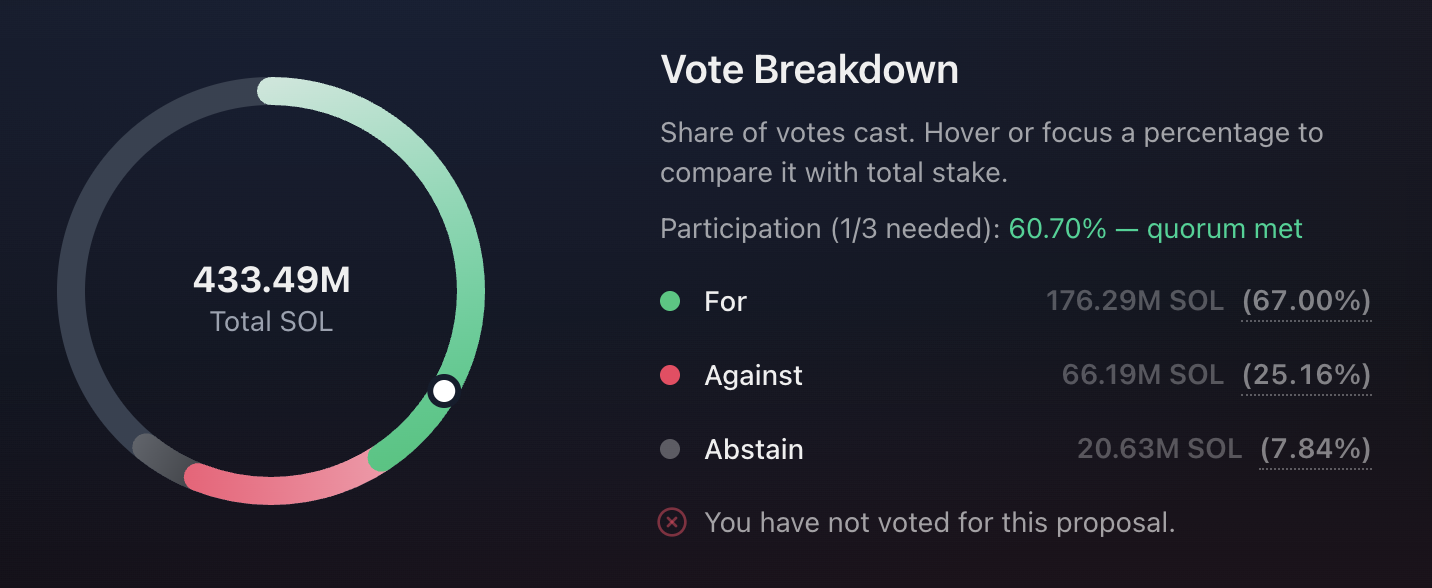
Solana validators have overwhelmingly approved a pivotal governance proposal, SGP-0002, commonly referred to as "Double Disinflation." This decision will effectively double the network’s annual disinflation rate from 15% to 30%, a move designed to significantly accelerate the pace at which Solana’s annual inflation rate approaches its long-term target of 1.5%. The finalized voting results indicate strong support for the measure, with 67% of eligible staked tokens voting in favor, while 25.16% opposed and 7.84% abstained. Overall participation in this crucial governance event reached 60.7% of the network’s eligible stake, signaling a robust engagement from the validator community.
This strategic adjustment to Solana’s monetary policy means the network is projected to reach its predetermined 1.5% terminal inflation rate in approximately 2.8 years. This represents a substantial acceleration compared to the previous schedule, which estimated the transition would take around 5.7 years. The impact of this expedited disinflation will be a reduction in future SOL issuance, with an estimated 18.9 million fewer SOL tokens expected to be minted over the next six years. This reduction in supply is anticipated to mitigate dilution for existing SOL holders, potentially bolstering the token’s value proposition. However, it also presents a trade-off, as it will lead to lower staking rewards for both validators and delegators, a factor that influenced some of the dissenting votes.
The approval of SGP-0002 marks a significant milestone as it is part of Solana’s inaugural binding governance process. This process saw the ratification of a proposed Solana Constitution, aiming to formalize the network’s decentralized governance framework. Alongside SGP-0002, the governance mechanism also addressed and rejected a separate proposal concerning resource and inclusion fees, underscoring the community’s careful consideration of various network parameters.
Deep Dive into the Governance Vote and Key Stakeholder Positions
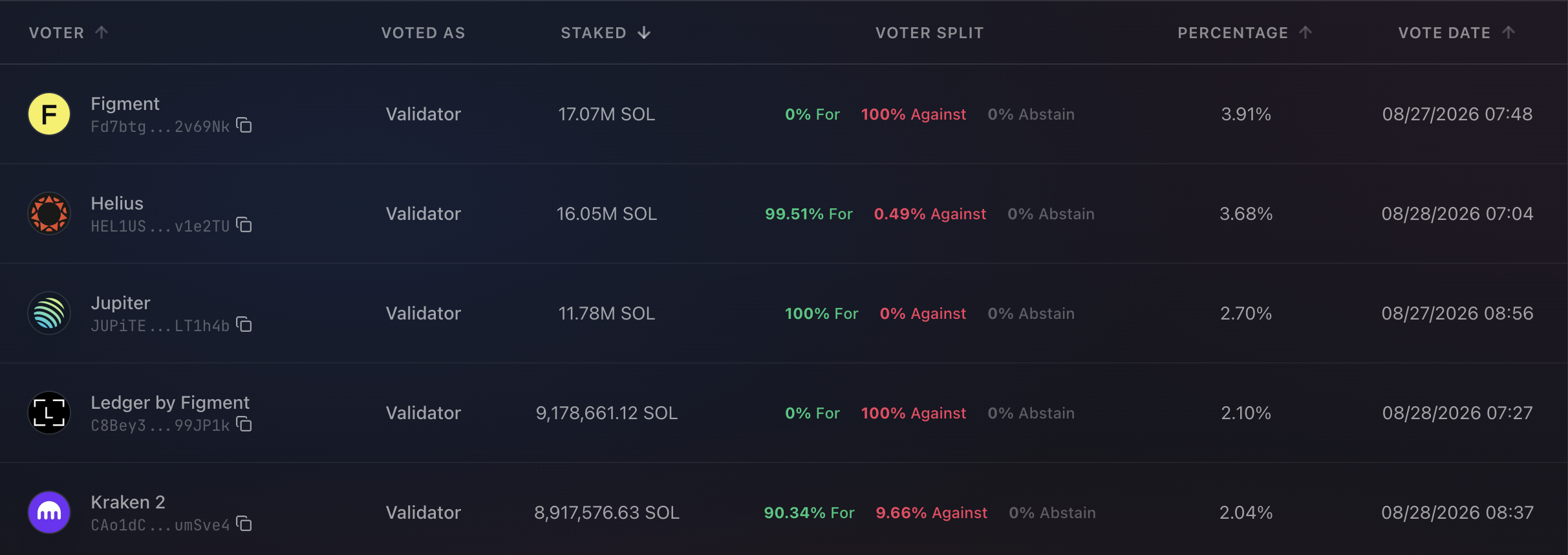
The SGP-0002 vote was characterized by diverse opinions among major network participants. Notably, some of the largest validators expressed conflicting views, highlighting the complexity of consensus-building in a decentralized ecosystem. Figment, a prominent staking provider and the largest voter recorded in the finalized governance data with 17.1 million SOL staked, cast its entire stake against the proposal. This opposition suggests a concern regarding the accelerated reduction in staking rewards or other potential implications not fully detailed in the proposal.
In contrast, other significant entities such as Helius and Jupiter, which are key infrastructure providers and decentralized exchange aggregators on Solana respectively, overwhelmingly supported the Double Disinflation initiative. Their backing indicates a belief that the long-term benefits of reduced inflation and a more streamlined path to a stable supply outweigh the short-term decrease in staking yields.
The dynamics of the vote also revealed the fluidity of stakeholder positions. Kraken, a well-established US-based cryptocurrency exchange, experienced a notable shift in its voting stance. Initially, Kraken voted against SGP-0002, a decision that, at one point, temporarily pushed the support for the proposal below the required threshold. However, by the conclusion of the voting period, Kraken’s position had reversed, with over 90% of its approximately 8.9 million SOL voting stake ultimately endorsing the proposal. This change of heart, as reported by Solana Compass, suggests that further deliberation, or perhaps the influence of other approved governance measures, may have played a role in their final decision.
The governance portal for Solana showcased the detailed breakdown of votes, illustrating the distributed nature of decision-making within the network. The image accompanying the report, sourced from Solana Governance, visually represents the distribution of votes, confirming the 67% approval rate and highlighting the significant participation from the validator community.
Context and Implications of Accelerated Disinflation
Understanding the significance of SGP-0002 requires a look at Solana’s economic model. Solana, like many proof-of-stake (PoS) blockchains, utilizes inflation as a mechanism to incentivize validators who secure the network and to reward token holders who stake their SOL. However, a perpetually high inflation rate can devalue the native token over time, a concern that governance mechanisms aim to address. Solana’s initial design incorporated a schedule for gradual reduction of this inflation, aiming for a stable, low-inflation environment in the long term.
The "Double Disinflation" proposal fundamentally alters the pace of this reduction. By increasing the disinflationary rate, the network aims to achieve its long-term monetary stability goals much faster. This has several key implications:
- Reduced Supply Pressure: A faster reduction in the rate of new SOL issuance directly translates to less new supply entering the market. Over time, this can create a more favorable supply-demand dynamic, potentially supporting SOL’s price appreciation. For holders, this means their existing stake is subject to less dilution from new token minting.
- Accelerated Path to Scarcity: While 1.5% inflation is still an increase in supply, reaching this target sooner means the network will move towards a state of near-fixed supply more rapidly. This can be a key factor for investors looking for assets with predictable and diminishing issuance.
- Impact on Staking Rewards: The primary trade-off is the impact on staking rewards. With less new SOL being minted, the pool of rewards available for distribution among validators and delegators shrinks proportionally. This could lead to lower annual percentage yields (APYs) for stakers, potentially requiring validators to seek alternative revenue streams or increasing the efficiency of their operations to remain profitable. This is likely the core reason behind opposition from large staking providers like Figment.
- Signaling Network Maturity: The successful passage of such a significant economic policy through a formal governance process signals a maturing network. It demonstrates the community’s ability to collectively make decisions that shape the long-term economic future of the blockchain.
Broader Market Context: Solana ETFs and Investor Interest
The governance vote unfolds against a backdrop of increasing institutional and retail interest in Solana, particularly evident in the performance of US-listed Solana Exchange Traded Funds (ETFs). Bitwise’s Solana ETF has recently achieved a significant milestone, surpassing $1 billion in assets under management. This makes it the first Solana ETF to reach this valuation, indicating strong investor demand for regulated exposure to the cryptocurrency.
According to Eric Balchunas, a Senior ETF Analyst at Bloomberg, US Solana ETFs have collectively attracted approximately $1.7 billion in net inflows since their inception. The sustained inflow, with minimal significant outflows, suggests a robust and consistent investor conviction in Solana’s long-term potential, despite periods of weaker performance in the underlying SOL asset earlier in the year.
This growing interest in Solana ETFs, coupled with the network’s ongoing development and governance activities, paints a picture of a blockchain ecosystem actively evolving and attracting significant capital. The successful implementation of SGP-0002 is a crucial step in solidifying Solana’s economic framework, potentially enhancing its appeal to a wider range of investors seeking a deflationary or low-inflation digital asset.
The Significance of Solana’s First Binding Governance
The transition to a binding governance model represents a critical step in Solana’s journey towards decentralization. Previously, Solana’s development and parameter adjustments were primarily driven by the Solana Foundation and core development teams. The introduction of a formal governance framework, allowing token holders to vote on proposals that directly impact the network’s protocol, is a testament to the project’s commitment to a more community-driven future.
The "Solana Constitution" approved alongside SGP-0002 provides a foundational document outlining the principles and processes for future governance decisions. This establishes a more predictable and transparent environment for stakeholders, fostering greater confidence in the network’s long-term stability and direction. The rejection of the resource and inclusion fees proposal also demonstrates the community’s capacity to critically evaluate and reject measures that may not align with their collective interests, even if proposed by other participants.
Future Outlook and Potential Challenges
The successful passage of SGP-0002 sets a new trajectory for Solana’s tokenomics. The accelerated disinflation will undoubtedly be a key talking point for the community and investors. While the reduction in supply is generally viewed as a positive for token value, the decrease in staking rewards could pose a challenge for validator economics. This may necessitate innovation in validator operations and potentially lead to consolidation within the staking provider landscape, favoring more efficient and diversified operations.
Furthermore, the Solana network has historically faced scrutiny regarding its performance and network stability. While recent transaction volume has reached record highs, the long-term scalability and resilience of the network remain paramount. The governance framework, now empowered with binding decisions, will be crucial in navigating future challenges and ensuring that Solana continues to evolve as a robust and competitive blockchain platform. The interplay between tokenomics, network infrastructure, and community governance will be critical in shaping Solana’s future success.