
 George Chandra Eka
The recent reintroduction of the much-anticipated, and long-delayed, Tesla Roadster on October 15 presented a vehicle not only boasting a futuristic, Cybertruck-esque aesthetic and a blistering 0-60 mph acceleration time of under a second but also a revolutionary, albeit unconventional, "flying" capability. This isn’t flight in the traditional sense, à la Back to the Future Part II, but rather a sophisticated suite of controlled maneuvers involving precise jumps, flips, and even moments of sustained airborne suspension. While undeniably a striking technological showcase, this concept of utilizing thrusters for dynamic vehicle control is not entirely novel, drawing surprising parallels with experimental missile defense systems developed by aerospace giants like Lockheed Martin decades prior, specifically their Multiple Kill Vehicle (MKV) program.
The Tesla Roadster’s Unconventional Aerial Maneuvers
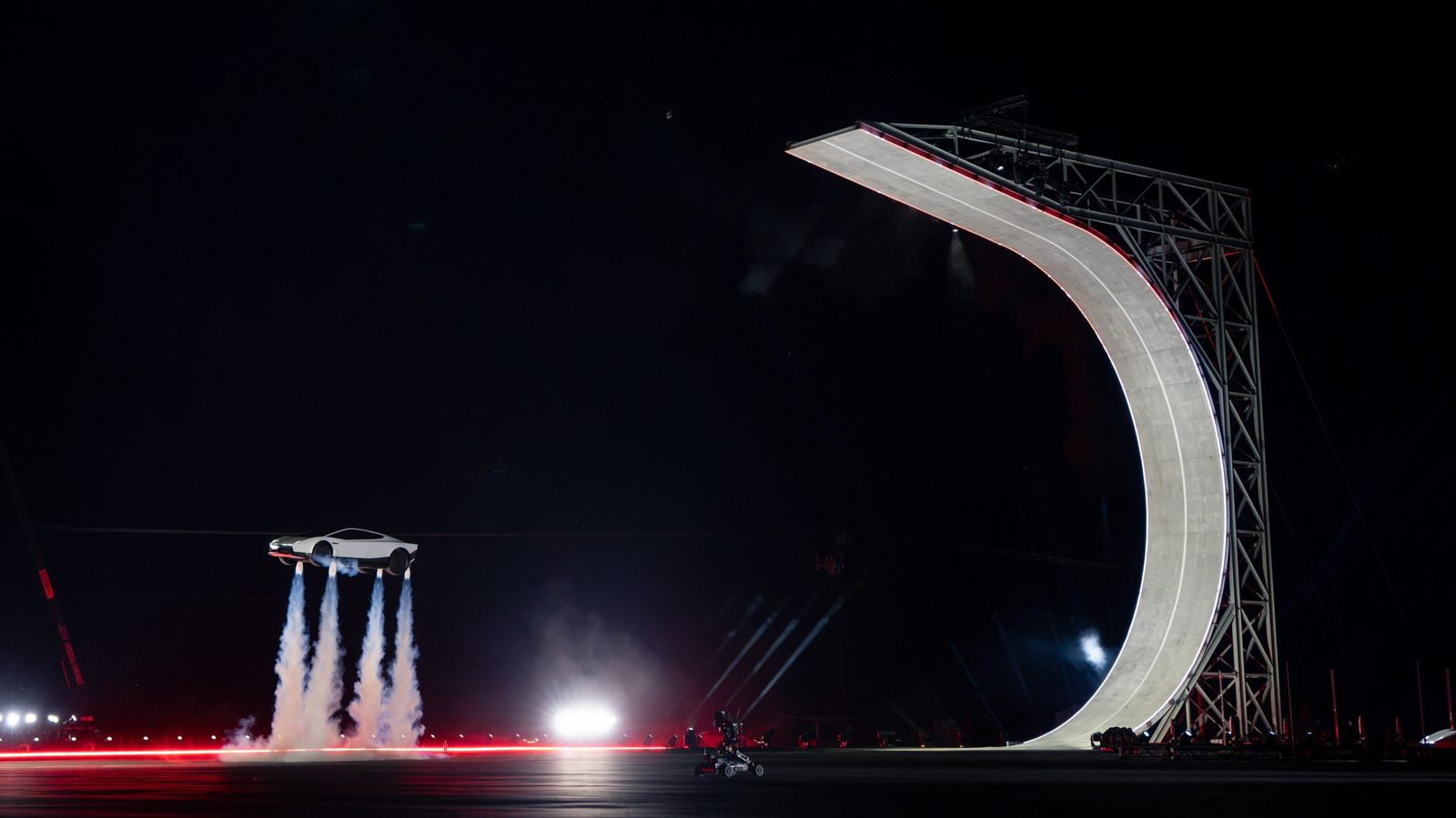
Tesla’s audacious claim for the Roadster’s "flying" ability centers around an advanced reaction control system. This system allows the electric supercar to perform maneuvers described as "kickflips," controlled jumps, and potentially even short bursts of hovering. The core of this capability lies in two high-pressure composite air tanks, strategically integrated into the vehicle’s structure, and a network of ten small, high-output nozzles distributed around the car’s exterior. These nozzles are designed to rapidly release bursts of compressed air, generating precise thrust vectors that can manipulate the car’s attitude and position. For instance, firing nozzles downwards can create lift for a jump, while differential firing can induce rotations for flips or stabilize the vehicle mid-air. Tesla asserts that these tanks can be autonomously refilled, presumably via an onboard compressor powered by the car’s electric powertrain, offering a degree of self-sufficiency.
This advanced thruster setup is not standard across all Roadster variants. It is exclusively offered on the high-performance "Rocket" trim, which is positioned as the pinnacle of the Roadster’s engineering prowess. A slightly less comprehensive "Thruster" trim includes only rear-mounted thrusters, primarily for enhanced acceleration and stability rather than full aerial acrobatics. The base "Performance" trim, while still exceptionally fast, foregoes the thruster system entirely. Crucially, Tesla has been forthright in stating that the full thruster setup is "not approved for public road use." This disclaimer highlights significant regulatory and safety hurdles that would need to be addressed before such technology could be integrated into mainstream consumer vehicles, encompassing concerns over pedestrian safety, potential misuse, and the sheer power of the forces involved.
Engineering the Roadster’s Thrusters: A Deeper Dive
The propulsion system employed by the Tesla Roadster is described as a "cold-gas thruster" system. Unlike traditional rocket engines or jet engines that generate thrust by igniting and expelling hot combustion gases, cold-gas thrusters operate by simply releasing a stored, inert gas—in this case, compressed air—through a nozzle. The principle is based on Newton’s third law of motion: for every action, there is an equal and opposite reaction. When compressed air is expelled rapidly in one direction, it generates a force (thrust) in the opposite direction, propelling the vehicle.
The advantages of cold-gas thrusters for an automotive application like the Roadster are manifold. They are inherently simpler and safer than hot-gas systems, as there is no combustion involved, eliminating the risk of fire or explosion associated with flammable propellants. This also means no extreme temperatures or toxic exhaust gases, making them more environmentally benign and suitable for proximity to human occupants and public spaces (though still with significant noise and air blast considerations). The response time of cold-gas thrusters is also exceptionally fast, allowing for very precise and rapid adjustments to the vehicle’s attitude and trajectory, which is crucial for controlled flips and jumps. The challenge, however, lies in the limited thrust duration and energy density compared to chemical propellants. Compressed air tanks, even at high pressures, have a finite capacity, meaning the "flying" capabilities would be intermittent and short-lived, likely reserved for specific performance demonstrations or emergency maneuvers rather than sustained flight.
A Precedent in Precision: Lockheed Martin’s Multiple Kill Vehicle (MKV)
While Tesla introduces thrusters to the realm of consumer supercars, the underlying principles of reaction control systems have been a cornerstone of advanced aerospace and defense technologies for decades. One striking historical parallel is Lockheed Martin’s Multiple Kill Vehicle (MKV) program. Initiated in the early 2000s, the MKV represented a paradigm shift in ballistic missile defense strategy. Instead of intercepting a single incoming ballistic missile with a single interceptor, the MKV concept aimed to destroy multiple threats—including sophisticated decoys—with a single launch. This required an unprecedented level of precision and maneuverability in the vacuum of space.
The genesis of modern ballistic missile defense can be traced back to the Cold War, notably President Reagan’s Strategic Defense Initiative (SDI) in the 1980s, famously dubbed "Star Wars." SDI envisioned a layered defense system that could intercept intercontinental ballistic missiles (ICBMs) in various phases of their flight. While SDI never fully materialized, it laid the groundwork for subsequent programs, including the National Missile Defense (NMD) system and eventually the Missile Defense Agency’s (MDA) efforts to develop more advanced interceptors. The MKV project emerged from this lineage, seeking to enhance the effectiveness and cost-efficiency of missile defense by increasing the "kill ratio" per interceptor.
The Genesis and Technology of the MKV Project
Lockheed Martin’s involvement with the MKV program formally began in 2004 when the company secured a substantial $760 million contract from the U.S. Missile Defense Agency. The objective was to develop the "first system capable of destroying multiple ballistic missile threats and decoys with a single launch." This ambitious goal necessitated a highly agile and intelligent interceptor. The MKV system was designed to carry several smaller, independent kill vehicles, each equipped with its own sensors and propulsion system. Once deployed from a larger booster rocket, these individual kill vehicles would autonomously navigate towards their assigned targets, distinguishing between warheads and decoys, and then collide with them at extremely high velocities to achieve a "hit-to-kill" interception.
The maneuverability of these individual kill vehicles, crucial for both target acquisition and precise impact, was achieved through a sophisticated thruster system. Unlike Tesla’s cold-gas approach, Lockheed Martin’s MKV utilized chemical propulsion, often referred to as "hot-fire" thrusters, meaning they burned propellants to generate thrust. A 2008 Lockheed Martin press release detailed "hot-fire tests" for the MKV’s propulsion component, confirming the use of combustion. These hot-gas thrusters provided significantly greater thrust and specific impulse (efficiency) compared to cold-gas systems, essential for rapid course corrections and high-velocity maneuvering in the vacuum of space where even small trajectory errors could lead to a miss. The ability to quickly change direction and orientation on the fly, akin to the Roadster’s dynamic control, was fundamental to the MKV’s operational concept, allowing it to evade countermeasures and precisely track its multiple targets.
The Evolution and Conclusion of MKV
The development of the MKV program involved intensive research, simulations, and testing phases. Lockheed Martin, alongside another defense contractor, Raytheon, pursued separate development tracks for the MKV concept. Both companies contributed to advancing the state-of-the-art in miniature kill vehicle technology, precision guidance, and autonomous target discrimination. However, despite promising technological advancements, the original MKV project faced significant challenges. The complexity of designing a system that could reliably differentiate between multiple warheads and an array of sophisticated decoys in the hostile environment of space proved to be immense.
Ultimately, the MKV project was retired in 2009 as part of broader military budget cuts and a re-evaluation of missile defense priorities. The decision, reported by The New York Times, reflected a shift in defense spending and a recognition of the substantial technical and financial resources required to bring such a complex system to full operational capability. While the specific MKV program was discontinued, the research and technological advancements made during its tenure were not lost. Many of the principles, components, and lessons learned from the MKV effort likely informed subsequent missile defense programs and technologies, contributing to the ongoing evolution of interceptor capabilities.
Parallel Principles, Divergent Paths
The comparison between the Tesla Roadster’s thrusters and Lockheed Martin’s MKV, despite their vastly different intended applications—transporting the ultra-rich versus destroying intercontinental ballistic missiles—reveals a fascinating convergence of fundamental engineering principles. Both systems rely on reaction control thrusters to achieve precise attitude and positional adjustments. The core physics, based on the conservation of momentum, remains identical whether the object is a luxury electric car performing a kickflip or a military interceptor fine-tuning its trajectory to destroy an incoming warhead.
However, the divergence in their practical implementation and operational environments is stark. The Roadster operates within Earth’s atmosphere, albeit briefly, where aerodynamic forces and gravity play dominant roles. Its thrusters are designed for short bursts of powerful, ground-effect-enhanced maneuvers. The MKV, conversely, was designed to operate in the vacuum of space, where there is no air resistance, and gravity’s influence is predictable over vast distances. Its thrusters needed to provide precise, sustained impulses for course corrections and target acquisition against objects traveling at hypersonic speeds.
Applications and Constraints: From Supercar to Strategic Defense
The choice of propulsion system—cold gas for Tesla versus hot gas for Lockheed Martin—underscores these differing requirements. Tesla’s cold-gas thrusters, using compressed air, prioritize safety, simplicity, and rapid, clean bursts of thrust suitable for close proximity to humans and within an atmospheric envelope. While powerful enough for brief, dynamic maneuvers, they offer limited duration and overall energy. This makes them ideal for an "overboost" or "jump" function in a car, where sustained flight is not the goal. The "not approved for public road use" caveat further reinforces the challenges of integrating such powerful, potentially disruptive technology into existing regulatory frameworks designed for conventional vehicles.
Lockheed Martin’s hot-fire thrusters, burning chemical propellants, provided the necessary sustained thrust and high specific impulse for prolonged maneuvering in space. These systems are significantly more complex, involve higher temperatures and pressures, and carry inherent risks associated with flammable propellants. However, for a military application where mission success outweighs these concerns, and where operation occurs in a controlled, remote environment, their performance advantages are critical. The MKV’s mission demanded absolute precision and reliability in neutralizing threats to national security, a context far removed from automotive luxury.
Implications for Future Technology
The technological overlap between the Tesla Roadster and the MKV illustrates a broader trend: advanced control systems, once exclusive to military or space exploration, are increasingly finding their way into consumer products. This democratization of technology hints at future possibilities. While a truly "flying car" in the traditional sense remains a complex challenge involving significant regulatory, safety, and infrastructure hurdles, the Roadster’s thruster system represents an intermediate step towards greater vehicle control and dynamic capabilities.
Such reaction control systems could evolve to offer enhanced safety features, such as advanced stability control in extreme conditions, or even active crash avoidance by subtly shifting the vehicle’s position mid-air. The regulatory landscape, however, will be a critical determinant of how quickly and widely these technologies are adopted. Governments and automotive bodies worldwide are grappling with the implications of autonomous driving, let alone vehicles capable of performing aerial maneuvers. Comprehensive frameworks for testing, certification, and public safety would need to be established, likely involving years of research and policy development.
Beyond the automotive sector, the ongoing refinement of compact, powerful, and efficient thruster systems, whether cold-gas or miniature hot-gas, has implications for drone technology, personal mobility devices, and even next-generation robotics. The ability to precisely control the attitude and position of objects in three dimensions is a fundamental engineering challenge, and solutions developed for applications as diverse as missile defense and luxury electric vehicles invariably contribute to a broader technological toolkit.
In conclusion, the Tesla Roadster’s "flying" capability, while a marvel of modern automotive engineering, stands on the shoulders of decades of aerospace and defense innovation. The surprising parallel with Lockheed Martin’s Multiple Kill Vehicle highlights how similar underlying scientific principles can be applied to vastly different, yet equally demanding, technological challenges. From preserving human lives by intercepting ballistic missiles to thrilling occupants with unprecedented automotive performance, the evolution of reaction control systems continues to push the boundaries of what is possible, bridging the gap between futuristic concepts and tangible realities. The journey from strategic defense to a supercar’s party trick underscores the universal applicability of engineering ingenuity.






