Vera Intan Clara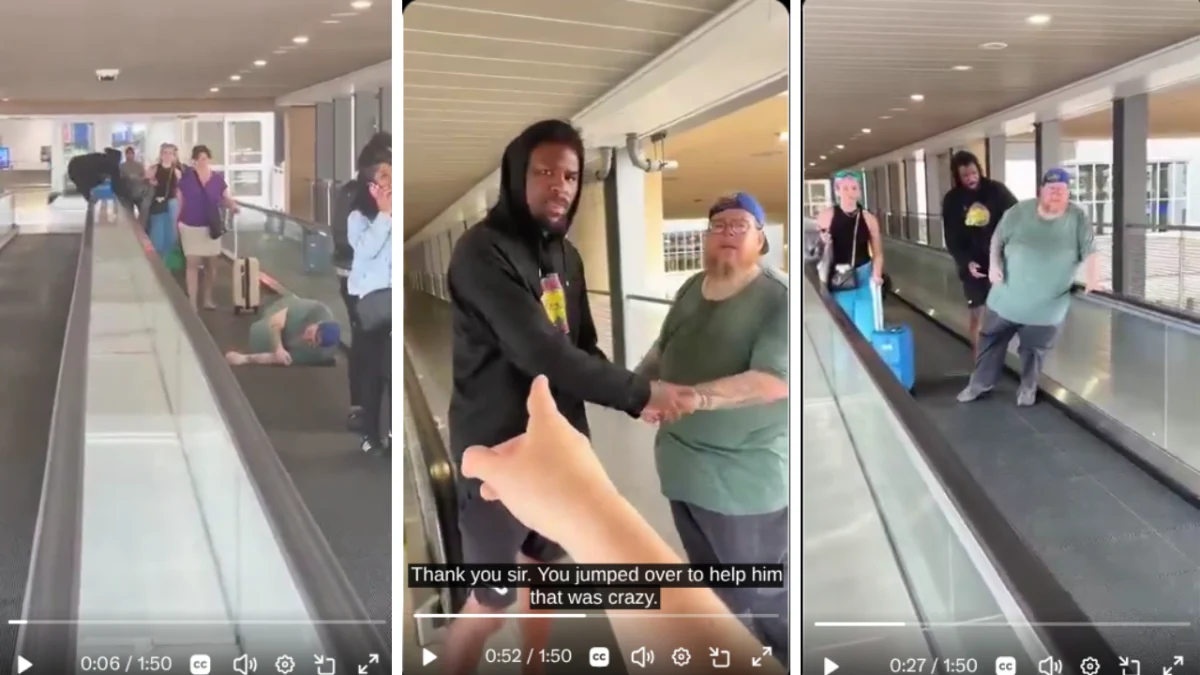
A video depicting a spontaneous act of altruism at a bustling airport has captivated millions online, sparking widespread discussion about human empathy, the bystander effect, and individual responsibility in public spaces. The footage, shared yesterday by the X account @omoelerinjare1, quickly amassed close to 600,000 views, showcasing a remarkable moment where one traveler rushed to the aid of a fallen stranger while others appeared to continue their journeys seemingly unconcerned. The incident, which unfolded on an airport travelator, has been hailed by many as a powerful reminder of humanity’s capacity for kindness, even as it simultaneously ignited a contentious debate about societal indifference. The man who collapsed later appeared to be unwell, using an inhaler, suggesting a possible asthmatic episode or other medical distress exacerbated by the stresses of travel. While the authenticity of the video has been questioned by some commenters, who pondered whether the incident might have been staged, the visual evidence itself offers no definitive confirmation or refutation of such claims, leaving viewers to interpret the scene as it unfolded.
The Unfolding Incident: A Detailed Chronology of Events
The viral video commences with a woman positioned at the end of a moving walkway, her phone recording the scene. A few seconds into the recording, a heavy-set man, identifiable by his green shirt and blue cap, abruptly lost his footing and fell to the ground. He landed on his side, seemingly incapacitated and unable to immediately regain his composure or stand up. The setting was a busy airport, characterized by the constant flow of passengers and the mechanical hum of travelators moving in opposite directions.
At the precise moment of the fall, on the travelator conveying passengers in the opposite direction, a tall man dressed in black shorts and a black hooded sweatshirt witnessed the dramatic collapse. The video distinctly shows numerous travelers both ahead of and behind the fallen man continuing their progression along the walkway. Disturbingly, none of these individuals appeared to halt their movement or offer immediate assistance. Several women walking ahead of the fallen man were observed fixated on their mobile phones, their gazes seemingly oblivious to the unfolding emergency just meters away, and did not turn back.
What transpired next was a pivotal moment that would resonate with viewers worldwide. Despite the physical barrier of the opposing travelator and the implicit social barrier of non-involvement, the man in black shorts exhibited an extraordinary display of initiative. He swiftly hopped over the side barrier separating the two travelators, bridging the gap to where the distressed man lay. With a determined sprint, the compassionate stranger ran directly to the fallen individual. Concurrently, one of the women who had been walking behind the man on the floor, pushing her carry-on luggage, proceeded to walk directly past him. Her action, or rather inaction, became a focal point of online criticism, as she neither stopped to inquire about his well-being nor offered even a fleeting glance of concern in his direction. This stark contrast between the helper’s immediate intervention and the bystanders’ apparent indifference underscored the central theme of the video.
Upon reaching the fallen traveler, the compassionate stranger immediately set about offering assistance. By this time, the first woman who had walked past had continued her journey further down the walkway. The helper, demonstrating considerable strength and care, assisted the struggling man back to his feet. Simultaneously, another woman approached from behind, initially passing the duo but then stopping briefly to assess the situation. After a short interaction, presumably a quick check-in, she too continued her journey down the walkway, leaving the helper and the now-standing man to continue their interaction.
Once upright, the man who had fallen appeared unsteady as he carefully stepped off the moving walkway. The woman who had been recording the incident from the outset, her initial passive observation giving way to active concern, called out, "Sir, sir, are you okay?" In a short, breathless response, the man affirmed, "Yeah," before immediately reaching for and using an inhaler, confirming the earlier visual cues of respiratory distress. The man who had rushed to his aid reiterated the question, asking if he was alright. The rescued traveler then explained that he was experiencing a stressful time following a long journey home, expressing profound gratitude to the compassionate stranger for his timely intervention. When the recording woman remarked on the helper’s extraordinary action of jumping over the travelator, he humbly replied, "Yeah, I mean, no one else. . . You saw everybody just walking. . . Somebody had to do something." This simple statement encapsulated the profound sense of responsibility and humanity that propelled his actions.
The Bystander Effect and Diffusion of Responsibility
The incident provided a stark visual illustration of the "bystander effect," a social psychological phenomenon where individuals are less likely to offer help to a victim when other people are present. This effect is often attributed to the "diffusion of responsibility," where each bystander feels less compelled to act because they assume others will. Research stemming from the tragic 1964 murder of Kitty Genovese, where numerous witnesses reportedly failed to intervene, has explored the complex factors at play. Studies suggest that factors such as the number of bystanders, ambiguity of the situation, and perceived competence to help can all influence an individual’s likelihood of offering assistance. In a busy airport environment, where individuals are often focused on their own travel plans, laden with luggage, and operating under time constraints, the conditions for the bystander effect can be particularly pronounced. The initial inaction of multiple travelers in the video aligns with this psychological principle, as each person might have implicitly assumed someone else would step forward, or that their own intervention would be redundant or ineffective. The helper, in contrast, appears to have overcome this psychological barrier, demonstrating an active sense of personal responsibility that transcended the prevailing social inertia.
Social Media as an Amplifier: Public Discourse on X
The rapid dissemination of the video across X (formerly Twitter) transformed a private airport incident into a global public debate. With hundreds of thousands of views and countless comments, the platform became an arena for expressing admiration, outrage, and nuanced perspectives. Many X users lauded the man who intervened, celebrating his compassion as a beacon of hope. Comments like, "This is what matters. Humanity. No race, no color, no labels. Just one human being helping another," encapsulated the widespread appreciation for his selfless act. Such sentiments often reflect a yearning for greater human connection and altruism in an increasingly disconnected world.
However, a significant portion of the online discourse veered into sharp criticism of the other travelers who walked past the fallen man. Users expressed dismay and anger, with one commenter writing, "What is wrong with people. How do you just walk by someone in need. Let’s be better." Another added, "I despise the kind of people that just walk by and sadly it’s the majority these days." This segment of the reaction highlights public frustration with perceived societal decline in empathy and community spirit.
Intriguingly, the debate also encompassed a practical consideration regarding the capacity of bystanders to help. Some users defended the inaction of certain individuals, particularly the women, by pointing to the fallen man’s physical size. One commenter controversially stated, "What do you mean everyone else walked right by you in the video? Two little women walked by you, what do you want them to do with your fat a**? They ain’t lifting you up." While the physical reality of lifting a heavy-set individual might indeed pose a challenge for some, this perspective was countered by others who argued that the fundamental issue was not necessarily the ability to physically lift the man, but rather the complete absence of concern, a simple pause, or an inquiry into his well-being. The lack of even a glance or a verbal offer of assistance was what truly perturbed many viewers, suggesting that compassion extends beyond physical intervention to include basic human acknowledgment and concern. This nuanced debate underscores the complexities of judging bystander behavior, balancing practical limitations with moral imperatives.
Airport Safety Protocols and the Role of Citizen Intervention
While airports are equipped with emergency protocols and medical personnel, the immediate response to incidents like a fall or medical distress often relies on the initial awareness and intervention of those closest to the scene. Major airports typically have rapid response teams, paramedics, and first aid stations, accessible via emergency call buttons or by informing airport staff. However, in a sprawling and dynamic environment like an airport terminal, it can take precious minutes for official help to arrive. In such critical moments, the actions of immediate bystanders can be life-saving. For instance, in cases of cardiac arrest, immediate CPR by a bystander significantly increases survival rates. While the man in the video appeared to suffer from an asthma attack, quick assistance to sit him up or provide space for an inhaler could be crucial.
The incident raises questions about the balance between relying on established safety infrastructure and fostering a culture of active citizen responsibility. While individuals are generally advised not to intervene if they lack medical training or fear for their own safety, a simple act of stopping, assessing the situation, and calling for official help (e.g., notifying airport staff or using an emergency phone) can make a significant difference. The helper in the video went beyond these basic steps, demonstrating a proactive engagement that, while commendable, also highlights the potential gaps between official response times and immediate need. This event serves as a powerful reminder that while systems are in place, individual human connection remains an invaluable first line of support.
Broader Implications: Empathy in Public Spaces
The viral video transcends a mere recounting of an airport incident; it serves as a potent commentary on contemporary societal values, particularly the presence or absence of empathy in public spaces. In an increasingly urbanized and digitally connected world, individuals often navigate public environments with a degree of anonymity and detachment. This phenomenon, sometimes referred to as "urban anomie," can lead to a reduction in spontaneous acts of communal support. The video forces viewers to confront uncomfortable questions about their own potential reactions in similar circumstances.
The act of the helper, who disregarded personal inconvenience and the unspoken social contract of non-interference, stands in stark contrast to the perceived indifference of others. This contrast amplifies the power of individual agency and the potential for a single person’s actions to challenge prevailing norms. The incident can be seen as a microcosm of broader societal challenges: how do we cultivate greater empathy and responsibility in public life? How do we encourage individuals to look up from their screens and engage with the immediate human needs around them? The positive outpouring of support for the helper suggests a collective longing for a more connected and compassionate society, even if the observed reality often falls short.
Verification Challenges in the Digital Age
A crucial aspect of the discussion surrounding the video has been the persistent question of its authenticity. Numerous commenters on X questioned whether the incident was staged, speculating that it might have been orchestrated to create a viral moment or to promote a particular message. The original article noted that The Daily Dot was unable to independently verify the circumstances surrounding the video, including whether the incident was scripted.
In the era of deepfakes and meticulously planned viral content, the skepticism of online audiences is understandable. Videos designed to elicit strong emotional responses, particularly those featuring acts of kindness or cruelty, are sometimes fabricated for various reasons, including gaining views, promoting brands, or even manipulating public opinion. Without independent verification from the airport authorities, the individuals involved, or reliable third-party sources, the definitive truth behind the video’s origin remains elusive. This challenge underscores a critical aspect of consuming media in the digital age: the need for media literacy and a healthy degree of skepticism, even when confronted with seemingly heartwarming or shocking content. While the act itself resonates powerfully, the underlying circumstances often remain shrouded in the ambiguities inherent to unverified viral phenomena.
Conclusion
The viral airport video, whether entirely spontaneous or partially orchestrated, has undeniably struck a chord with millions globally. It presents a vivid tableau of contrasting human behaviors: profound compassion against apparent indifference. The swift, selfless action of one man to aid a stranger, who appeared to be in medical distress and overwhelmed by the journey, stands as a powerful testament to the enduring capacity for human kindness. Simultaneously, the observed inaction of others has fueled a critical examination of the bystander effect and the pervasive challenges of fostering empathy in modern public spaces. As the footage continues to circulate and provoke discussion, it serves as a compelling reminder that even amidst the hurried anonymity of travel, moments of genuine human connection can emerge, challenging us all to consider our role in creating a more compassionate world. The debate it has ignited is a crucial one, prompting reflection on individual responsibility and the collective desire for a society where no one falls unnoticed.