Lina Irawan
The rapid proliferation of generative artificial intelligence has shifted the focus of enterprise development from basic model training to the sophisticated management of the data environments in which these models operate. As organizations move beyond simple chatbots toward autonomous "agentic" systems, the concepts of context architecture, infrastructure, and engineering have emerged as the primary pillars of reliable AI deployment. Experts from Stack Overflow, including technical lead Doug Whitley and product manager Ash Zade, recently provided a comprehensive breakdown of these disciplines, highlighting how the "context" surrounding an AI model determines its utility, safety, and cost-effectiveness in a professional setting.
The Architectural Framework of Modern AI
At its core, context architecture in AI is analogous to physical architecture in the built environment; it is the philosophical and structural design that determines how an AI system interacts with its surroundings. In the context of large language models (LLMs), architecture addresses the "why" and the "how" of information flow. It is the blueprint that ensures an AI agent focuses on relevant data while ignoring the noise of irrelevant logs or extraneous datasets.
Whitley notes that while it is easy to become mired in the minute technical details of AI, the architecture provides the necessary focus. For instance, an AI tasked with solving a specific software bug does not need to ingest every log ever generated by a company; it requires a curated "context" of specific logs related to the incident. This architectural decision—limiting the scope of information—prevents the model from becoming overwhelmed and reduces the likelihood of hallucinations, which are often triggered when a model attempts to find patterns in unrelated data.
Infrastructure vs. Engineering: The Mechanics of Context
To understand the full lifecycle of an AI system, it is necessary to distinguish between context infrastructure and context engineering. These terms are often used interchangeably in casual discourse, but they represent distinct layers of the technology stack.
Context Infrastructure
Infrastructure refers to the delivery mechanisms and storage solutions that serve context to the AI. This includes context libraries, vector databases, and RAG-specific (Retrieval-Augmented Generation) frameworks. If architecture is the design of a car, infrastructure represents the supply chain and the quality of the parts used to build it. It is the "mode" of storing and surfacing data so that an AI agent can access it in real-time to solve a problem.
Context Engineering
Engineering is the practical application of the architectural design. It involves the actual coding and implementation, using languages such as Python, .NET, or Rust to build the systems defined by the architecture. While architecture asks why a certain goal should be achieved, engineering focuses on the most effective algorithms and languages to reach that goal. For example, deciding to use a specific RAG pattern is an architectural choice, but writing the code to implement that pattern is an engineering task.
The Role of RAG and Model Context Protocol (MCP)
Two of the most significant developments in the field are Retrieval-Augmented Generation (RAG) and the Model Context Protocol (MCP). According to Whitley, MCP is purely an architectural protocol. It defines a set of requirements and standards for how models should interact with data, but it remains language-agnostic. Organizations can implement MCP in any language they choose, selecting which server features or clients to support based on their specific design goals.
RAG, conversely, sits at the intersection of architecture, infrastructure, and engineering. The infrastructure side involves the indexing and the "context store"—highly performant query setups that make data searchable. The engineering side involves the actual construction of these systems in a specific programming language. The architecture side dictates the rules and processes, such as using Markdown files to store coding agent instructions, ensuring the model follows a logical path during retrieval.
Chronology of Contextual Evolution in AI
The evolution of AI context has followed a distinct timeline, moving from simple input-output models to complex, memory-retaining agents:
- Direct Prompting (2022-2023): Users provided all necessary information within a single prompt. This was limited by the "context window" of the model, leading to lost information in long conversations.
- Basic RAG Implementation (Late 2023): Developers began connecting LLMs to external databases. This allowed models to "look up" information, but they often struggled with "drifting"—bringing back irrelevant data (e.g., finding bicycle tire data when asked about car tires).
- Agentic Memory and Guardrails (2024-Present): The current era focuses on "agentic memory," where AI agents maintain a history of their work across multiple sessions. This allows for complex, multi-day tasks, such as designing a sports car, where the agent remembers previous decisions and avoids redundant work.
Mitigating Drift through Agentic Memory and Guardrails
A significant challenge in AI deployment is "drift," where an agent loses sight of its specific task due to an overabundance of information. Ash Zade emphasizes that context architecture serves as the "guardrails" for AI agents. By controlling what data an agent has access to, developers can ensure predictable outcomes.
For example, if an agent is tasked with researching sports car tires, a well-architected system will prevent it from accessing libraries containing information on wheelbarrows or airplanes. Even if the prompt is clear, without architectural constraints, the agent might still retrieve irrelevant data. By setting limits on the data source itself, the agent’s decision-making process is simplified, leading to higher accuracy.
Furthermore, agentic memory allows these systems to handle long-term projects. In a professional environment, a task is rarely completed in a single session. Context architecture ensures that the agent saves what it has learned, what it has built, and what it has communicated, allowing it to resume work exactly where it left off, even if it is simultaneously managing dozens of other tasks.
Trust and Security: The Human-in-the-Loop Paradigm
One of the most critical aspects of context architecture is the establishment of trust. Stack Overflow’s research indicates that user trust in AI is directly tied to whether the output matches their professional expectations. For experts, this is easy to verify, but for non-experts, it poses a significant risk.
To solve this, modern architectures incorporate "trust scores" and "human-in-the-loop" mechanisms. In systems like Stack Internal, knowledge is scored as high, medium, or low quality. If an AI agent encounters "low-trust" information—data that is incomplete or potentially incorrect—it is programmed not to make a judgment call. Instead, the architecture routes the query to a subject matter expert (SME) for validation. This prevents the agent from acting on faulty data and ensures that the final output is verified by a human professional.
Security and Permissions
Privacy and security are equally paramount. When an AI agent is connected to enterprise tools like Slack, Google Drive, or SharePoint, there is a risk of data leakage. Context architecture addresses this through "Permissions" and "Scopes."
- Permissions: The agent inherits the specific access rights of the user. If a user does not have access to a private Slack channel, their AI agent will not have access either.
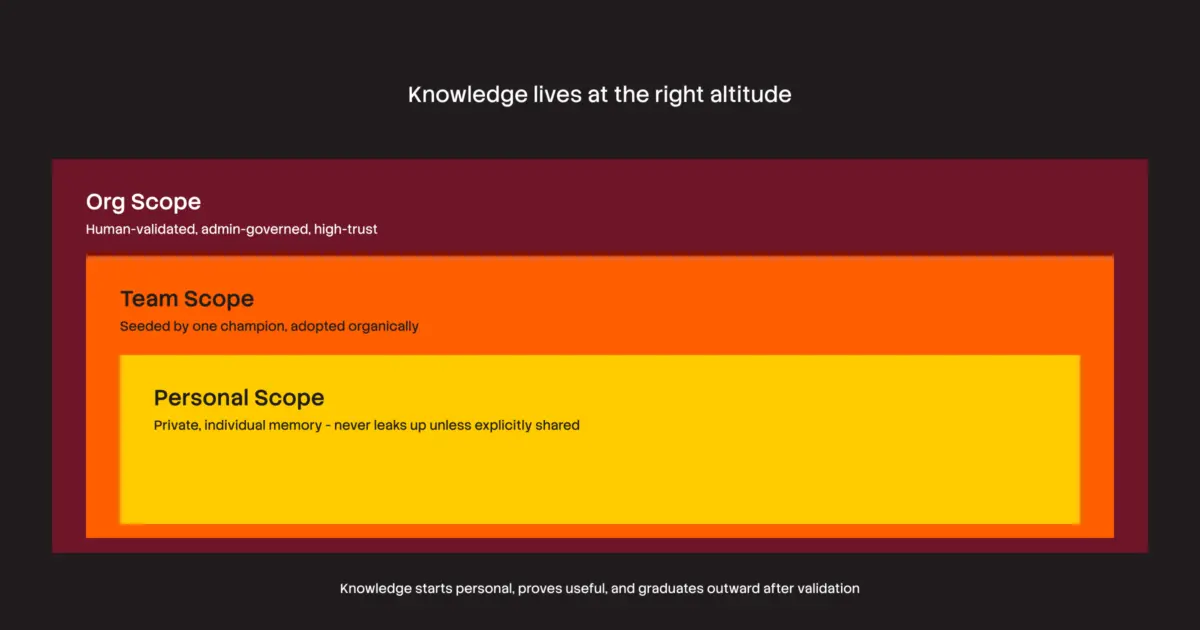
- Scopes: Even if a user has broad access, they may want to restrict their agent to a specific project area. Scopes allow users to curate a subset of their own data for the agent to use, ensuring that sensitive but irrelevant information is not incorporated into the agent’s work.
Economic and Strategic Implications: The Build vs. Buy Debate
As companies weigh whether to build their own context architecture or purchase existing solutions, several economic factors come into play. A primary consideration is token optimization. Every piece of information sent to an AI model incurs a cost in "tokens." By using sophisticated context architecture to filter out irrelevant data—moving from a whole library to a single paragraph—organizations can significantly reduce their operational costs.
Additionally, the "build" route requires solving complex philosophical and technical problems that have already been addressed by established providers. Doug Whitley points out that specialized providers have already encountered and categorized the majority of "edge cases" in context architecture. By "buying," companies benefit from the generalized knowledge and refined algorithms that have been tested across thousands of different use cases.
Future Outlook: Predictability as the New Benchmark
The ultimate goal of a refined context architecture is consistency and predictability. For years, AI has been characterized by its "black box" nature—it provides impressive results, but users are often unsure why or how it reached a specific conclusion. By implementing rigorous context architecture, infrastructure, and engineering, the industry is moving toward a future where AI agents are as reliable as traditional software.
In this new paradigm, the "perfect answer" is not just an accurate one, but one that is delivered consistently across different users and sessions. As organizations continue to integrate AI into the core of their operations, the ability to define, restrict, and manage the context of these systems will be the deciding factor in their successful digital transformation. Through the combination of protocol standards like MCP, retrieval techniques like RAG, and human-centric trust systems, the path toward truly autonomous and trustworthy AI agents is becoming increasingly clear.