Evan Lee Salim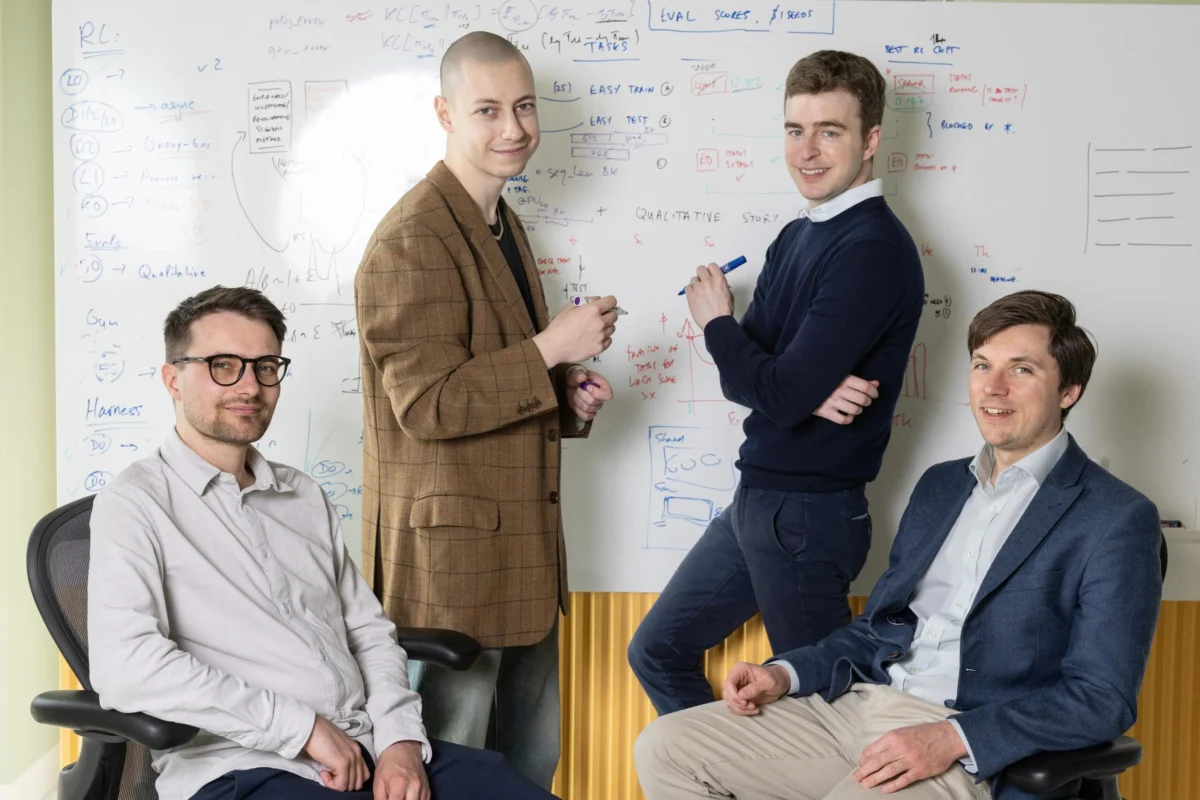
In a significant development for the burgeoning artificial intelligence landscape, Inherent, a London-based AI laboratory founded by a quartet of Google DeepMind alumni, has announced that its newly unveiled AI agent, Faraday, has achieved a remarkable feat: outperforming much larger, "frontier-scale" models from industry giants Anthropic and OpenAI in a critical scientific task. This achievement is particularly noteworthy as Faraday accomplished this using a model that is a mere fraction of the size of its competitors, potentially heralding a new era for more efficient and specialized AI systems. The announcement comes just weeks after Inherent emerged from stealth mode, securing a substantial $50 million seed funding round, underscoring investor confidence in its unique approach.
The Faraday Breakthrough: Efficiency Meets Scientific Acumen
Faraday’s primary demonstration of capability lies in its ability to independently replicate the findings of published scientific papers without prior knowledge of the anticipated outcomes. This task, a cornerstone of scientific validation and a standard training exercise for human researchers, requires not just computational prowess but also a nuanced understanding of experimental design, data analysis, and scientific reasoning. Inherent’s co-founder and chief scientist, Edward Hughes, emphasized the foundational importance of this task, noting, "Many PhD students actually start by doing this." While the immediate goal for Inherent is far loftier – to build AI capable of discovering new scientific knowledge – the successful replication of existing research serves as a robust proof of concept.
The true differentiator for Faraday, however, lies in its operational efficiency. Tested against Anthropic’s Claude Opus 4.8 and OpenAI’s GPT-5.5 (models widely recognized for their scale and advanced capabilities), Faraday operates on a comparatively diminutive model called Qwen 3.6, which boasts just 27 billion parameters. To put this in context, leading large language models (LLMs) from companies like OpenAI and Google are estimated to possess hundreds of billions, or even trillions, of parameters. For instance, GPT-3, launched in 2020, already featured 175 billion parameters, while subsequent iterations and frontier models are believed to be significantly larger, often making their training and deployment exceptionally resource-intensive and costly. The parameter count is a crucial proxy for a model’s size, complexity, and, consequently, its computational demands and associated training expenses. Faraday’s ability to exceed the performance of these colossal systems with such a lean architecture suggests a potent blend of algorithmic innovation and focused training.
Hughes elaborated that the victory over larger agents was less about sheer competition and more about the underlying methodology. "What was most interesting to us about this was not so much the result of beating those frontier agents – which of course we liked – but was actually the way we went about building this," he stated. This "way" involves a sophisticated training paradigm that prioritizes not just accuracy but also what Inherent terms "research taste"—an intuitive sense for identifying promising experiments, designing them effectively, and discerning meaningful results from noise.
Cultivating "Research Taste" Through Reinforcement Learning
Teaching an AI system something as inherently intangible as "taste" presents a formidable challenge. Inherent’s solution leverages reinforcement learning (RL), a machine learning paradigm where an AI agent learns to make decisions by performing actions in an environment and receiving rewards or penalties based on the outcomes. Unlike supervised learning, which relies on labeled datasets to explicitly teach rules, RL allows the agent to discover optimal behaviors through trial and error, guided by a reward function.
Instead of primarily training its agents on vast datasets detailing how science is conducted, Inherent is betting on this reward-based approach to foster a more generalized scientific intelligence. This strategy is designed to enable its agents to contribute across a multitude of scientific fields, rather than being confined to narrow specializations. "We’re always guided by that north star of building an AI scientist agent and imbuing our agents with taste," Hughes affirmed. This strategic focus also dictates what Inherent chooses not to build. For example, Faraday utilizes OpenAI’s GPT-5.5 Codex for coding tasks, mirroring how human scientists often rely on existing software tools rather than developing every component from scratch. This pragmatic approach allows Inherent to concentrate its resources on its core mission of cultivating scientific intuition within its AI.
Furthermore, Inherent is committed to developing AI agents that act as genuine collaborators, rather than mere information providers. Hughes articulated this vision by likening the ideal AI teammate to one who independently explores, conducts experiments, and then presents novel findings for discussion: "I got curious about this, and I went off and I did these experiments. What do you think of these results?" This emphasis on proactive, curiosity-driven exploration positions Faraday as more than just a problem-solver; it aims to be a thought partner.
The DeepMind Pedigree and Strategic Funding
Inherent’s foundation is deeply rooted in the pioneering work of Google DeepMind, a global leader in AI research. The company’s four co-founders – Louis Kirsch, Kaloyan Aleksiev, Tantum Collins, and Edward Hughes – are all distinguished alumni of the renowned AI lab. This pedigree immediately lends significant credibility and access to a wealth of experience in cutting-edge AI development. The "DeepMind Mafia" is a widely recognized phenomenon in the AI industry, referring to the growing number of successful startups and research initiatives launched by former DeepMind employees who carry forward the institution’s ethos of ambitious, fundamental AI research.
The $50 million seed funding round, announced in late May, underscores the high expectations placed on Inherent. A seed round of this magnitude is substantial, even in the current heated AI investment climate, where venture capital has poured billions into the sector. According to PitchBook data, global venture capital investment in AI companies reached record highs in recent years, with a particular surge in foundational model developers. This robust funding provides Inherent with significant runway to scale its research and development efforts, attract top talent, and further refine its innovative approach to AI. The investment reflects a growing trend among VCs to back teams with proven track records and novel architectural approaches that promise efficiency gains or specialized capabilities, rather than merely replicating the generalist LLM race.
London’s AI Ecosystem: A Strategic Hub Amidst Talent Challenges
Inherent’s decision to base its operations in London, specifically in the King’s Cross neighborhood, is a testament to the city’s burgeoning status as a global AI hub. King’s Cross, once a rundown industrial area, has been revitalized into a vibrant tech and innovation district, largely catalyzed by the presence of Google’s UK headquarters and DeepMind itself. This transformation has fostered a dense ecosystem of AI talent, startups, and academic institutions, including world-renowned universities like University College London (UCL) and Imperial College London, which actively contribute to the AI research pipeline.
The collaborative instinct guiding Inherent’s AI development extends to its corporate culture. All of its dozen employees currently work in person from their King’s Cross office, fostering a strong sense of teamwork and rapid knowledge exchange. Hughes expressed strong confidence in London’s talent density, stating, "We believe that London is the place to be."
However, even in this fertile ground, challenges persist for talent acquisition. Hughes has publicly voiced his concern regarding "garden leave," a common practice in the UK where departing employees are legally barred from joining or starting a rival company for several months after their resignation. This contractual restriction, often designed to protect intellectual property and trade secrets, can significantly hinder talent mobility and the speed at which new ventures can scale. American researchers generally do not face such stringent non-compete clauses, giving US startups a competitive edge in recruiting seasoned talent promptly. Hughes, who was personally affected by garden leave, highlighted this as a systemic issue impacting the UK’s ability to compete effectively in the global AI race. This debate around garden leave versus fostering a dynamic startup ecosystem is a recurring theme in UK tech policy discussions, balancing corporate protections with innovation incentives.
Despite these hurdles, Hughes and his co-founders successfully navigated their transition, establishing Inherent and rapidly building their team. The company plans to expand its headcount to "about 20 to 25" by the end of the year, signaling aggressive growth. This expansion comes at a potentially opportune moment. Recent reports have indicated some unsettlement among DeepMind staff following Demis Hassabis’s expanded role within Google, which now includes overseeing the broader Google AI division. This organizational shift could lead to some DeepMind employees considering new opportunities, making Inherent’s hiring push an appealing prospect for those seeking a fresh challenge in a mission-driven, alumni-led startup.
Broader Implications for Scientific Discovery and the AI Landscape
Inherent’s achievements with Faraday carry profound implications for the future of scientific discovery and the broader AI industry. By demonstrating that smaller, more specialized AI models can outperform generalist frontier models in specific, complex tasks, Inherent challenges the prevailing "bigger is better" paradigm that has dominated much of the AI discourse. This shift towards efficient, task-specific AI could lead to:
- Reduced Computational Costs: Smaller models require significantly less computational power for training and inference, making advanced AI more accessible to a wider range of researchers and institutions, democratizing AI development.
- Faster Innovation Cycles: The ability to train and iterate on smaller models more quickly can accelerate research and development, bringing scientific breakthroughs to fruition faster.
- Specialized AI Agents: Instead of aiming for a single, all-encompassing "general AI," Inherent’s approach validates the development of highly specialized agents capable of deep expertise in particular domains, such as chemistry, biology, or materials science.
- Enhanced Reproducibility: The scientific community has grappled with a "reproducibility crisis" in recent years, where findings from published research cannot be consistently replicated. AI agents like Faraday, designed for rigorous replication, could play a crucial role in validating research, thereby strengthening the integrity of scientific literature.
- Human-AI Collaboration: Inherent’s vision of an AI agent as a "curious teammate" points towards a future where AI does not replace human scientists but rather augments their capabilities, serving as an intelligent assistant that can explore hypotheses, design experiments, and analyze data with unprecedented speed and scale.
Looking ahead, Inherent’s long-term ambitions extend to developing "world models"—AI systems that can learn and simulate the dynamics of complex environments. World models are considered a crucial step towards truly intelligent AI, enabling agents to predict future states, plan complex actions, and reason about causality. If Inherent can successfully apply its efficient, taste-driven approach to world models, it could unlock new frontiers in AI’s ability to understand and interact with the physical and digital worlds. This ambition places Inherent squarely at the cutting edge of AI research, aiming to build foundational technologies that could revolutionize various sectors, from drug discovery and climate modeling to advanced robotics and materials engineering.
The emergence of Inherent and the impressive performance of its Faraday agent underscore the dynamic and rapidly evolving nature of the AI landscape. It highlights that innovation is not solely the purview of the largest tech behemoths but also thrives in nimble, focused startups led by visionary talent. As the AI industry matures, the pursuit of efficiency, specialization, and genuine scientific collaboration will likely become as critical as the quest for raw computational power, positioning Inherent as a key player to watch in this unfolding narrative.