Clarissa Hana
Threat actors have escalated their tactics in the ongoing battle against email security, now employing a sophisticated technique known as ASCII smuggling to conceal malicious phishing lures. This method leverages invisible Unicode characters, specifically from the Tags block (U+E0000–U+E007F), to bypass the increasingly advanced detection mechanisms of email security gateways. Originally observed in AI prompt injection attacks to mask nefarious instructions, this technique has now crossed over into widespread phishing campaigns, posing a significant new challenge to cybersecurity professionals.
The Genesis of ASCII Smuggling and its Adaptation
The ASCII smuggling technique gained notoriety for its ability to embed hidden commands within seemingly innocuous text. In the context of AI, this meant users might interact with an AI model without realizing it was being manipulated by hidden instructions, leading to unintended or harmful outputs. The core principle involves exploiting the way software interprets character encoding. By inserting characters that are technically valid but invisible to the human eye, attackers can break up keywords or phrases that security filters are designed to recognize.
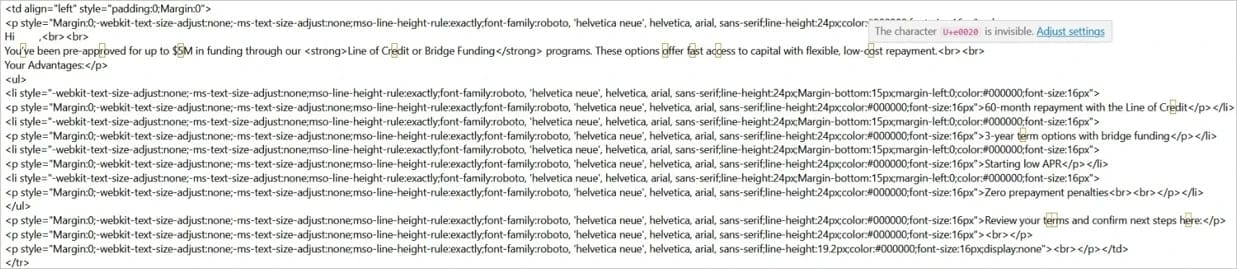
This adaptation to phishing represents a strategic evolution for cybercriminals. Traditional filters often rely on keyword blacklists and pattern matching to identify malicious emails. For instance, emails containing words like "funding," "loan," or "credit" might be flagged if they appear in conjunction with other suspicious indicators. However, by inserting an invisible Unicode character within such a keyword, like splitting "funding" into "fun[invisible character]ding," the word no longer matches the exact string in the filter’s database. The email gateway may process the text, but the security algorithm, looking for precise matches, fails to detect the illicit term.

A Surge in Phishing Activity
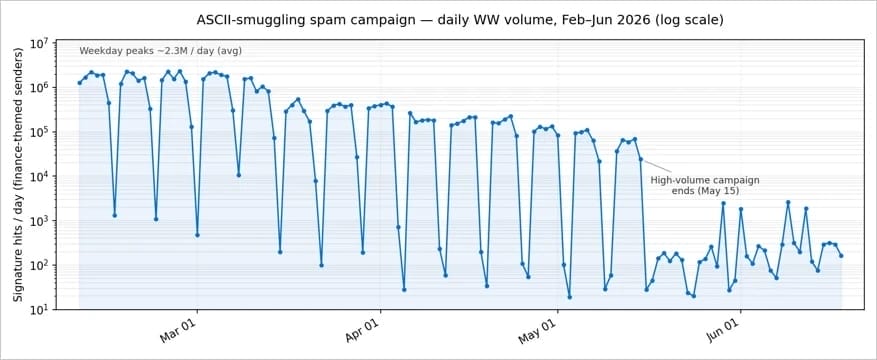
Microsoft threat researchers have been at the forefront of observing and documenting this escalating threat. Their analysis revealed a large-scale phishing campaign that adopted this ASCII smuggling technique, reaching an astonishing peak of up to 2.37 million daily messages in late February. While the volume has seen a gradual decline in the months leading up to and including May, the operation remains active, indicating a persistent and resourceful threat actor.
Microsoft’s security blog detailed the observed timeline, noting: "The high-volume phase persisted for roughly three months after February 9 and dropped sharply after May 15, 2026. These dates bound the observed use of the specific technique in our telemetry, not the broader campaign, which started earlier without it and continued without it." This suggests that the ASCII smuggling component was a specific, highly effective phase of a larger, ongoing operation.
Mechanics of the Evasion
The primary modus operandi of this campaign involved meticulously inserting invisible Unicode characters within finance-related keywords. This strategic placement was designed to create a smokescreen, rendering the malicious intent undetectable by standard signature-based detection methods. The financial sector is a prime target for such attacks due to the perceived high value of potential victims and the urgency often associated with financial matters, making individuals more susceptible to clicking on malicious links or divulging sensitive information.
The impact of this technique is significant because it directly undermines the efficacy of word-list-based detection systems, which form a cornerstone of many email security solutions. By fragmenting keywords, attackers effectively render these lists obsolete, allowing their phishing emails to slip through the initial layers of defense.
Data and Scope of the Campaign
Microsoft’s telemetry provided stark evidence of the campaign’s scale. On February 9, the company identified a specific cluster of 148 finance-themed sender domains that were instrumental in powering this attack. These domains accounted for approximately 96% of all messages flagged by Microsoft Defender for Office 365’s new hunting logic for Unicode-tag signatures. This concentration of activity from a defined set of domains suggests a coordinated and well-resourced operation.
The sender domains themselves were crafted to appear legitimate, often incorporating words like "funding," "capital," "loan," "advance," and "credit." The messages typically promoted enticingly vague business funding, loan, and credit services, aiming to lure unsuspecting recipients into engaging with the fraudulent content.
Furthermore, the infrastructure used to deliver these messages was particularly insidious. The attackers leveraged the legitimate ActiveCampaign email-marketing platform. This is a common tactic employed by threat actors; by utilizing established and reputable services, they can obscure their malicious activity and benefit from the established trust and delivery rates of these platforms, making it harder for security systems to distinguish between legitimate marketing communications and phishing attempts.
Official Responses and Mitigation Strategies
Following Microsoft’s report of service abuse, ActiveCampaign promptly responded. A spokesperson stated that their moderation systems are designed to detect invisible Unicode characters with the same efficacy as they detect unobfuscated text. They further emphasized that "heavy use" of such characters is treated as suspicious, indicating their commitment to combating malicious activity on their platform.
.jpg)
Microsoft, in its advisory, provided concrete recommendations for defenders to counter this evolving threat. The core suggestion is to implement a pre-detection normalization step. This involves stripping or normalizing Unicode tag characters and other invisible code points before applying keyword, regex, or signature-based detection. By treating unexpected characters from the tag block as a strong anomaly, security systems can be reconfigured to flag potentially malicious content that might otherwise go unnoticed.
The implications of this normalization extend beyond traditional email security. Microsoft also highlighted that applying the same normalization techniques before passing email content to AI assistants could significantly mitigate the risk of prompt-injection attacks. This underscores the interconnectedness of cybersecurity threats and the need for unified defensive strategies across different technological domains.
Broader Impact and Future Implications
The successful deployment of ASCII smuggling in large-scale phishing operations signifies a critical inflection point in cybersecurity. It demonstrates that threat actors are not only adapting existing techniques but are also actively innovating and exploiting new technological avenues to achieve their objectives. The reliance on invisible characters is a testament to the sophistication and resourcefulness of these actors, forcing a re-evaluation of foundational security principles.
The ability of these attacks to bypass initial filters means that even organizations with robust email security solutions are not entirely immune. The success of this campaign, despite Defender catching over 99% of messages based on other signals, underscores the importance of a multi-layered defense strategy. These signals, which include sender reputation, IP address analysis, and domain reputation checks, remain vital components of a comprehensive security posture.
The financial implications of such phishing campaigns can be substantial, ranging from direct financial loss due to fraudulent transactions to reputational damage and the cost of incident response and recovery. Moreover, the continuous evolution of these tactics necessitates an ongoing investment in security research, development of advanced detection mechanisms, and regular training for end-users to recognize and report suspicious communications.
The trend of attackers leveraging obscure character sets and encoding methods is likely to continue. As security solutions become more adept at detecting known evasion techniques, threat actors will inevitably seek new and innovative ways to circumvent them. This creates a perpetual arms race, where defenders must remain vigilant, adaptable, and proactive in anticipating and countering emerging threats. The ASCII smuggling technique serves as a stark reminder that the digital landscape is constantly shifting, and cybersecurity defenses must evolve in parallel to effectively protect individuals and organizations from the ever-present threat of cybercrime. The ongoing analysis of such campaigns by entities like Microsoft is crucial in providing the intelligence needed to fortify defenses against these sophisticated and evolving attacks.