admin
admin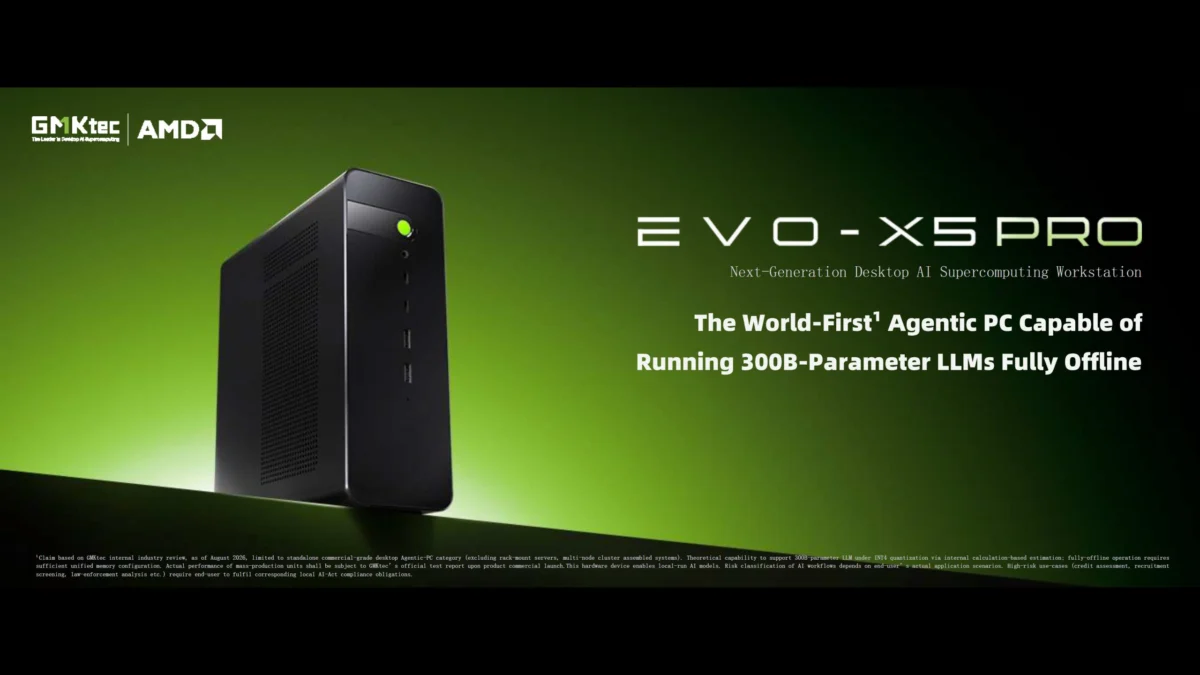
GMKtec has officially unveiled its latest flagship mini workstation, the EVO-X5 PRO, a high-performance computing solution engineered to leverage the full potential of AMD’s most powerful mobile silicon to date. Positioned as a direct competitor to high-end professional workstations and edge AI solutions, the EVO-X5 PRO is powered by the AMD Ryzen AI MAX+ PRO 495 "Gorgon Halo" System-on-Chip (SoC). This release marks a significant milestone in the evolution of the small-form-factor (SFF) market, transitioning from consumer-grade desktop replacements to specialized "Agentic PCs" capable of handling massive Large Language Models (LLMs) and complex AI orchestration tasks locally.

The EVO-X5 PRO represents the pinnacle of GMKtec’s engineering, building upon the foundations laid by its predecessors, the EVO-X2 and the more recent EVO-X3. However, the X5 PRO differentiates itself by targeting the professional enterprise and AI research sectors, offering a hardware suite that focuses on unified memory throughput and local inferencing capabilities that were previously reserved for full-sized server racks or expensive cloud-based GPU clusters.
Technical Specifications: The Power of Gorgon Halo
At the heart of the GMKtec EVO-X5 PRO lies the AMD Ryzen AI MAX+ PRO 495, an SoC based on the high-performance "Gorgon Halo" architecture. This processor is a powerhouse of multi-threaded performance, featuring 16 cores and 32 threads built on the advanced Zen 5 architecture. The chip is capable of reaching boost clocks of up to 5.2 GHz and is equipped with a generous 64 MB of L3 cache. To ensure stability across various workloads, the SoC operates within a configurable TDP range of 45W to 120W. GMKtec has implemented a physical toggle or software-controlled interface that allows users to cycle through three distinct power modes, optimizing the machine for either silent operation, balanced productivity, or maximum AI throughput.

Graphics and parallel computing tasks are handled by the integrated Radeon 8065S iGPU. Unlike standard integrated graphics solutions, the 8065S features 40 Compute Units (CUs) and operates at frequencies up to 3000 MHz. This level of integrated graphical power rivals mid-range discrete GPUs, making it suitable for video editing, 3D rendering, and GPU-accelerated AI computations. Furthermore, the SoC includes a dedicated XDNA 2 Neural Processing Unit (NPU), which contributes 55 TOPS (Trillions of Operations Per Second) of dedicated AI performance. When the CPU, GPU, and NPU are utilized in tandem, the system delivers a combined AI compute total of 131 TOPS, placing it at the forefront of the current AI PC generation.
Memory and Storage: Breaking the Local LLM Barrier
One of the most significant bottlenecks in local AI development is memory capacity and bandwidth. The EVO-X5 PRO addresses this by incorporating 192 GB of unified shared memory. This memory operates at a high-speed frequency of 8533 MT/s, ensuring that data transfer between the processor and the memory bank does not impede performance.

The unified architecture allows the system to allocate up to 160 GB of this total capacity specifically as Video RAM (VRAM). This is a critical feature for AI researchers and developers, as it enables the machine to run Large Language Models with over 300 billion parameters fully offline. Traditionally, models of this scale required multi-GPU setups or substantial cloud investment. By hosting these models locally, organizations can ensure data privacy, reduce latency, and eliminate recurring subscription costs associated with AI-as-a-Service (AIaaS) providers.
Storage capabilities are equally robust. The EVO-X5 PRO features a triple M.2 2280 PCIe Gen4 x4 array. Each slot supports up to 8 TB of NVMe storage, allowing for a maximum internal capacity of 24 TB. This massive storage pool is designed to house large datasets, extensive AI model libraries, and high-resolution media assets without the need for external enclosures or NAS dependency.

Performance Claims and Comparative Analysis
GMKtec has made bold claims regarding the EVO-X5 PRO’s efficiency compared to industry benchmarks. According to internal testing data provided by the manufacturer, the EVO-X5 PRO offers 66% faster CPU orchestration compared to NVIDIA’s DGX Spark systems in specific cloud-hybrid workflows. CPU orchestration is a vital metric in AI environments, as it dictates how efficiently the system manages data flow, task scheduling, and the hand-off between different processing units.
In addition to raw speed, GMKtec emphasizes the economic advantages of the EVO-X5 PRO. The company claims a 40% lower cost per completed AI workflow when compared to traditional enterprise solutions like the DGX Spark. This cost-efficiency is attributed to the lower power draw of the SoC-based architecture and the elimination of the high licensing fees often associated with proprietary enterprise hardware. By providing a "local-first" AI platform, GMKtec aims to democratize high-level AI research for smaller firms and individual developers who require significant VRAM but lack the budget for server-grade infrastructure.

Industrial Design and Thermal Management
To house such powerful components in a compact frame, GMKtec has utilized a CNC-machined all-metal chassis. The use of premium metals serves a dual purpose: providing structural integrity for professional environments and acting as a secondary heat sink. The front of the unit features an "All-In-One Smart Function" key, which can be programmed for various tasks such as power management, mode switching, or quick-launching AI agents.
Thermal management is a critical aspect of any workstation drawing up to 120W in a small form factor. The EVO-X5 PRO employs a custom-designed Vapor Chamber (VC) heat spreader. This technology allows for more efficient heat distribution across the cooling fins compared to traditional copper heat pipes. The cooling system is further augmented by a triple-fan smart thermal control solution. These fans are governed by an intelligent algorithm that adjusts RPM based on real-time sensor data from the Zen 5 cores and the Radeon iGPU, ensuring that the system maintains peak performance without thermal throttling during sustained workloads.

Connectivity and Enterprise Features
The IO (Input/Output) array on the EVO-X5 PRO is designed for maximum versatility. The front panel includes dual USB4 ports for high-speed peripherals and quick data transfers. The rear panel is even more expansive, featuring dual USB4 V2 ports. These V2 ports are particularly noteworthy as they support external GPU (eGPU) expansion and allow the EVO-X5 PRO to be used in cluster workstation configurations. By linking multiple units together via high-speed USB4 V2, users can create a distributed computing node for even larger AI tasks.
Other connectivity options include:

- Dual 10GbE Ethernet LAN ports for high-bandwidth networking and server integration.
- HDMI and DisplayPort outputs supporting up to 8K resolution.
- Dual USB 3.2 ports for legacy devices.
- Support for a quad-display MAX 8K output setup.
For software and security, GMKtec includes its proprietary "GMKtec Claw" AI agent solution, designed to help users manage local LLMs and automate workflows. Enterprise users will benefit from the inclusion of a dedicated dTPM 2.0 security chip and support for AMD DASH (Desktop and mobile Architecture for System Hardware) Remote Management. This allows IT administrators to manage, troubleshoot, and update the workstation out-of-band, even if the operating system is unresponsive.
Context and Chronology of the "Gorgon Halo" Launch
The launch of the EVO-X5 PRO comes at a time when the "AI PC" marketing push is at an all-time high. Earlier in the year, AMD announced its Strix Point architecture, which brought significant NPU improvements to the mobile market. However, the "Gorgon Halo" chips (part of the broader Ryzen AI MAX+ series) were long-rumored as the true enthusiast-grade silicon intended to bridge the gap between mobile efficiency and desktop power.

The timeline of this release suggests a strategic move by AMD and partners like GMKtec to capture the "Prosumer" AI market before the end of the fiscal year. By integrating 192GB of LPDDR5X-8533 memory directly into the platform, GMKtec is following a trend set by Apple’s M-series Ultra chips, which use unified memory to achieve high VRAM counts that traditional PC architectures struggle to match without expensive workstation GPUs like the NVIDIA RTX 6000 Ada.
Market Implications and Future Outlook
The introduction of the EVO-X5 PRO could signal a shift in how AI startups and research departments allocate their hardware budgets. If the claims of 40% lower cost per workflow hold true in independent testing, the demand for compact, high-VRAM workstations could surge. The ability to run a 300B-parameter model on a device that fits in a backpack is a transformative prospect for field researchers, data scientists, and developers who prioritize local control over cloud dependency.

Furthermore, the inclusion of dual 10GbE ports and USB4 V2 clustering suggests that GMKtec is looking beyond the single-user workstation market. These units could potentially be used as high-density AI inference nodes in edge computing environments, providing localized intelligence for smart factories, medical imaging centers, or secure government facilities where external data transmission is restricted.
While GMKtec has not yet finalized the official MSRP for the EVO-X5 PRO, the device is scheduled for a global launch in October. Given the premium nature of the AMD Ryzen AI MAX+ PRO 495 SoC and the 192GB of high-speed memory, industry analysts expect the pricing to reflect its position as a high-end professional tool rather than a consumer mini PC. As the AI hardware landscape continues to accelerate, the EVO-X5 PRO stands as a testament to the rapid miniaturization of extreme computing power.