admin
admin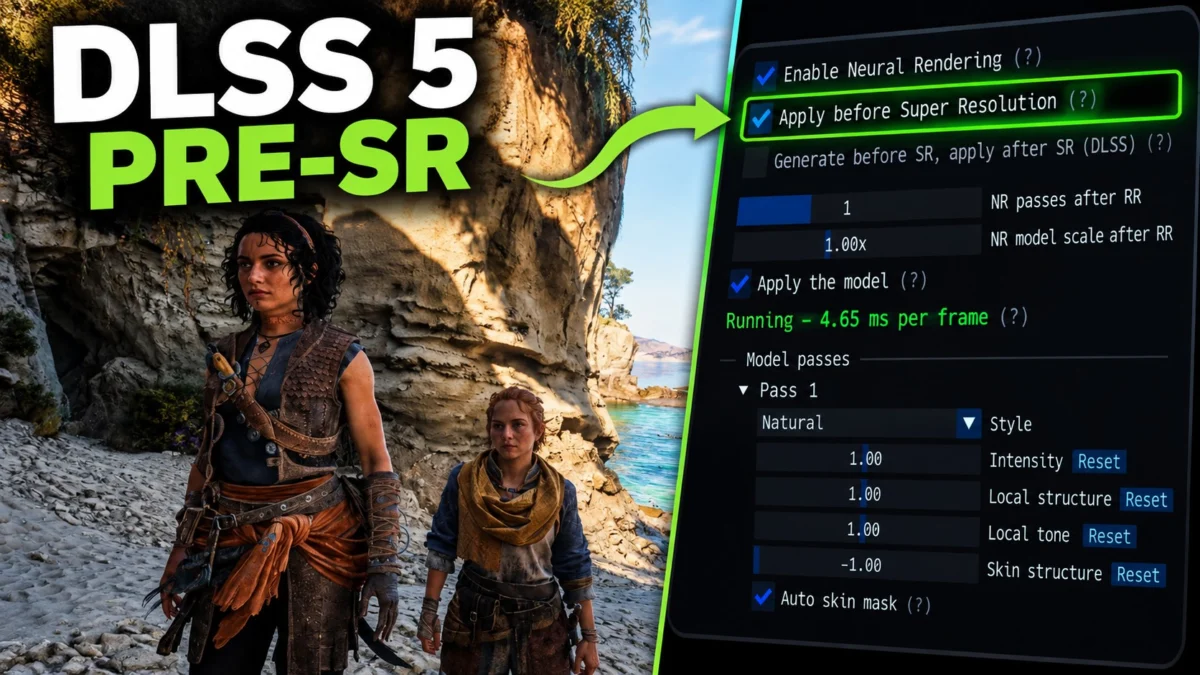
The Evolution of Neural Rendering and the DLSS 5 Milestone
To understand the importance of this mod, one must look at the trajectory of NVIDIA’s Deep Learning Super Sampling (DLSS) technology. Since its inception, DLSS has evolved from a simple upscaling tool into a comprehensive suite of AI-powered features. DLSS 2 introduced stable temporal upscaling; DLSS 3 added Frame Generation to bypass CPU bottlenecks; and DLSS 3.5 introduced Ray Reconstruction to improve ray-traced image quality. DLSS 5 represents the next major leap, focusing on Neural Rendering. This technology uses deep learning models to replace traditional, computationally expensive shaders with AI-generated approximations that can handle complex light transport and geometry details with unprecedented accuracy.
However, the implementation of DLSS 5 NR has proven to be a double-edged sword. Even on flagship hardware like the Blackwell-based RTX 5090, the activation of Neural Rendering can lead to a precipitous drop in frame rates. This is primarily because the standard rendering pipeline applies Neural Rendering after the image has been upscaled to the target resolution. For a user playing at 4K, the AI must process over 8 million pixels per frame, creating a bottleneck that can neutralize the gains provided by upscaling.
The Technical Breakthrough: Moving NR Before SR
The experimental mod, known as the OptiScaler-DLSSNR-PreSR-Multipass fork, proposes a fundamental shift in logic. Instead of applying Neural Rendering to the final, high-resolution output, the mod moves the NR stage to an earlier point in the pipeline—specifically, before the DLSS Super Resolution (SR) upscaling occurs.

In a standard configuration, the GPU renders the game at a lower internal resolution (for example, 1080p), upscales it to 4K using DLSS SR, and then applies DLSS 5 NR to that 4K image. The OptiScaler mod changes this sequence: the GPU renders at 1080p, applies DLSS 5 NR to that 1080p frame, and then upscales the "cleaned" neural-rendered image to 4K.
The mathematical implications of this change are profound. Processing a 1080p frame requires the AI to analyze only 2 million pixels, compared to the 8.3 million pixels found in a 4K frame. By reducing the workload of the Neural Rendering model by approximately 75%, the performance overhead is slashed. This approach mirrors the logic behind the "DLSS 5 Autopilot" project, which sought similar efficiencies by automating the placement of AI modules within the rendering stack.
Case Study: Performance Metrics in Resonance: A Plague Tale Legacy
Concrete data regarding this mod’s efficacy surfaced via community testing on the social platform Reddit. A user identified as u/Sad-Victory-8319 conducted extensive benchmarking using an NVIDIA GeForce RTX 5070 Ti while running the title Resonance: A Plague Tale Legacy. This game is known for its dense environments and sophisticated lighting, making it an ideal testbed for DLSS 5.
The baseline performance for the game at 4K using DLSS Performance mode (which utilizes a 1080p internal render resolution) without Neural Rendering was recorded at approximately 180 FPS. Upon enabling the standard, official implementation of DLSS 5 NR, the frame rate plummeted to 80 FPS. This represents a performance penalty of roughly 56%, a loss so severe that it arguably negates the "smoothness" benefits of high-end hardware.

However, once the experimental OptiScaler fork was applied to move DLSS 5 NR before the upscaling step, the results changed dramatically. The frame rate rose from 80 FPS to 122 FPS. Under this configuration, the performance penalty for enabling Neural Rendering was reduced from 56% to approximately 32%. While still a significant cost, the 122 FPS output remains well within the "high-refresh-rate" territory desired by enthusiasts, representing a 52% improvement over the standard DLSS 5 implementation.
Visual Fidelity and the Trade-off Debate
A critical concern with applying AI rendering to lower-resolution inputs is the potential for "smearing" or a loss of fine detail. Because the Neural Rendering model has fewer source pixels to work with when placed before the upscaling step, there is a theoretical risk that the final image will lack the precision of a post-upscale implementation.
Initial reports from the modding community suggest that the visual impact is surprisingly minimal. The user who conducted the RTX 5070 Ti benchmarks noted that the image quality remained high, with the improvements to lighting and shadows still clearly visible. However, some technical analysts have pointed out that in fast-moving scenes, applying NR to a lower-resolution buffer can lead to minor temporal artifacts or "ghosting" that would not be present if the AI had the full 4K data set to work with.
For most players, this appears to be a favorable trade-off. The consensus in enthusiast circles is that a 25-30% performance hit for superior lighting is a "price worth paying," whereas a 50-60% hit renders the technology a niche feature for screenshots rather than active gameplay.

Chronology of Recent DLSS 5 Developments
The release of this OptiScaler fork is the latest in a series of rapid-fire developments within the GPU modding community. The timeline of these events highlights a growing trend of users taking "software-defined hardware" into their own hands:
- Early September 2026: NVIDIA officially launches the RTX 50-series and DLSS 5, marketed as exclusive to the Blackwell architecture due to specific hardware requirements in the Tensor cores.
- Mid-September 2026: Modders successfully "backport" DLSS 5 NR to older RTX 20 and 30-series GPUs, proving that while Blackwell is more efficient, older Tensor cores are still capable of running the models.
- Late September 2026: The "DLSS 5 Autopilot" project is released, introducing the concept of dynamic pipeline placement to save resources.
- Current Week: The OptiScaler-DLSSNR-PreSR-Multipass fork is released, providing a user-friendly way to move the NR stage before the SR stage, effectively halving the performance cost.
Broader Implications for NVIDIA and the Industry
The success of the OptiScaler mod places NVIDIA in a complex position. Historically, NVIDIA has been conservative with its rendering pipelines, ensuring that visual quality remains the top priority. The official placement of NR after SR ensures the highest possible fidelity, but at a cost that many users find prohibitive.
This community-led innovation suggests that a "Performance Mode" for Neural Rendering—one that officially allows users to choose where in the pipeline the AI is applied—could be a highly requested feature for future driver updates. Furthermore, it highlights the increasing importance of the "modding-as-R&D" ecosystem. Projects like OptiScaler and ReVio often act as a testing ground for features that eventually find their way into official software suites like NVIDIA App or GeForce Experience.
As AI continues to dominate the graphics landscape, the battle will no longer be fought just on the number of transistors or clock speeds, but on the efficiency of the AI models themselves. If third-party modders can find ways to double the performance of flagship features through simple pipeline reordering, it suggests that there is still significant room for optimization within the current generation of AI-driven graphics.

Conclusion and Outlook
The experimental OptiScaler fork represents a milestone in user-driven optimization. By demonstrating that DLSS 5 can be run at a fraction of its original cost without a catastrophic loss in visual quality, modders have essentially extended the life and utility of both current and next-generation GPUs. While the software remains in an "experimental" state and may not be compatible with every title, its existence serves as a proof of concept for the future of efficient neural rendering. For gamers currently struggling to balance the visual splendor of DLSS 5 with the need for high frame rates, this mod offers a glimpse into a more optimized, AI-enhanced future.