Sisilia Frederika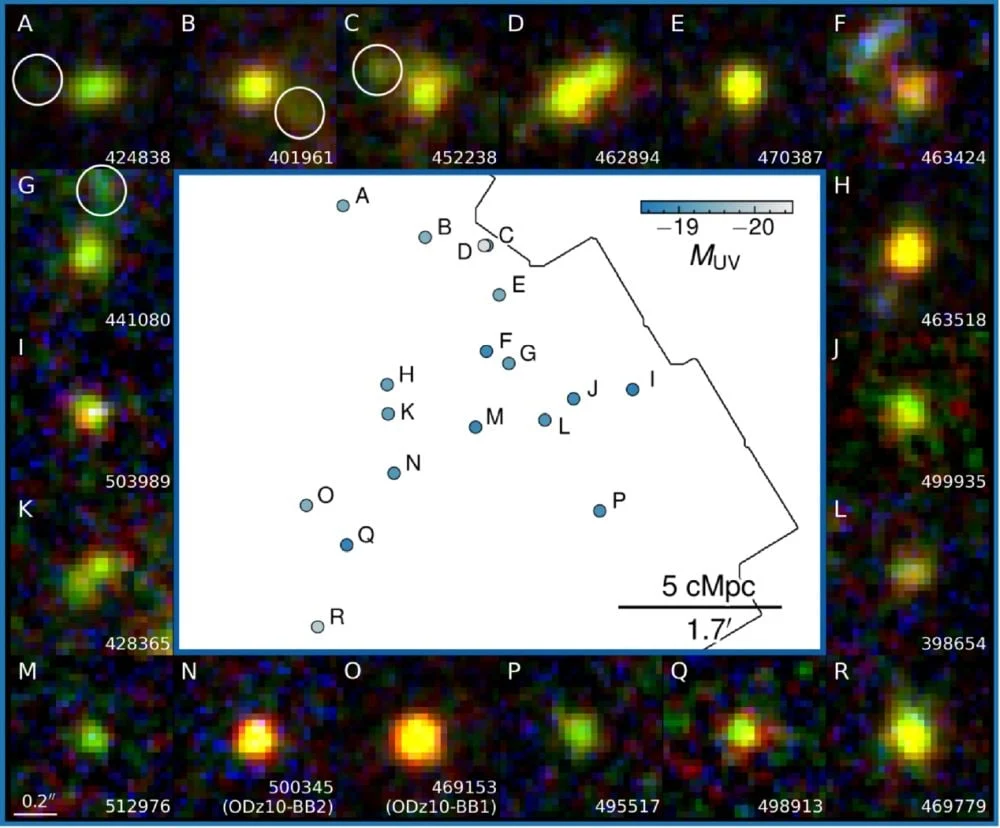
The James Webb Space Telescope (JWST) has reached a new milestone in its mission to map the infancy of the cosmos, identifying a significant "galaxy overdensity candidate" that existed just 500 million years after the Big Bang. This discovery, emerging from the JWST Advanced Deep Extragalactic Survey (JADES), offers a rare glimpse into the mechanisms of cosmic reionization—the era when the first stars and galaxies cleared the opaque hydrogen fog that dominated the early universe. Led by Zihao Wu of the Center for Astrophysics | Harvard & Smithsonian, the research highlights a dense cluster of 18 galaxies that appear to be collectively "blowing bubbles" of ionized space, providing some of the earliest evidence of large-scale structure formation in the history of the universe.
The Long Road to Scientific Triumph
The success of the JADES survey and the subsequent discovery of this overdensity represent the culmination of decades of technical and political persistence. For nearly 25 years, the James Webb Space Telescope remained a project of extreme uncertainty. Originally conceived in the late 1990s as the Next Generation Space Telescope, the project faced a litany of setbacks, including technical failures during testing and massive budget overruns that eventually saw the total cost climb to approximately $10 billion.
The most critical moment for the program occurred in 2011, when the United States Congress moved to cancel the telescope entirely due to mismanagement and spiraling costs. It was only after a concerted effort by the international scientific community and a restructuring of the project’s management that the funding was restored. Following years of meticulous engineering to ensure the 6.5-meter primary mirror and tennis-court-sized sunshield could deploy perfectly in the vacuum of space, the JWST finally launched on an Ariane 5 rocket on December 25, 2021. Since its first images were released in July 2022, the observatory has consistently challenged existing cosmological models, finding that galaxies in the early universe were larger, brighter, and more organized than previously theorized.
Deciphering the JADES Overdensity at Redshift 10.5
The recent findings, published in The Astrophysical Journal under the title "JADES: A Prominent Galaxy Overdensity Candidate within the First 500 Myr," focus on a specific region within the Great Observatories Origins Deep Survey-South (GOODS-S) field. Using the JWST’s Near-Infrared Camera (NIRCam), the research team identified a co-moving group of 18 galaxies at a redshift of approximately z ≈ 10.5. In astronomical terms, redshift measures how much the light from a distant object has been stretched by the expansion of the universe; a redshift of 10.5 corresponds to a time when the universe was less than 4% of its current age.
The data reveals that this specific arrangement of galaxies is roughly four times denser than the average "field expectation" for that epoch. This "overdensity" accounts for nearly one-third of the comparably bright galaxies in that volume of space and contributes approximately 50% of the total star formation rate (SFR) within the specific redshift slice of the GOODS-S field. Observations indicate that these galaxies are not merely close in proximity but are actively interacting. A higher-than-average number of these galaxies possess close companions and complex substructures, suggesting a chaotic environment of gravitational tugs and mergers. Despite these interactions, their individual stellar masses and star formation rates remain largely consistent with high-redshift expectations, implying that while the environment is dense, the galaxies are not yet undergoing a "runaway" starburst phase.
The Mystery of the Cosmic Dark Ages and Reionization
To understand the significance of this overdensity, one must look back to the "Dark Ages" of the universe. Following the Big Bang and the subsequent cooling of the plasma, the universe was filled with neutral hydrogen gas. This gas was opaque to ultraviolet light, meaning that even as the first stars began to ignite, their light could not travel far before being absorbed or scattered. This period ended during the Epoch of Reionization, a transformative era when the radiation from early stars and galaxies became intense enough to strip electrons from hydrogen atoms, turning the neutral gas into an ionized plasma.
This transition was not instantaneous. It occurred in pockets, as individual galaxies and clusters carved out "bubbles" of transparency in the cosmic fog. Eventually, these bubbles merged, rendering the entire universe transparent to light as we see it today. The overdensity identified by the JADES team appears to be a primary engine for this process. By clustering together, these 18 galaxies combined their ionizing radiation to create a significant "ionizing bubble" with a radius of approximately 6 co-moving Megaparsecs (cMpc).
Lyman-Alpha Transmission: The Smoking Gun
The most compelling evidence for this ionizing bubble comes from the detection of Lyman-alpha (Lyα) radiation. Lyman-alpha is a specific spectral line produced by hydrogen atoms when electrons drop to their lowest energy state, often triggered by the intense UV radiation of young stars. Under normal circumstances in the early universe, neutral hydrogen would scatter this radiation so effectively that it would be virtually impossible for an Earth-based telescope to detect it.
However, the JADES data revealed a tentative but distinct spatial variation in Lyman-alpha transmission. The radiation was found to be elevated near the center of the galaxy overdensity and decreased toward the outskirts. This pattern is exactly what physicists expect to see if an ionizing bubble is present. In the center of the bubble, the hydrogen has been fully ionized, allowing the Lyman-alpha photons to travel freely. As the photons reach the edge of the bubble—where they encounter the wall of neutral hydrogen—they begin to scatter and fade.

If confirmed by further study, this would represent the earliest ionized bubble produced by a galaxy overdensity ever recorded. It serves as a "natural laboratory" for scientists to study how the very first large-scale structures in the universe began to influence their environment and change the physical state of the cosmos.
Technical Specifications and Data Analysis
The study utilized the unprecedented sensitivity of the JWST’s NIRCam to perform multi-band photometry. By looking at the colors and brightness of these distant objects across multiple infrared wavelengths, the team could estimate their distances and physical properties.
Key data points from the study include:
- Redshift (z): ~10.5 (approximately 13.3 billion years ago).
- Galaxy Count: 18 confirmed candidates in a concentrated volume.
- Density Factor: 4x higher than the surrounding field average.
- Bubble Radius: ~6 cMpc (co-moving Megaparsecs).
- Star Formation Contribution: The overdensity accounts for 50% of the star formation in its local redshift field.
While the photometric data is robust, the researchers emphasize that these conclusions are currently based on "candidate" status. To move from a candidate overdensity to a confirmed one, the team requires full spectroscopic confirmation. Spectroscopy involves breaking the light down into a detailed spectrum to measure precise chemical signatures and velocities, which would eliminate any remaining ambiguity regarding the distance and composition of these galaxies.
Broader Implications for Modern Cosmology
The discovery of such a prominent overdensity so early in cosmic time has significant implications for our understanding of dark matter and galaxy formation. According to the standard Lambda Cold Dark Matter (ΛCDM) model, galaxies form within "halos" of invisible dark matter. Overdensities like the one found by JADES indicate regions where dark matter was particularly concentrated, acting as gravitational wells that pulled in gas and sparked rapid star formation.
Finding such a dense structure at z=10.5 suggests that the "seeds" of large-scale structures—like the galaxy clusters we see in the local universe today—were planted much earlier than some models predicted. It also reinforces the idea that reionization was a "bottom-up" process driven by the collective power of small, dense groups of galaxies rather than a few isolated, massive sources.
Future Observations and Global Collaboration
The scientific community has reacted with cautious optimism to the Wu et al. findings. While the JADES survey has already provided a wealth of data, the next steps involve multi-wavelength follow-up. The research team has already outlined plans to utilize the Atacama Large Millimeter/submillimeter Array (ALMA) in Chile. While JWST looks at the infrared light from stars, ALMA can detect the cool dust and gas within these galaxies, specifically targeting signatures like doubly-ionized oxygen ([O III]) and hydrogen-alpha (Hα) emissions.
Combining JWST’s infrared vision with ALMA’s radio-frequency capabilities will allow astronomers to build a three-dimensional map of the overdensity. This 3D model will help determine the exact shape of the ionizing bubble and the velocity at which these galaxies are moving relative to one another.
"Together, these observations will map the three-dimensional structure of the overdensity and provide a direct test of its role in cosmic reionization within the first 500 Myr of the Universe," the authors concluded in their report.
As the James Webb Space Telescope continues its five-to-ten-year primary mission, discoveries like the JADES overdensity are rewriting the opening chapters of the cosmic story. What was once a period of theoretical darkness is now being illuminated, showing a young universe that was far more active, crowded, and transformative than anyone dared to imagine during the decades the telescope spent on the drawing board. For the astronomers who fought to keep the project alive, these results are more than just data; they are the long-awaited payoff for a generation of scientific ambition.