admin
admin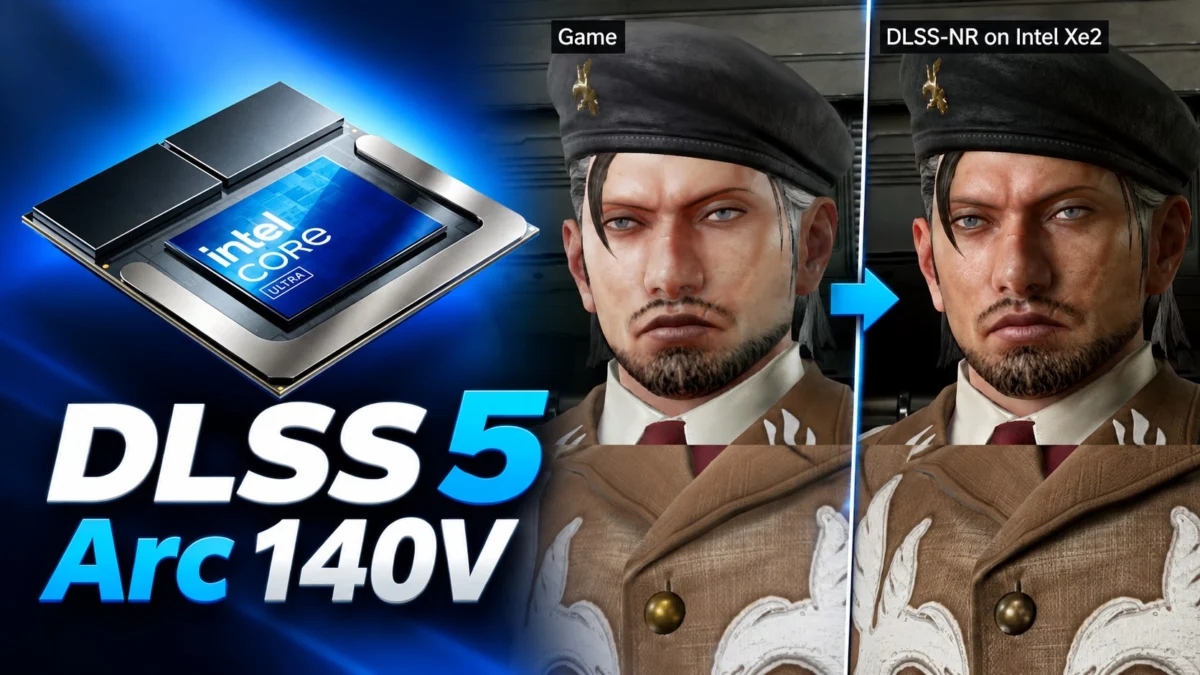
The implementation, titled "dlss-nr-on-intel," specifically targets the Intel Arc 140V integrated GPU (iGPU), which is a core component of the Intel Core Ultra 7 256V "Lunar Lake" processor. By bypassing NVIDIA’s closed ecosystem—which typically requires CUDA, the NGX framework, and specific execution libraries—the modder has reconstructed the neural rendering pipeline to run natively on Intel’s Xe2-LPG architecture. This feat was achieved by leveraging Intel’s XMX (Xe Matrix eXtensions) engines, which serve as the hardware equivalent to NVIDIA’s Tensor cores, to handle the intensive mathematical operations required by deep learning models.
Technical Architecture and the Vulkan Implementation
The technical foundation of this project rests on the reconstruction of a 71-block U-Net, the specific neural network architecture utilized by NVIDIA for DLSS 5 Neural Rendering. In traditional graphics pipelines, rendering involves a series of shaders and rasterization techniques. DLSS 5 Neural Rendering, however, replaces or augments these steps with an AI model that reconstructs the final image based on low-resolution inputs and motion vectors.

To make this functional on Intel hardware, the developer utilized the VK_KHR_cooperative_matrix Vulkan extension. This extension allows the GPU to perform matrix multiplications—the "bread and butter" of AI workloads—across multiple threads simultaneously. By using FP16 (half-precision) and FP32 (single-precision) accumulation, the modder was able to map the weights and biases of the DLSS 5 model onto the Intel XMX engines.
The integration into the game engine is handled via a custom Vulkan layer. This layer hooks into the vkQueuePresentKHR function, which is the final step in the rendering process where a frame is sent to the display. By intercepting the frame at this stage, the "dlss-nr-on-intel" tool can apply the neural rendering pass as a post-processing effect, effectively "cleaning" and enhancing the frame before the user sees it. This method allows the technology to be applied to any application that presents frames through the Vulkan API, provided the user has the necessary model files.
Performance Analysis and Hardware Bottlenecks
While the project is a triumph of engineering, the current performance metrics highlight the massive computational cost of neural rendering. On the Intel Arc 140V iGPU, the impact on frame rates is severe. Testing conducted by the developer across several titles revealed that the iGPU struggles to maintain playable speeds when the neural rendering pipeline is active.

In Tekken 7, running at a base resolution of 640x360p, the system achieved only 10.5 frames per second (FPS). When attempting to process a 720p frame, the performance dropped further to a range of 3 to 5 FPS. The developer noted that processing a single 1080p frame can take several hundred milliseconds, which is an eternity in the context of real-time gaming, where a 60 FPS target allows only 16.6 milliseconds per frame.
Memory consumption is another significant hurdle. The Intel Arc 140V uses shared system RAM rather than dedicated VRAM. The DLSS 5 NR implementation requires approximately 2.3 GB of device buffers just to hold the neural network’s weights and intermediate data at 720p. For a mobile processor like the Core Ultra 7 256V, which often operates in systems with 16 GB of total RAM, dedicating nearly 15% of the system’s memory to a single upscaling pass creates a substantial resource bottleneck. These figures underscore why NVIDIA has limited DLSS 5 NR to its high-end RTX 50-series GPUs, which feature massive memory bandwidth and dedicated high-speed Tensor cores.
Chronology of DLSS 5 Modding Efforts
The journey to bring DLSS 5 to non-NVIDIA hardware has moved with surprising speed. The timeline of events showcases a community-driven effort to dismantle the exclusivity of AI-driven graphics:

- Late 2025: NVIDIA announces DLSS 5 with Neural Rendering, officially supporting only the Blackwell-based RTX 50-series GPUs.
- January 2026: Modders successfully enable DLSS 5 NR on older NVIDIA hardware, specifically the RTX 3080 and RTX 4090, proving that older Tensor cores are capable of running the model, albeit with a performance penalty.
- February 2026: A breakthrough occurs for the "Red Team" as developers port the neural rendering pipeline to the AMD Radeon RX 9000 series using ROCm and Vulkan compute shaders.
- March 2026: The "dlss-nr-on-intel" project is released, bringing the technology to the Intel Xe2 architecture and proving that even integrated graphics can execute these complex AI models.
This rapid succession of developments suggests that the "moat" NVIDIA has built around its software features is increasingly vulnerable to sophisticated reverse-engineering and the flexibility of modern graphics APIs.
Comparative Software Solutions: XeSS vs. DLSS 5
Intel already possesses its own AI-based upscaling technology, XeSS (Xe Super Sampling). XeSS is designed to be hardware-agnostic, running on any GPU that supports DP4a instructions, while offering an XMX-accelerated path for Intel Arc GPUs. However, DLSS 5 Neural Rendering represents a different approach. While XeSS focuses primarily on temporal upscaling (using previous frames to reconstruct the current one), DLSS 5 NR uses a much larger neural network to reconstruct lighting and shading details that were never actually rendered by the GPU.
The "dlss-nr-on-intel" project effectively creates a hybrid environment where Intel hardware is performing NVIDIA’s specific style of AI reconstruction. This has sparked a debate within the enthusiast community regarding whether Intel should pursue its own version of "Neural Rendering" or if the future of the industry lies in open-source, cross-vendor standards that prevent the fragmentation of the PC gaming market.

Broader Industry Implications and Potential Reactions
The ability to run DLSS 5 on Intel and AMD hardware carries significant implications for the future of GPU marketing and software development. For years, NVIDIA has used DLSS as a primary "system seller," encouraging users to upgrade to the latest hardware to access the newest features. If the community continues to bridge these gaps, the value proposition of hardware-locked software may diminish.
Industry analysts suggest that NVIDIA may respond in several ways. One possibility is a "cat-and-mouse" game involving more robust encryption for the DLSDS (Deep Learning Super Data Set) files that contain the neural network weights. Currently, modders require users to provide their own compatible model files, which are often extracted from official NVIDIA driver packages. Tightening the security around these files could slow down modding efforts.
Conversely, this project serves as a validation of Intel’s XMX architecture. By showing that an integrated GPU can technically execute the most advanced AI rendering pipeline in the world—even at unplayable frame rates—Intel demonstrates that its hardware is forward-looking and capable of handling future AI-centric workloads.

The Role of the Open-Source Community
The "dlss-nr-on-intel" project is currently hosted on GitHub, allowing other developers to contribute to the codebase. The goal of the community is now focused on optimization. While 3-5 FPS is not usable for gaming, it provides a baseline. Future optimizations in how the U-Net is traversed, or the potential use of lower-precision INT8 math (if the model weights can be quantized without losing too much quality), could theoretically bring performance into a more acceptable range for future Intel hardware, such as the upcoming "Battlemage" discrete GPUs.
The project also highlights the importance of Linux in the graphics modding scene. Because Linux allows for more granular control over the graphics stack and the injection of Vulkan layers, it has become the primary laboratory for these kinds of experimental breakthroughs. Windows users may eventually see a port of this technology, but for now, the most cutting-edge developments in cross-vendor AI rendering are happening on open platforms.
Conclusion
The successful execution of DLSS 5 Neural Rendering on an Intel Arc 140V is a landmark achievement for the modding community. It strips away the aura of impossibility surrounding high-end AI features and places the focus squarely on hardware efficiency rather than software compatibility. While the Intel Arc 140V lacks the raw horsepower to make DLSS 5 NR a practical reality for gamers today, the "dlss-nr-on-intel" project has provided a roadmap for the future. It proves that with the right software translation layers, the barriers between GPU vendors can be breached, potentially leading to a future where the most advanced graphics technologies are available to all users, regardless of the logo on their silicon.