admin
admin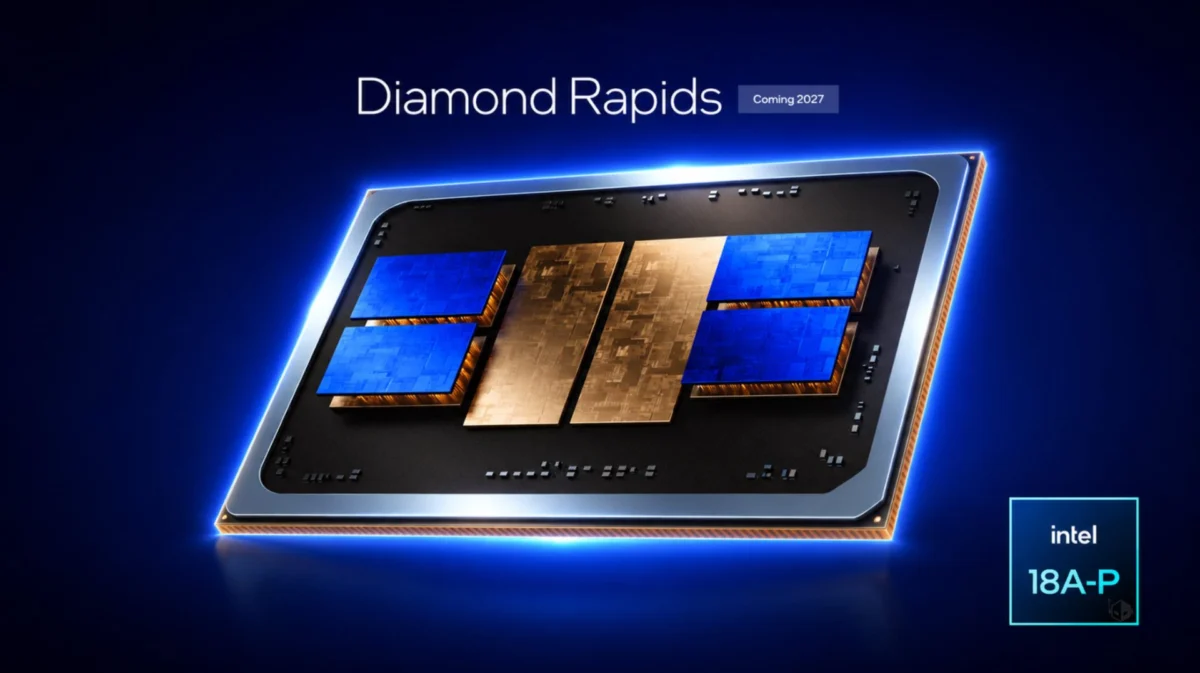
Intel Corporation is recalibrating its long-term server roadmap to address the intensifying competition in the high-performance computing and artificial intelligence sectors. The upcoming Diamond Rapids platform, branded under the Xeon 7 series, is now reportedly targeting a flagship configuration of up to 256 Performance-cores (P-cores). This strategic pivot marks a significant shift from previous internal plans and positions Intel to engage in a direct, core-for-core confrontation with AMD’s future EPYC "Venice" processors. Scheduled for a 2027 release, Diamond Rapids represents a critical juncture for Intel as it seeks to reclaim undisputed leadership in the data center through its next-generation Panther Cove-X architecture and the advanced Intel 18A-P manufacturing node.
Strategic Refocusing and the Cancellation of High-Density E-Core Variants
The development of Diamond Rapids has undergone a series of internal revisions as Intel aligns its engineering resources with shifting market demands. Earlier projections for the Diamond Rapids platform were notably more expansive, with internal documents suggesting the development of high-density (HD) variants capable of housing between 384 and 512 Efficiency-cores (E-cores). These designs were intended to serve the "cloud-native" segment, succeeding the Clearwater Forest family. However, industry reports and supply chain leaks indicate that Intel made the decision to "gut" the original platform definition in December 2023.
The cancellation of the 512-core E-core designs suggests a refocusing on per-core performance and architectural efficiency rather than pursuit of maximum core count through smaller, less powerful cores. By streamlining the Diamond Rapids portfolio to focus primarily on the P-core architecture, Intel is prioritizing workloads that require high instructions-per-clock (IPC) throughput, such as complex AI inferencing, large-scale database management, and traditional enterprise applications. The current roadmap indicates that the P-core density will increase by approximately 50% over the preceding Granite Rapids architecture, which currently reaches a ceiling of 128 cores in the Xeon 6900P series.
Architectural Foundations: Panther Cove-X and Intel 18A-P
The technical foundation of the Diamond Rapids "Xeon 7" family rests on the Panther Cove-X core architecture. While specific microarchitectural details remain under wraps, Panther Cove-X is expected to introduce substantial improvements in branch prediction, cache hierarchy, and specialized accelerators for AI and cryptographic workloads. These cores will be fabricated using the Intel 18A-P process, a refined version of Intel’s 1.8nm-class node.
The 18A-P node is a cornerstone of Intel’s "five nodes in four years" strategy. It utilizes RibbonFET gate-all-around (GAA) transistor technology and PowerVia backside power delivery. PowerVia is particularly relevant for high-core-count server CPUs, as it decouples the power delivery network from the signal interconnects, reducing voltage droop and allowing for higher clock speeds or lower power consumption at equivalent frequencies. For a 256-core processor, managing the thermal and electrical delivery is a monumental engineering challenge; the 18A-P node is designed specifically to mitigate these physical constraints.

The Oak Stream Platform and I/O Capabilities
Diamond Rapids will transition to the "Oak Stream" platform, succeeding the Birch Stream platform used by Granite Rapids and Sierra Forest. This transition is necessitated by the massive increase in core count and the resulting demand for memory bandwidth and input/output (I/O) throughput.
According to preliminary specifications, the Diamond Rapids platform will support up to 16-channel DDR5 memory, with speeds potentially exceeding 9000 MT/s through the use of Multiplexer Combined Rank (MCR) DIMMs. This represents a significant leap from the 12-channel support found in current-generation high-end server platforms. In terms of connectivity, Intel is expected to integrate PCIe Gen 6 support. PCIe 6.0 utilizes PAM4 (Pulse Amplitude Modulation 4-level) signaling to double the bandwidth of PCIe 5.0 while maintaining backwards compatibility. This is crucial for next-generation AI accelerators and high-speed networking fabrics that require massive data movement between the CPU and external clusters.
The Competitive Landscape: Intel vs. AMD vs. ARM
The primary target for Intel’s 256-core Xeon 7 is the AMD EPYC "Venice" family. AMD has consistently utilized a chiplet-based approach to scale core counts rapidly, and the Zen 6 architecture powering Venice is expected to offer its own 256-core flagship (rumored as the EPYC 9996). By matching AMD’s core count with high-performance P-cores, Intel aims to neutralize AMD’s historical advantage in multi-threaded density.
However, the competitive horizon extends beyond the traditional x86 rivalry. The data center market is increasingly being disrupted by ARM-based solutions from both established vendors and hyperscalers. NVIDIA’s Grace CPU and the upcoming "Rosa" architecture represent a significant threat in AI-centric data centers, where tight integration with GPU clusters is paramount. Simultaneously, firms like Qualcomm are entering the fray with the "Dragonfly" C1000, targeting 250+ cores by 2028.
Intel’s strategy with Diamond Rapids appears to be a dual-track approach: providing the raw compute density required to compete with ARM and AMD, while leveraging its legacy software ecosystem and specialized on-chip accelerators (such as Advanced Matrix Extensions or AMX) that many enterprise customers rely on for mission-critical stability.
Chronology of Intel’s Server Evolution
To understand the significance of Diamond Rapids, one must look at the progression of the Xeon roadmap over the last decade:

- 2017–2021 (Skylake to Ice Lake): Intel maintained a steady 28 to 40 core limit, focusing on 14nm and early 10nm refinements while AMD’s EPYC began its rapid ascent.
- 2023 (Sapphire Rapids/Emerald Rapids): Intel introduced the "Eagle Stream" platform and multi-chip package (MCP) designs, reaching up to 64 cores and introducing integrated HBM (High Bandwidth Memory).
- 2024 (Granite Rapids/Sierra Forest): The "Birch Stream" era begins, pushing P-core counts to 128 and E-core counts to 288, utilizing the Intel 3 process.
- 2026 (Clearwater Forest): Expected to be the lead vehicle for the Intel 18A node, focusing on E-core efficiency for cloud-scale deployments.
- 2027 (Diamond Rapids): The projected launch of the "Oak Stream" platform and the 256-core Xeon 7, marking the return to a P-core-heavy flagship strategy to combat Zen 6.
Market Implications and Economic Outlook
The move toward 200+ core processors is driven by the economic realities of the modern data center. Hyperscalers (AWS, Google, Azure) and enterprise private clouds are seeking to maximize "rack density"—the amount of compute power available per unit of physical space and power consumption. A single 256-core processor allows for higher virtualization ratios, meaning a single server can host more virtual machines or containers than previously possible, reducing the total cost of ownership (TCO).
Intel’s ability to deliver Diamond Rapids on time is also a litmus test for its Foundry Services (IFS). As Intel moves to the 18A-P node, it is not only manufacturing its own chips but also attempting to attract external customers. Success with a chip as complex as a 256-core Xeon would serve as a powerful marketing tool for Intel’s manufacturing prowess.
Conversely, the risks are substantial. Intel has historically struggled with delays in its server roadmap, most notably with Sapphire Rapids. If Diamond Rapids slips into 2028, it may find itself competing against even more advanced architectures from AMD and the ARM ecosystem. Furthermore, the power requirements for a 256-core P-core chip are expected to be immense. While TDP (Thermal Design Power) figures are not yet finalized, industry analysts expect flagship SKUs to exceed the 500W mark, necessitating advanced liquid cooling solutions in many data center environments.
Industry Response and Future Outlook
While Intel has not officially confirmed the 256-core count for Diamond Rapids, the "leak" of a 32-core early engineering sample with a massive 240 MB L3 cache suggests that the underlying architecture is being built for massive scalability. Analysts suggest that the 256-core configuration will likely be achieved through a multi-tile (chiplet) design, allowing Intel to maintain high yields by manufacturing smaller, individual compute tiles and stitching them together using its EMIB (Embedded Multi-die Interconnect Bridge) or Foveros 3D packaging technologies.
The broader tech industry is watching Intel’s "Oak Stream" transition closely. For server OEMs like Dell, HPE, and Lenovo, the Diamond Rapids platform represents a massive leap in capability that will require entirely new motherboard designs and power delivery systems. For the software ecosystem, the challenge will be ensuring that operating systems and applications can efficiently scale across 256 physical cores and 512 threads (if SMT is maintained).
As the industry moves toward 2027, the battle for the data center will no longer be fought on clock speeds alone, but on the intersection of architectural IPC, interconnect bandwidth, and transistor density. With Diamond Rapids, Intel is signaling that it is no longer content to play defense against AMD, but is instead preparing a platform designed to set the pace for the next decade of enterprise computing. Success will depend on the flawless execution of the 18A-P node and the ability of the Panther Cove-X architecture to deliver meaningful performance-per-watt gains in an increasingly power-constrained world.