Clarissa Hana
A sophisticated cybercriminal operation, attributed to the North Korean hacking group known as WaterPlum, has successfully compromised an estimated 30,000 devices globally and illicitly transferred over $10.7 million in stolen cryptocurrency to the Democratic People’s Republic of Korea (DPRK). This alarming revelation comes from a comprehensive joint cybersecurity advisory issued by law enforcement and intelligence agencies from Japan, the United States, Australia, and Germany, who have collectively traced the group’s extensive and malicious activities. The advisory details a multi-year campaign, codenamed "Contagious Interview," which exploits individuals seeking employment, particularly in the rapidly evolving fields of Artificial Intelligence (AI), cryptocurrency, and Non-Fungible Tokens (NFTs).
The modus operandi of WaterPlum involves a deceptive strategy of impersonating legitimate technology companies or leveraging popular job recruitment and freelance platforms to ensnare unsuspecting victims. Through carefully orchestrated fake interviews and seemingly legitimate coding challenges, the attackers manipulate victims into downloading malicious software disguised as project files, troubleshooting tools for video conferencing issues, or even executing seemingly innocuous code snippets that, in reality, embed malware onto their systems. This insidious approach has allowed WaterPlum to infiltrate a vast network of devices across more than 100 countries, a testament to the group’s reach and the global appeal of their deceptive tactics.
The "Contagious Interview" Campaign: A Deep Dive into WaterPlum’s Tactics
The "Contagious Interview" campaign, a central pillar of WaterPlum’s operations, has been ongoing for several years, evolving its techniques to remain effective. Initially, the group gained notoriety for its deployment of malicious npm packages, a common package manager for JavaScript, which were subtly hidden within legitimate-looking code repositories. These packages, when downloaded by developers or individuals working with web technologies, would silently install malware onto their systems. The advisory specifically highlights the use of 35 such npm packages in earlier phases of the campaign, a number that has likely increased as the group refines its arsenal.
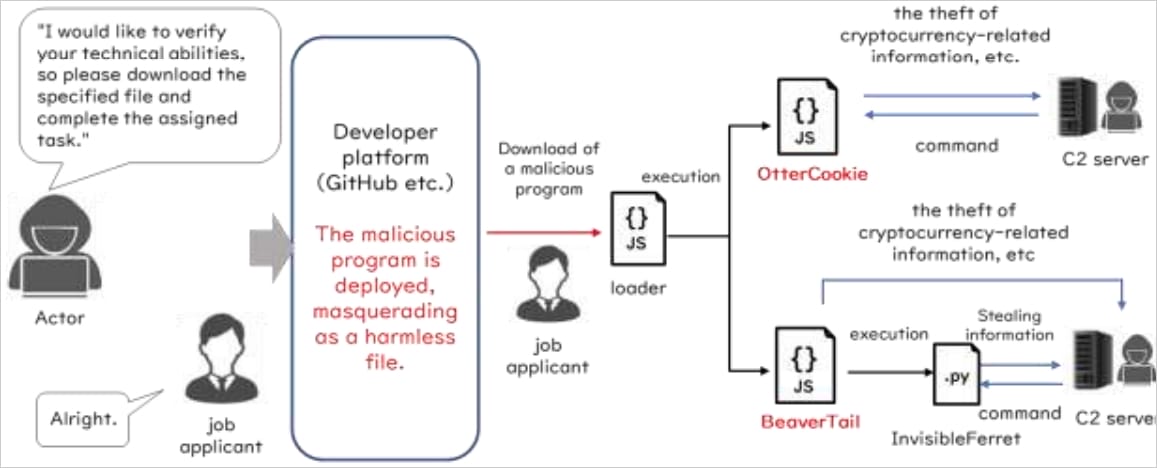
The current iteration of the campaign focuses on a more personal and insidious form of social engineering. WaterPlum actors meticulously craft their online personas, often posing as recruiters or technical interviewers for well-known AI, cryptocurrency, and NFT firms. They leverage platforms like LinkedIn, Upwork, and Fiverr, creating convincing profiles and engaging in extensive communication with potential targets. The fake interviews are designed to build rapport and trust, making the subsequent requests for actions like downloading code or executing commands appear routine and professional.
During these simulated technical assessments, victims are presented with scenarios that necessitate the execution of code or the downloading of project repositories. This is where the malware is delivered. For instance, victims might be asked to debug a supposed video conferencing issue, which requires them to download and run a specific application or script. Alternatively, they might be tasked with completing a coding exercise for a "prospective project," which involves cloning a repository containing malicious code. The attackers are adept at exploiting the pressure and eagerness of job seekers, who are often keen to impress and demonstrate their technical prowess.
The Financial Nexus: Funding North Korea’s Regime and Weapons Programs
The financial gains derived from WaterPlum’s activities are not merely for the enrichment of the cybercriminals. The advisory strongly links these operations to the broader North Korean cyber ecosystem, which is primarily focused on generating revenue to support the regime and, critically, to fund its highly secretive and volatile weapons programs. The $10.7 million in stolen cryptocurrency represents a significant injection of foreign currency into an economy heavily reliant on external funding and facing extensive international sanctions.
The advisory provides specific figures detailing the extent of the financial exploitation. Beyond the total cryptocurrency value, WaterPlum actors have successfully exfiltrated funds or account credentials from over 7,000 cryptocurrency wallets. This indicates a sophisticated understanding of cryptocurrency security and a targeted approach to acquiring not just digital assets but also the keys and phrases that grant access to them. The translated amount of 1.7 billion Japanese Yen (JPY) further underscores the global nature of their financial operations, with transactions being tracked and converted across various currencies.
Malware Families and Data Exfiltration: The Technical Underpinnings of the Attacks
The joint advisory meticulously details several malware families that have been directly linked to WaterPlum’s operations. While the original article snippet did not fully list these, it is understood that these families are designed to achieve a range of malicious objectives once a system is compromised. These typically include:
- Credential Stealing: Malware designed to capture usernames and passwords for various online accounts, including email, social media, and, crucially, cryptocurrency exchange platforms.
- Clipboard Monitoring: The ability to read and record data copied to the clipboard, which can include sensitive information like private keys or seed phrases that users might be transferring.
- Keystroke Logging: Recording every key pressed by the victim, allowing attackers to capture passwords, sensitive communications, and other typed data in real-time.
- Cryptocurrency Wallet Compromise: Specifically targeting private keys and seed phrases associated with cryptocurrency wallets, enabling direct theft of digital assets.
- Document Theft: The unauthorized access and exfiltration of sensitive documents stored on the victim’s computer, which can include intellectual property, financial records, or personal information.
- Screenshot Capture: Periodically taking screenshots of the victim’s screen to gain visual context of their activities and identify further opportunities for exploitation.
This comprehensive data exfiltration capability allows WaterPlum to not only seize immediate financial gains but also to gather intelligence for future attacks and to sell on the dark web.
Expanding the Attack Surface: From Individual Compromise to Corporate Espionage
The threat posed by WaterPlum extends beyond the individual devices they compromise. The advisory highlights a critical concern: the potential for attackers to use compromised computers as a stepping stone to infiltrate their employers’ or clients’ networks. This opens the door to far more damaging attacks, including the theft of valuable intellectual property, corporate secrets, and the execution of espionage operations. For businesses, particularly those in the tech sector, the compromise of an employee’s machine can have catastrophic consequences, leading to significant financial losses, reputational damage, and a loss of competitive advantage.
The Intertwined World of IT Workers and Cybercrime
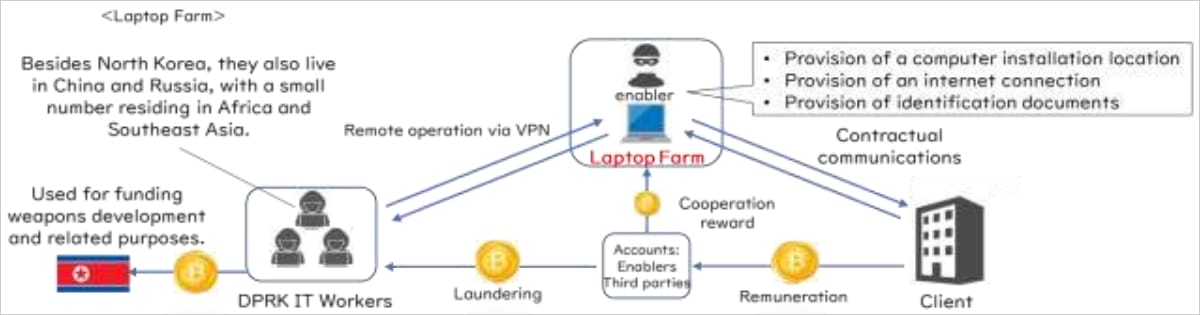
A particularly disturbing aspect of WaterPlum’s operations, as revealed by the advisory, is their direct connection to North Korea’s fraudulent IT worker schemes. It is now understood that some individuals involved in WaterPlum’s hacking activities also operate as remote IT workers, offering web development and other technical services to clients. Investigations have revealed shared IP addresses and operational overlaps between these two distinct but connected groups.
This fusion of cybercrime and legitimate-seeming IT work creates a deeply concerning dual-use model. North Korean IT workers, often operating under deceptive pretenses, provide a front for illicit activities. Furthermore, the advisory warns that identity documents stolen during WaterPlum attacks are subsequently reused by these North Korean IT workers to impersonate victims and secure legitimate employment, further blurring the lines between legitimate work and criminal enterprise. This practice of identity theft and impersonation makes it exceedingly difficult for companies to verify the authenticity of their remote workforce.
Advanced Deception Techniques: AI and Face-Swapping
In their relentless pursuit of sophisticated deception, WaterPlum actors have reportedly employed AI-powered face-swapping software during online interviews. This allows them to present a convincingly human and professional appearance to their victims. However, once the critical moments of the interview or coding test arrive, they are known to abruptly turn off their cameras, often attributing the disruption to network problems. This tactic, combined with their ability to impersonate others using stolen identities, further amplifies their capacity for deception and makes them incredibly difficult to detect and apprehend.
The Munitions Industry Department Connection: A State-Sponsored Threat
The FBI and Japanese police have made a significant assessment, linking WaterPlum actors and some North Korean IT workers to the country’s 313 General Bureau. This bureau is a crucial component of the Munitions Industry Department, an entity directly responsible for North Korea’s extensive weapons research and production initiatives. This direct connection provides strong evidence of state sponsorship and highlights the strategic importance of these cybercriminal activities to the North Korean regime. The revenue generated is not simply for profit but is systematically funneled to bolster the nation’s military capabilities, a fact that raises significant geopolitical concerns.
Japanese Authorities Dismantle "Laptop Farm"
In a significant operational success, Japan’s National Police Agency has announced the identification, investigation, and dismantling of a North Korean IT-worker "laptop farm" operating within the country. This marks the first time such an operation has been uncovered and disrupted in Japan. Investigations at the site revealed evidence of substantial financial transfers, amounting to several hundred million yen, being illicitly sent abroad. The discovery of these "laptop farms" suggests a more organized and centralized approach to managing their remote IT workforce and facilitating the transfer of illicit funds.
Broader Implications and Recommended Safeguards
The pervasive threat posed by WaterPlum and similar North Korean cyber operations carries profound implications for global cybersecurity. The financial motivation behind these attacks, coupled with their direct link to state-sponsored weapons programs, elevates the threat beyond mere financial crime to a matter of national and international security.
The joint advisory offers critical recommendations for companies and individuals to mitigate these risks:
-
For Companies:
- Rigorous Applicant Verification: Implement stringent processes to verify the identities, locations, and qualifications of all job applicants, especially for remote positions. This may include multi-factor authentication for employee onboarding and regular background checks.
- Least Privilege Access: Restrict employee access to only the systems and data absolutely necessary for them to perform their job functions. This limits the potential damage if an account is compromised.
- Enhanced Network Monitoring: Deploy advanced network monitoring tools to detect anomalous activities and unauthorized access attempts in real-time.
- Employee Training: Conduct regular cybersecurity awareness training for all employees, focusing on recognizing phishing attempts, social engineering tactics, and the dangers of downloading unknown software.
-
For Developers:
- Sandbox Environments: Always run unknown code and execute downloaded files within a secure sandbox environment that is isolated from the main system and corporate networks.
- Code Inspection: Meticulously inspect all provided files and code for suspicious commands, particularly those designed to fetch additional payloads or establish external connections.
- Dependency Verification: Scrutinize the dependencies of any code or packages downloaded from public repositories, looking for unusual or unexpected libraries.
The coordinated efforts of international law enforcement agencies underscore the global nature of this threat and the necessity for continued collaboration to disrupt and dismantle these sophisticated cybercriminal networks. The WaterPlum campaign serves as a stark reminder of the evolving tactics employed by state-sponsored cyber actors and the critical importance of robust cybersecurity measures for both individuals and organizations in an increasingly interconnected world.