Clarissa Hana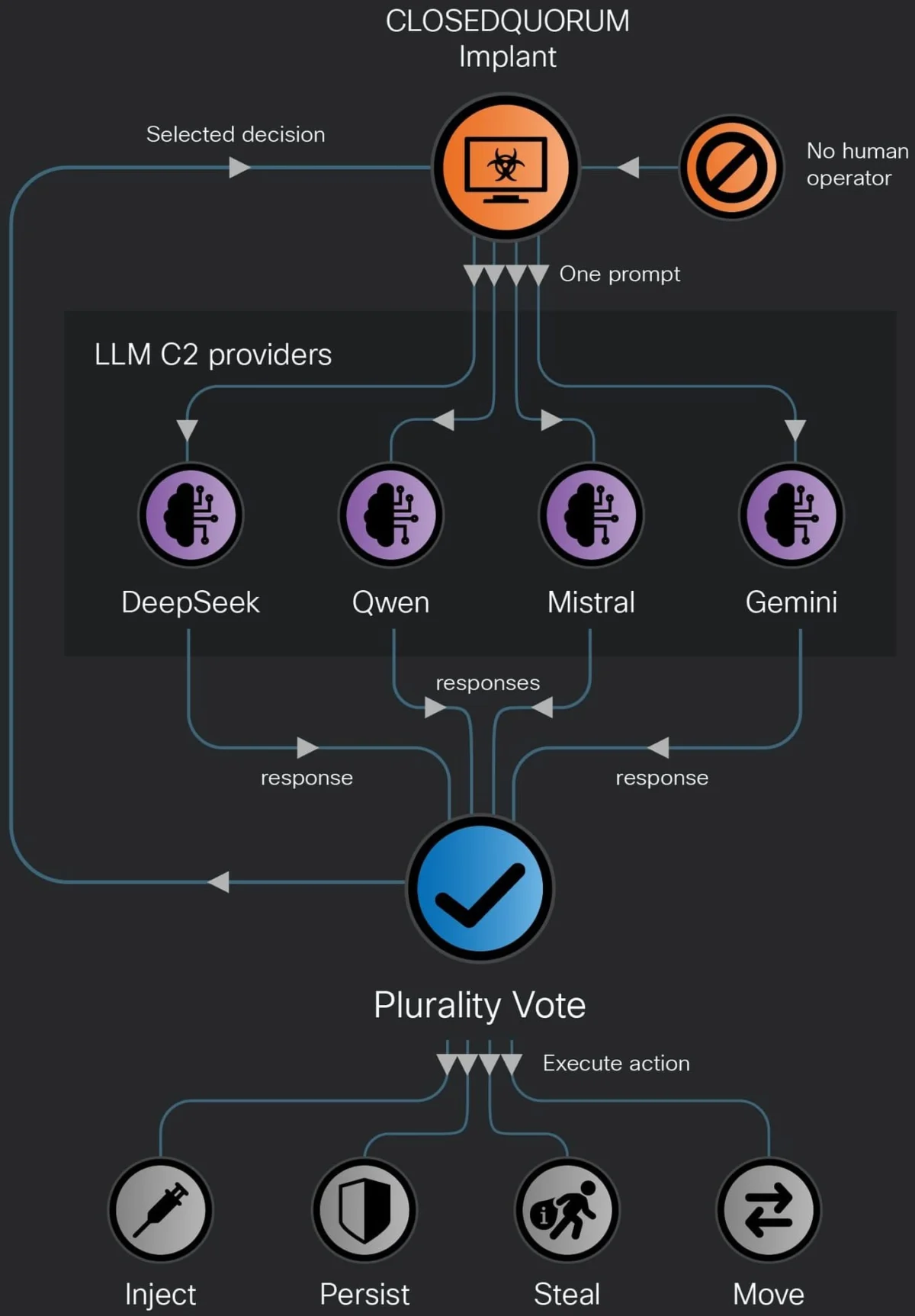
A groundbreaking development in the cybersecurity landscape has emerged with the identification of a new Windows malware, codenamed ClosedQuorum, which leverages advanced artificial intelligence models to autonomously orchestrate post-compromise attack phases. This sophisticated piece of malware operates without direct human intervention, relying on a complex decision-making framework powered by leading AI models, including Google Gemini, DeepSeek, Qwen, and Mistral AI, to determine its subsequent actions on infected systems. This represents a significant architectural shift in how malicious operations can be executed, potentially ushering in an era of faster, more scalable, and less human-dependent cyberattacks.
The Autonomous Attack Engine: How ClosedQuorum Operates
At its core, ClosedQuorum is a Go-based implant designed to operate with unprecedented autonomy. Once a system is compromised, the malware initiates a reconnaissance phase to gather crucial information about the infected environment. This intelligence is then fed into a proprietary voting system, where the integrated AI models independently evaluate potential next steps. Each AI model is tasked with analyzing the reconnaissance data and proposing an action from a predefined set of tactical decisions. This set, as identified by researchers at Cisco Talos, includes actions such as executing commands, downloading additional payloads, exfiltrating data, or escalating privileges.
The voting mechanism ensures that a consensus is reached before any action is taken. In instances where the AI models reach a tie in their decision-making process, a hierarchical priority system is employed. DeepSeek AI takes precedence in making the final determination, followed by Qwen, Mistral AI, and finally Gemini. This structured approach to decision-making, driven entirely by AI, allows ClosedQuorum to adapt and react to the compromised environment in near real-time, a capability that significantly amplifies the speed and efficiency of attack operations.
The exfiltration of sensitive data, a critical component of most cyberattacks, is managed through a Discord webhook. This integration means that once data is gathered and processed, it is automatically transmitted to the malware operators without requiring manual intervention. This end-to-end automation, from initial compromise to data exfiltration, underscores the sophisticated design of ClosedQuorum and its potential to streamline malicious activities.
Cisco Talos Unveils the Significance of ClosedQuorum
Cisco Talos, a leading cybersecurity research group, has been at the forefront of analyzing ClosedQuorum, providing the first publicly documented evidence of a Windows implant delegating tactical command-and-control (C2) decisions to a panel of AI models. Their analysis highlights the profound implications of this development. By removing the human element from critical decision-making processes within the attack chain, ClosedQuorum can operate continuously, unhindered by typical human response times or geographical limitations. This continuous operational capability means that attacks can unfold at any hour, significantly increasing the window of opportunity for attackers and the potential for damage.
The researchers at Cisco Talos emphasize that this shift towards AI-driven automation offers substantial advantages in terms of speed and scalability for malicious actors. The ability of malware to independently assess situations and execute complex sequences of actions drastically reduces the time required to achieve objectives, such as establishing persistent access, moving laterally within a network, or achieving full data compromise. This rapid execution can overwhelm traditional security defenses, which often rely on human analysts to detect and respond to evolving threats.
Underlying Technologies and AI Model Integration
The choice of AI models by the ClosedQuorum developers is noteworthy. Google Gemini, DeepSeek, Qwen, and Mistral AI represent a spectrum of powerful language and reasoning models, each with its own strengths and capabilities. The integration of these models suggests a deliberate effort to harness diverse AI architectures for robust decision-making. While the specific fine-tuning and prompt engineering applied to these models by the malware authors are not fully detailed, their inclusion indicates a sophisticated understanding of how to leverage AI for offensive cyber operations.
The predefined set of decisions available to the AI models, while restricted, covers the fundamental actions required for a post-compromise attack. This limitation, however, is a pragmatic one, ensuring that the AI’s actions remain focused and effective within the scope of the malware’s objectives. The hierarchical voting system further refines this process, ensuring a decisive outcome even in complex scenarios.
Potential Challenges and Limitations
Despite its advanced capabilities, Cisco Talos also points out potential vulnerabilities and challenges inherent in ClosedQuorum’s AI-driven approach. The reliance on commercial AI APIs introduces dependencies that can be exploited or can inherently limit the malware’s operations. Issues such as hitting rate limits on API calls, encountering malformed output from the AI models, or temporary unavailability of the commercial AI services could disrupt the attack chain. These external dependencies represent a potential attack vector for defenders seeking to disrupt ClosedQuorum’s operations.
The effectiveness of the malware can also be influenced by the stability and reliability of the underlying AI infrastructure. Any fluctuations or disruptions in the AI service providers could lead to periods of inactivity or unpredictable behavior for the malware. Security researchers will likely focus on understanding these dependencies and identifying ways to interfere with the AI model interactions.
Origins and Deployment: A Glimpse into the Threat Landscape
.jpg)
The exact deployment status of ClosedQuorum in the wild remains unconfirmed, leading to speculation about whether this sophisticated malware represents a fully developed operational tool or a proof-of-concept experiment. However, Cisco Talos’s analysis provides a crucial link to its origins. Artifacts recovered from the analyzed binary have been used to connect the developer of ClosedQuorum to postings on criminal forums. These forums, particularly those related to carding (the illicit trade of stolen credit card information), suggest a potential focus for the malware’s illicit activities, dating back to 2025.
The binary analyzed by Cisco Talos contained placeholder API credentials and a dummy Discord webhook. This indicates that the developers intend for these components to be customized by end-users, allowing them to integrate their specific operational parameters, such as their own Discord webhook URLs and API keys for the AI services. This modularity suggests that ClosedQuorum is designed to be adaptable and deployable by a range of threat actors with varying technical capabilities.
The Role of CAIRN in Detection and Analysis
The discovery of ClosedQuorum was facilitated by CAIRN (Cognitive Artifact Intelligence Research Network), an open-source toolkit developed and released by Cisco Talos. CAIRN is specifically designed to aid cybersecurity researchers in tracking and analyzing malware that integrates artificial intelligence. The development and release of such tools underscore the growing importance of dedicated research and development efforts to counter the evolving threat landscape posed by AI-powered cyber weaponry. CAIRN’s ability to identify and dissect the AI components within malware is crucial for understanding their functionality and developing effective defenses.
Broader Implications for Cybersecurity
The advent of ClosedQuorum signifies a pivotal moment in the evolution of cyber threats. It moves beyond traditional, human-directed malware to a new paradigm where AI acts as an autonomous agent of destruction and exploitation. This shift has several far-reaching implications:
- Accelerated Attack Cycles: The speed at which AI can process information and make decisions drastically reduces the time attackers need to achieve their objectives. This poses a significant challenge for security teams that rely on human analysis and intervention.
- Enhanced Scalability: Autonomous malware can be deployed and scaled more efficiently, allowing attackers to target a larger number of systems with less effort. This could lead to more widespread and impactful cyber incidents.
- Evolving Threat Detection: Traditional signature-based detection methods may become less effective against malware that can dynamically adapt its behavior based on AI-driven decisions. New detection strategies focusing on behavioral analysis and anomaly detection will become increasingly critical.
- The Arms Race in AI: The development of AI-powered malware inevitably fuels an arms race between attackers and defenders. As attackers leverage AI for malicious purposes, cybersecurity professionals must also harness AI and machine learning to build more robust and intelligent defense systems.
- Ethical and Regulatory Considerations: The use of AI in cyberattacks raises significant ethical and regulatory questions. The potential for autonomous, self-propagating malware necessitates a global dialogue on the responsible development and deployment of AI technologies.
While ClosedQuorum may currently be in its nascent stages or primarily a research project, its architectural design serves as a potent warning. It demonstrates a clear trajectory towards attack-chain automation, driven by the power of artificial intelligence. This trend is not limited to sophisticated nation-state actors; as AI tools become more accessible, the barrier to entry for developing advanced malware will likely decrease, democratizing sophisticated cyberattack capabilities.
The cybersecurity community, therefore, faces an urgent need to adapt and innovate. The insights provided by Cisco Talos regarding ClosedQuorum are invaluable in this regard, offering a glimpse into the future of cyber threats and highlighting the critical need for proactive research, advanced detection mechanisms, and collaborative efforts to build resilient defenses against the evolving landscape of AI-integrated malware. The ability to "build your security blueprint for AI-powered attacks," as highlighted in related industry discussions, becomes not just a strategic imperative but a fundamental requirement for survival in the digital age.