Lina Irawan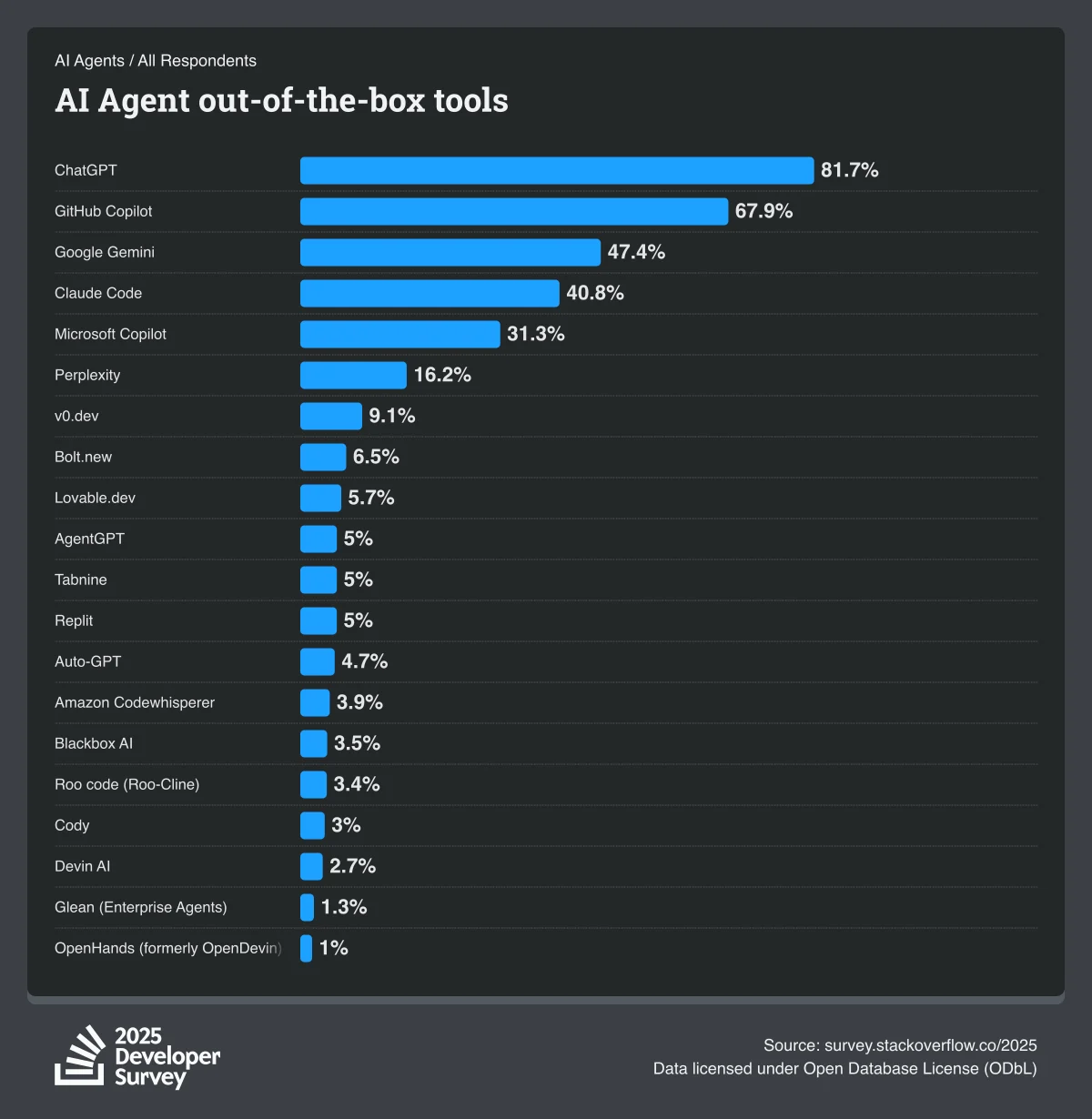
The global technology ecosystem stands at a critical juncture as the 2026 Stack Overflow Developer Survey prepares to release its latest findings. With fifteen years of longitudinal data as a foundation, the transition from 2024 to 2026 represents one of the most volatile and transformative periods in the history of software development. By analyzing year-over-year trends across three core pillars—the evolution of artificial intelligence (AI), the changing dynamics of the human workforce, and shifting community demographics—a picture emerges of an industry that is rapidly automating while simultaneously growing more skeptical of the tools it employs. The following analysis synthesizes data from the 2024 and 2025 surveys, supplemented by a specialized April 2026 pulse survey, to provide a comprehensive view of how developers are navigating this new era.
The Rapid Ascent of AI Integration and the Rise of Autonomous Agents
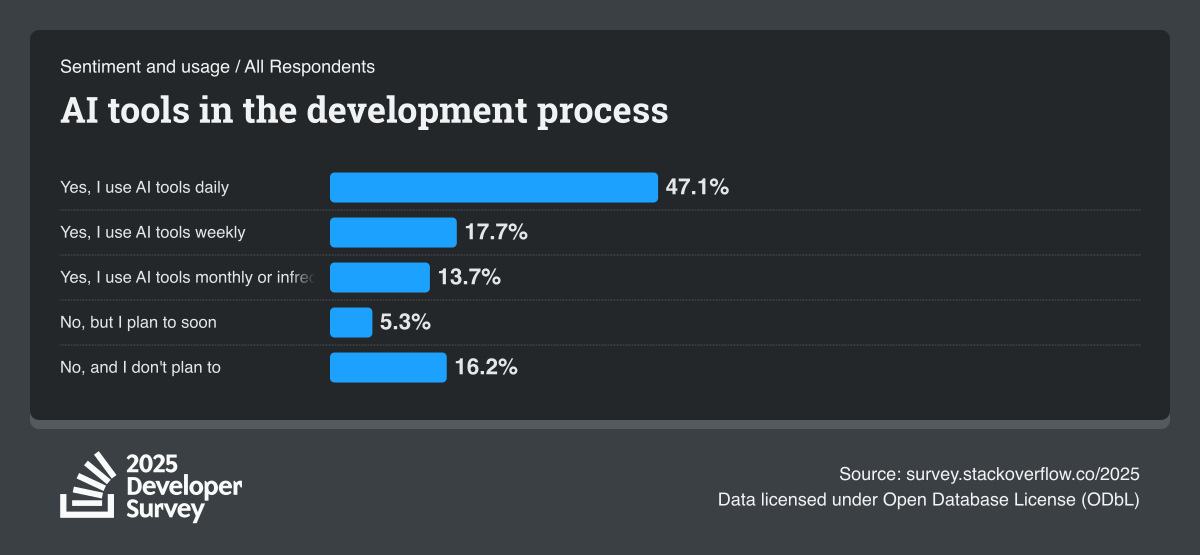
The integration of AI into the software development lifecycle has moved from a speculative novelty to a functional requirement in less than three years. In 2023, when Stack Overflow first began tracking AI usage, 44% of developers reported using AI tools. This figure surged to 62% in 2024 and reached a significant 79% by 2025. Current data suggests that nearly half of all professional developers now interact with AI tools on a daily basis, a frequency that suggests AI has become as foundational as the integrated development environment (IDE) or version control systems.
However, the nature of these tools is shifting. While 2024 was defined by "assistants"—tools that provide suggestions or autocomplete code—2025 and early 2026 have seen the rise of "agents." AI agents are distinguished by their ability to perform multi-step tasks with a degree of autonomy. In the 2025 survey, 31% of respondents were already utilizing agentic workflows, with OpenAI’s ChatGPT (82%) and GitHub Copilot (68%) serving as the primary gateways. By the April 2026 pulse survey, agent usage nearly doubled to 59%. Notably, newer, more specialized tools such as Claude Code saw their market share grow from 41% to 55% in just a few months, indicating that developers are moving away from general-purpose LLMs toward tools optimized for engineering contexts.

This growth is not uniform across all demographics. Data indicates that adoption is highest among those in executive leadership roles and daily power users. This suggests a top-down pressure to implement AI efficiencies, even as individual contributors maintain a more measured approach to how these tools are integrated into complex systems.
From Novelty to Pragmatism: The Cooling of AI Sentiment
Despite the record-breaking adoption rates, the "hype cycle" of AI appears to be entering a period of consolidation and skepticism. This is most visible among the student population—the next generation of the workforce. In 2024, 63% of students used AI resources; by 2025, that climbed to 73.3%. However, their enthusiasm has plummeted. Positive sentiment among learners dropped from 72.2% in 2024 to 52.8% in 2025. Conversely, skepticism quadrupled, rising from 6.4% to 26.3% over the same period.
This cooling trend is mirrored in the professional community. Overall positive sentiment fell from 72% in 2024 to 59.7% in 2025. Industry analysts suggest this is a result of "pragmatic evaluation." As developers move past simple code generation and attempt to use AI for complex architectural tasks, they are confronting the reality of inaccurate, incomplete, or confusing outputs. Trust in the accuracy of AI output among students fell from 49.1% to 37.4% year-over-year.
Perhaps most concerning for the future of the craft is the impact on problem-solving skills. In 2025, 20% of respondents reported feeling less confident in their own problem-solving abilities due to AI reliance, and 16.3% admitted they found it increasingly difficult to understand why the code generated by an AI actually worked. This has created a "comprehension gap," where the ability to produce working code is becoming decoupled from the ability to explain its underlying logic.
The Shifting Geography of the Workplace: Beyond the Remote-Office Binary
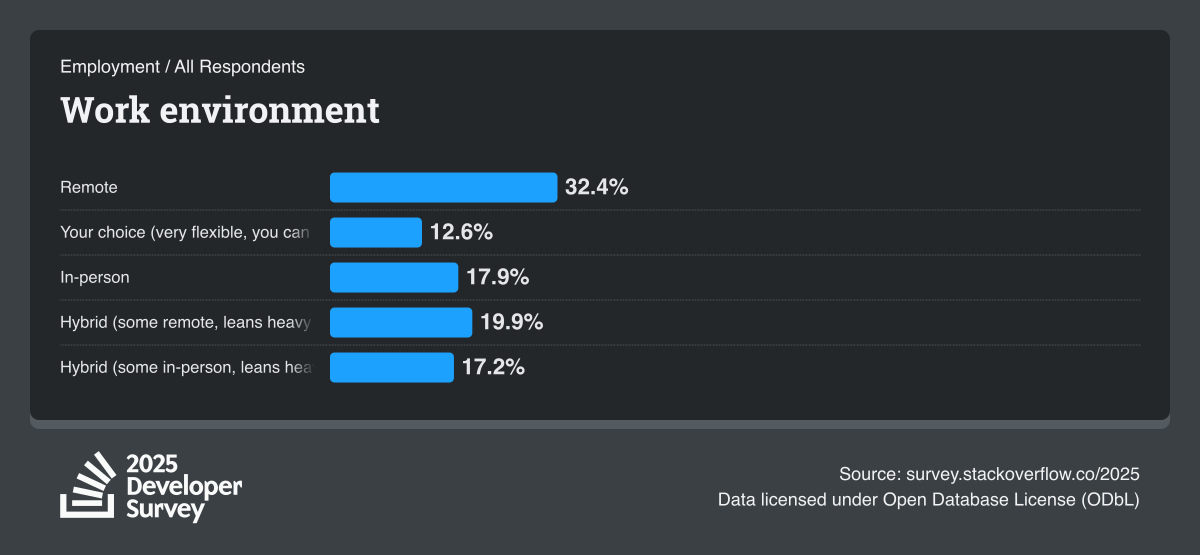
The Developer Survey has tracked work settings since 2019, documenting a historic shift in labor dynamics. In 2019, only 12% of developers worked fully remotely. This peaked in 2022 at 43% during the height of the global pandemic. By 2025, the market has settled into a more nuanced "structured hybrid" model.
The 2025 data reveals that 32.4% of developers remain completely remote, while 17.9% are strictly on-site. The remaining majority (approximately 50%) navigate various hybrid arrangements. A new category emerged in the latest data: the "flexible hybrid" or "choice" model, where 12.6% of developers have the autonomy to decide when to enter the office based on project needs rather than corporate mandates.
Regional variations provide a stark look at global cultural differences in tech work:
- United States: Leads in remote work at 45%.
- India: Boasts the highest share of strictly on-site professionals at 30.5%.
- Germany and the UK: Favor high-flexibility hybrid models, with German workers reporting exceptional levels of self-directed choice despite lower full-remote numbers.
- France: Shows the strongest preference for office-leaning hybrid arrangements (32.8%).
These figures suggest that "one-size-fits-all" return-to-office (RTO) mandates may struggle in a globalized talent market where regional expectations vary significantly.
Tool Sprawl and the Persistence of Enterprise Foundations
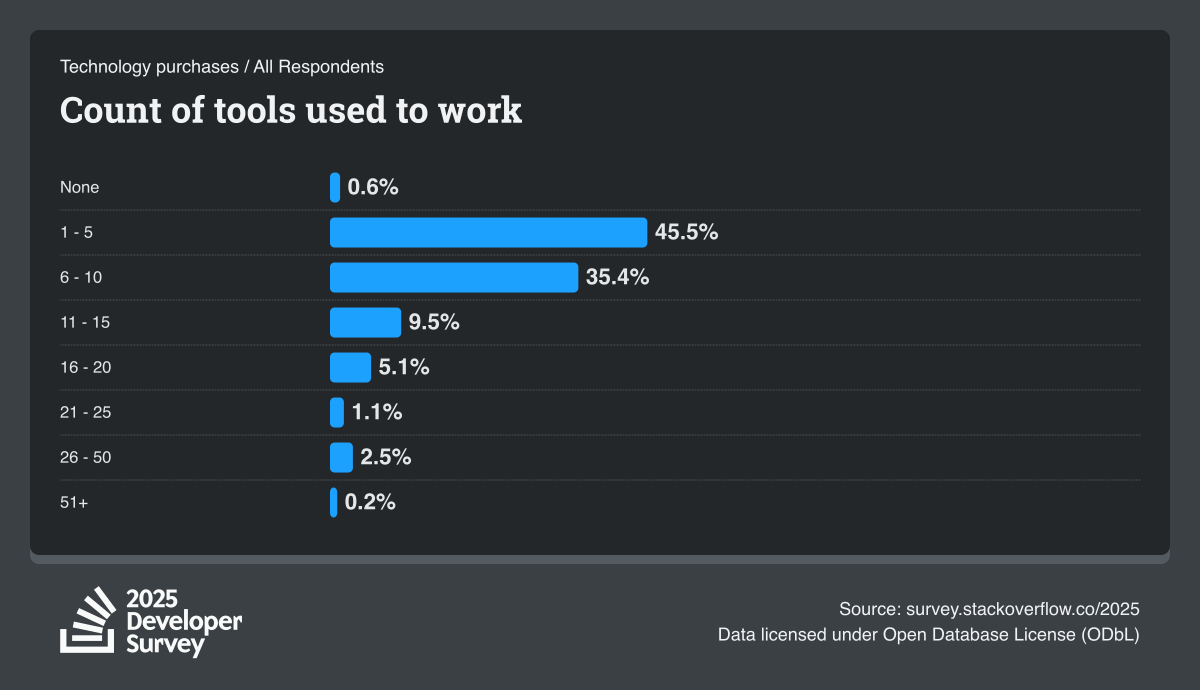
As AI tools flood the market, there is a growing concern regarding "tool sprawl"—the friction caused by switching between too many disparate systems. However, the 2025 survey shows that most engineers are successfully managing their ecosystems. Approximately 81% of developers use 10 or fewer primary tools. Only 3.8% of "power users" operate across 21 or more systems, highlighting that while the market is crowded, most developers curate a lean, functional stack.
While AI tools like Cursor (17.9%) and Windsurf (4.9%) are making inroads, the foundational enterprise layer remains remarkably stable and continues to expand:
- Docker: Usage grew from 35% in 2020 to 71.1% in 2025.
- PostgreSQL: Now used by 55.6% of developers, up from 32.9% in 2018.
- Kubernetes: Has tripled its footprint since 2019, now reaching 28.5%.
In the realm of collaboration, a clear shift in preference has occurred. Microsoft Teams usage surged from 25.6% in 2020 to 53.1% in 2024, largely at the expense of Zoom, which dropped from 56.1% to 40% in the same period. Slack has also seen a moderate decline from 53% to 43.9%, suggesting that the integration of communication tools into broader enterprise suites (like Microsoft 365) is winning out over best-of-breed individual platforms.
Economic Realities and the "Complacency" Crisis
Job satisfaction in the 2025 survey presents a sobering reality for tech recruiters and HR departments. Only 24.5% of developers report being "genuinely happy" at work. The largest segment—47.1%—identifies as "complacent," while 28.4% are actively unhappy. This "complacency gap" suggests that while developers are not necessarily resigning in mass numbers (likely due to broader economic uncertainty), they are also not deeply engaged or inspired by their current roles.
Regional happiness levels show the US at the top (28.7% happy) and Germany at the bottom (19.2% happy, with over 50% complacent). India reported the highest level of active unhappiness at 32.7%.
When asked what factors contribute most to job satisfaction, developers prioritized:
- Autonomy and Trust: The ability to manage their own tasks.
- Compensation: Competitive pay and benefits.
- Impact: Solving real-world, complex problems.
The emphasis on autonomy is particularly relevant as AI agents become more prevalent. As machines take over more of the "execution" of code, developers are placing a higher premium on the "ownership" of the solution.
Economically, the 2024–2025 period saw significant salary gains for specialized roles. Product Managers and Applied Scientists saw median compensation jumps of nearly 30%. Conversely, traditional infrastructure roles like System Administrators (8.4%) and Cloud Infrastructure engineers (6.7%) saw much more modest growth. This reflects a market that is aggressively rewarding roles that bridge the gap between AI research and product delivery.
Implications for the Future: The Human Element in an Automated Workflow
The data from the 2024 and 2025 surveys, looking toward the 2026 results, suggests that the developer of the future is not someone who is replaced by AI, but someone who manages AI while maintaining a deep connection to human communities.
When asked about a future where AI can perform most coding tasks, 61.3% of developers stated they would still seek human help to fully understand a concept, and 58.1% would seek a person to learn best practices. This underscores a vital truth: AI is an excellent tool for "doing," but it remains a poor tool for "mentoring." The reliance on community-vetted platforms like Stack Overflow remains high, with 68.7% of users seeking reliable, human-verified guidance.
As the 2026 survey results prepare to drop, the industry must answer how it will support this "mixed reality." The trend is clear: more AI in the workflow, higher scrutiny of its limitations, and an intensified need for professional autonomy and trustworthy human context. The transition from 2025 to 2026 will likely be remembered as the year the tech industry stopped asking if it should use AI, and started asking how to remain human while doing so.