Lina Irawan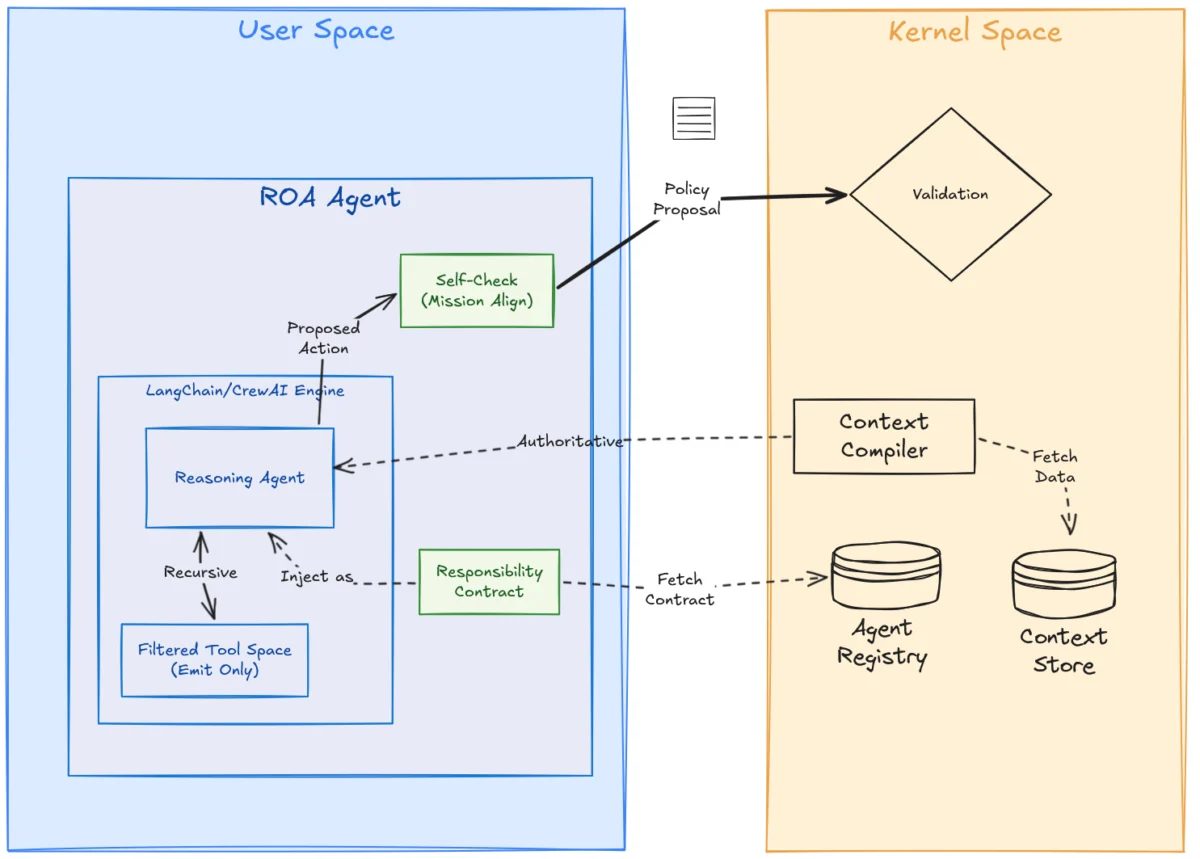
The rapid evolution of artificial intelligence has moved the industry from simple retrieval-augmented generation (RAG) chatbots to sophisticated "agentic" systems capable of autonomous reasoning and action. However, as these agents transition from research copilots to production actors—authorized to move capital, manage critical infrastructure, or modify sensitive medical records—the traditional methods of governance have proven inadequate. The industry is currently facing a critical inflection point where the focus must shift from what an agent can do to what it is authorized to do. This paradigm shift, known as Responsibility-Oriented Agents (ROA), introduces a deterministic execution kernel designed to validate every proposed action before it affects the real world, ensuring that high-stakes systems operate within strict, machine-enforceable boundaries.
The Scalability Trap of Human-in-the-Loop Governance
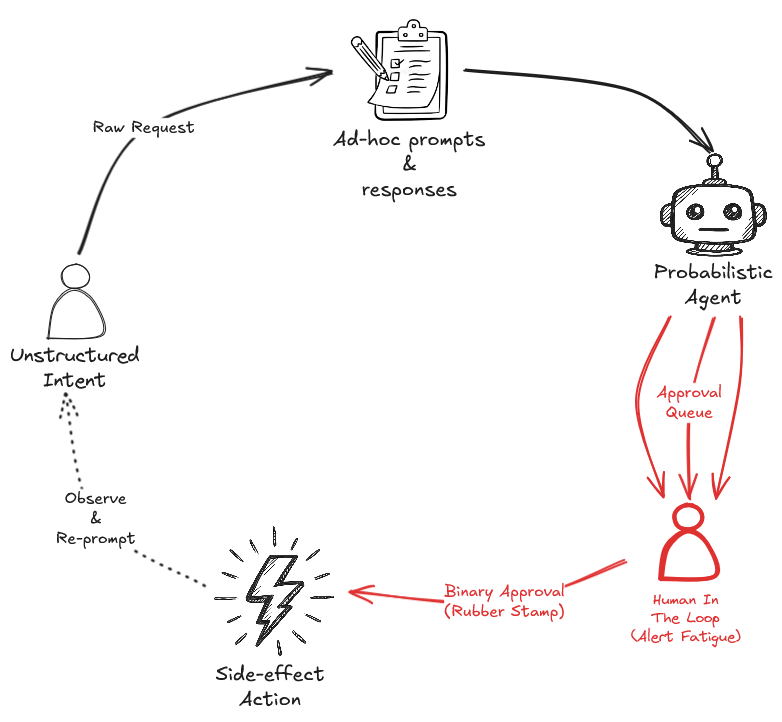
For the past several years, the standard safety protocol for AI agents has been the Human-in-the-Loop (HITL) model. In this framework, any decision involving external state mutation is routed to a human operator for approval. While this approach is functional in low-frequency development environments, it creates what experts call the "Scalability Trap" when deployed in high-volume production settings.
Data from the cybersecurity and financial sectors suggest that human operators are susceptible to "alert fatigue" when forced to manage dozens of decisions per hour. In a typical enterprise environment with hundreds of agents operating simultaneously, the queue of requests for human review grows exponentially. Under pressure to maintain throughput, human reviewers often stop scrutinizing the underlying JSON payloads and begin approving actions reflexively. This degrades governance into a manual throughput management exercise rather than a meaningful safety check.
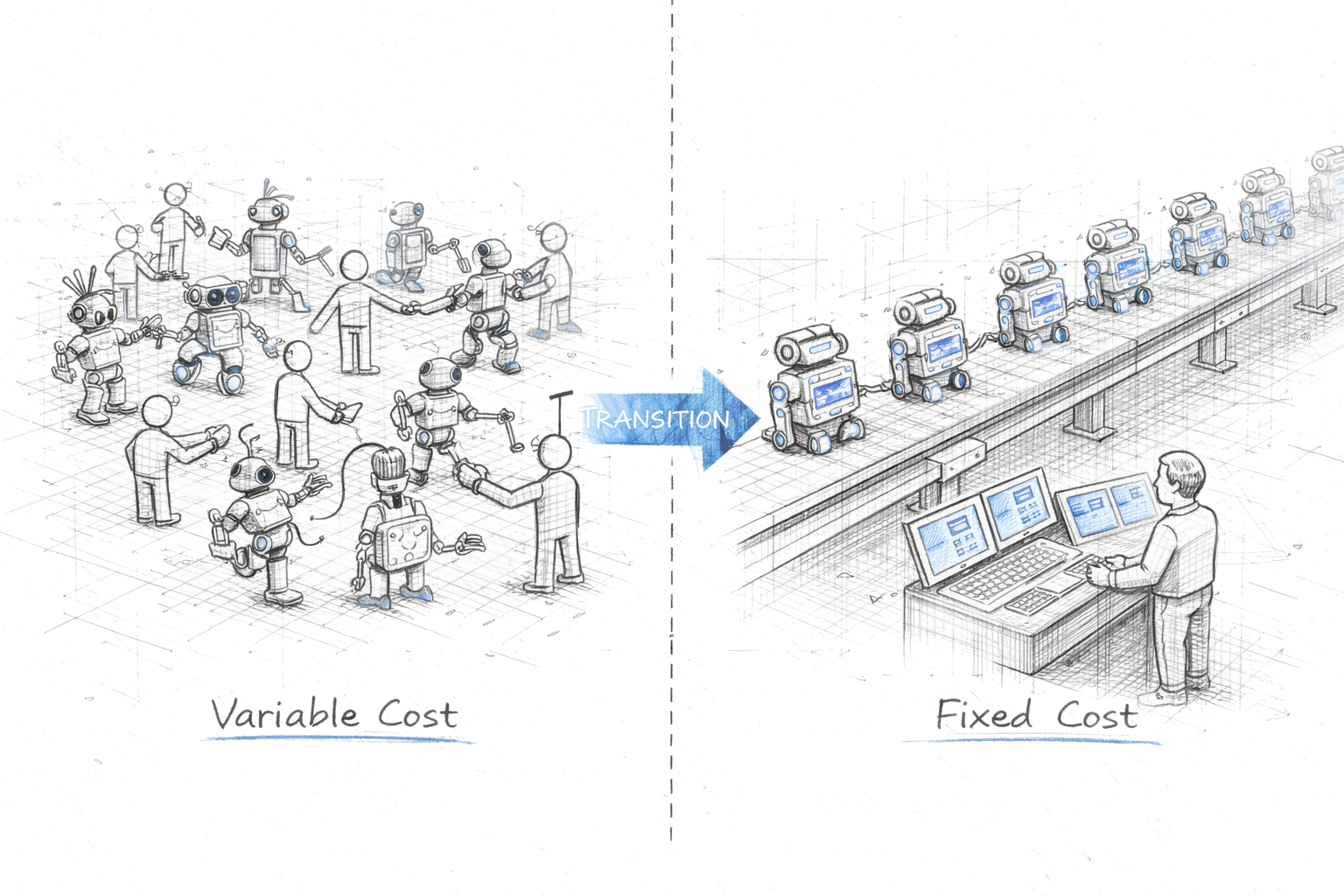
Industry analysts point to a growing "governance-layer technical debt" created by routing too many binary decisions through manual queues. As AI capabilities expand, the cost of human supervision scales linearly with agent volume, making the HITL model economically and operationally unsustainable for large-scale deployments.

A Chronology of Agentic Development and the Rise of ROA
The path to Responsibility-Oriented Agents can be traced through several distinct phases of AI development:
- The Conversational Era (2022–2023): Focused on Large Language Models (LLMs) as interfaces for information retrieval and summarization.
- The Capability Era (2023–2024): The emergence of frameworks like LangChain and AutoGen, which equipped agents with "tools" and API access, allowing them to perform tasks like code execution and database queries.
- The Accountability Crisis (Late 2024): Organizations began realizing that giving agents "capabilities" without deterministic "responsibilities" led to unpredictable behaviors and security vulnerabilities, such as prompt injection and state-mutation errors.
- The Governance Era (2025 and beyond): The introduction of the ROA pattern, which emphasizes "Governance by Exception" over constant manual intervention.
This evolution mirrors the history of distributed systems. In 1973, Carl Hewitt introduced the Actor Model, which defined computational entities by their messaging interfaces rather than their internal logic. ROA adapts this 50-year-old principle for the AI era, treating the agent as a "decision actor" that proposes intent but lacks the inherent authority to execute it without kernel-level validation.
The Five Pillars of the Responsibility-Oriented Agent Pattern
To transform a probabilistic LLM into a governable production component, the ROA architecture relies on five engineering pillars. These pillars collectively address the failure modes found at the boundary between AI reasoning and real-world execution.
1. The Responsibility Contract
Unlike a system prompt, which is a natural-language suggestion, the Responsibility Contract is a versioned, machine-readable file (often YAML or JSON) registered in a central Agent Registry. It defines the "authority envelope" of the agent. For example, a trading agent might have a contract field max_order_size_usd: 10000.0. If the agent attempts to propose a trade of $15,000, the deterministic runtime kernel rejects the action immediately. Because this enforcement happens in "Kernel Space" rather than the agent’s "User Space," it is immune to prompt injection or reasoning drifts within the LLM.
2. Mission Integrity
While the Contract defines what an agent may do, the Mission defines what it should optimize for. In the ROA framework, the Mission is a deployment artifact that includes a human-readable statement and a machine-verifiable context hash. This hash ensures that the agent’s objective remains immutable at runtime. If a malicious actor attempts to redirect an agent’s goal through a "jailbreak" prompt, the resulting proposal will fail a hash-integrity check, preventing the system from executing the corrupted intent.
3. Epistemic Isolation
ROA agents operate under a "Claims, Not Commands" philosophy. The agent does not have direct access to external API keys or database write-privileges. Instead, its only output is a structured PolicyProposal. This proposal includes an "Explain" narrative (human-readable justification) and a "Policy" block (machine-enforceable data). By isolating the agent from the execution channel, the system ensures that no action is taken without being parsed and validated by the deterministic runtime.
4. Longevity and Decision Trajectory
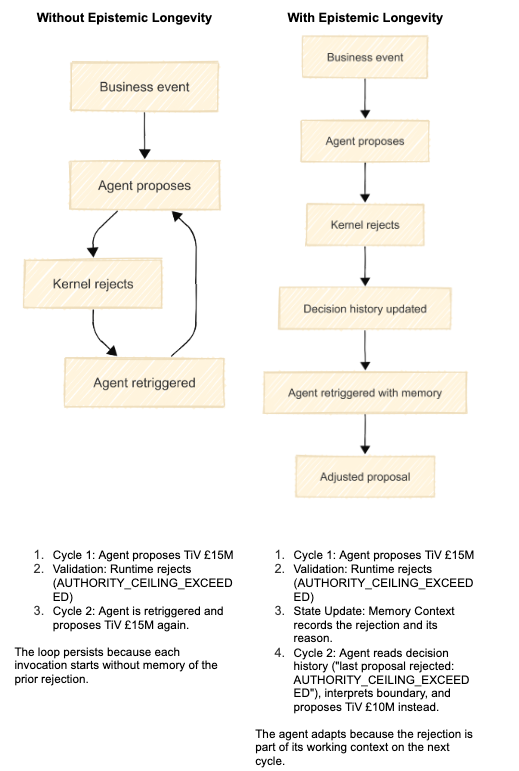
A common failure in current AI agents is "decision amnesia," where an agent repeats the same rejected action because it lacks a persistent memory of its governance history. ROA agents are designed as long-lived entities that maintain a "decision trajectory." This record includes prior proposals, validation outcomes, and the business consequences of past actions. This continuity allows the agent to learn from rejections and prevents infinite loops of invalid proposals.
5. Structured Auditability (DFID)
Every decision in an ROA system is bound to a Decision Flow ID (DFID). This creates a relational trace that connects the agent’s identity, the version of its contract, the exact snapshot of the world it observed (the Working Context), and the final execution outcome. This level of telemetry is essential for compliance with emerging regulations, such as the EU AI Act, which requires high-risk AI systems to maintain detailed logs and ensure human-reconstructable decision paths.
From Human-in-the-Loop to Human-Over-The-Loop
The ROA pattern facilitates a shift toward the Human-Over-The-Loop (HOTL) model. In this setup, the human’s role changes from an "approval clerk" to a "Policy Designer." The agent operates autonomously within its predefined contract, and the system escalates only "exceptions" to the human operator.
Escalation triggers are not left to the agent’s own assessment of its "confidence." Instead, the runtime kernel forces escalation if:
- The proposal violates a contract boundary (e.g., a transaction limit).
- The agent signals uncertainty below a hard-coded threshold (e.g.,
confidence < 0.65). - The execution environment has drifted too far from the state the agent originally observed (Time-of-Check to Time-of-Use protection).
This "Governance by Exception" allows a single human operator to supervise a much larger fleet of agents without suffering from fatigue, as they are only pining for high-stakes decisions that require genuine subjective judgment.
Industry Implications and Regulatory Context
The transition to responsibility-oriented architectures comes at a time of increasing regulatory scrutiny. The European Union’s AI Act, which entered into force in 2024, categorizes AI systems by risk level. "High-risk" systems—those used in critical infrastructure, recruitment, or financial services—are subject to strict requirements regarding risk management, data transparency, and human oversight.
The ROA pattern provides a technical blueprint for meeting these legal requirements. By separating reasoning (probabilistic) from execution (deterministic), organizations can provide regulators with "proof-carrying intent." This allows for independent verification of an AI’s actions without requiring the regulator to trust the "black box" of the LLM’s internal weights.
Furthermore, economic analysis suggests that the ROA model significantly reduces operational costs. While the initial engineering overhead of defining contracts and building a deterministic kernel is higher than simply deploying a prompt-based agent, the long-term savings in human supervision and the mitigation of "catastrophic tail risk" (expensive errors) make it the preferred choice for enterprise-grade deployments.
Integrating ROA with Existing Frameworks
Adopting ROA does not require discarding popular orchestration tools like LangChain, CrewAI, or AutoGen. Instead, the ROA pattern acts as a governance wrapper. In a typical implementation, an organization might use LangChain to handle the agent’s internal reasoning and tool use within a sandbox. However, the "execution tool" provided to that agent is restricted to a single function: emit_policy_proposal().
The framework handles the complexity of the reasoning loop, but the ROA wrapper ensures that the final output is captured, structured, and passed to the "Kernel Space" for validation. This allows developers to maintain the agility of modern AI frameworks while imposing the rigor of enterprise governance.
Conclusion: The End of the AI Demo Era
The era of AI demos, where a "clever" prompt was sufficient to showcase potential, is rapidly coming to an end. As enterprises move toward production-ready AI, the distinction between a successful deployment and a costly failure will lie in the architecture of governance.
Responsibility-Oriented Agents represent a move toward "Decision Intelligence," where the goal is not just to build more intelligent models, but to build more governable systems. By shifting the focus from capabilities to responsibilities, and from commands to claims, the industry can finally build the infrastructure necessary for agents to move from the sandbox to the center of global commerce and infrastructure. The future of AI is not unconstrained autonomy, but rather autonomous operation within deterministic, human-defined boundaries.