Vera Intan Clara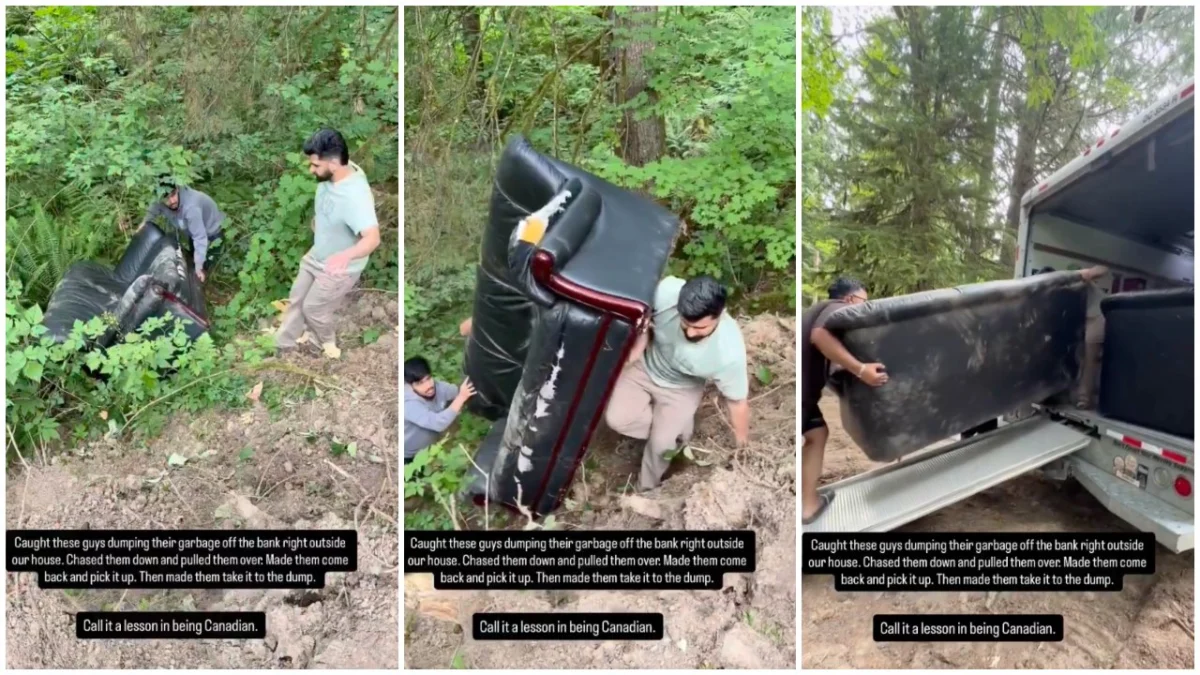
A recent viral video has captured widespread attention across Canada and beyond, depicting a local man confronting three individuals he claims to have caught in the act of illegally dumping an old couch in a wooded area near his home. The incident, which culminated in the men being compelled to retrieve the discarded furniture and transport it to a proper waste facility, has ignited a fervent online discussion regarding environmental ethics, community vigilance, and, controversially, the intersection of immigration and societal norms. The footage, initially shared by the intervening citizen, quickly gained traction, becoming a flashpoint for various interpretations and sparking both praise for the man’s decisive action and critical commentary on broader social issues.
The Incident: A Citizen’s Intervention
The sequence of events, as narrated by the man who filmed the encounter, began when he observed three individuals attempting to dispose of a dilapidated, ripped black leather couch off a bank in a forested area adjacent to his residence. This act of "fly-tipping," as illegal dumping is commonly known, immediately prompted his intervention. Rather than passively observing or reporting the incident to authorities after the fact, the man chose to directly confront the perpetrators. He reportedly pursued their vehicle, managed to pull them over, and then firmly instructed them to return to the site of the dumping.
The viral clip opens with the three men visibly engaged in the arduous task of hauling the heavy, soiled couch back up the steep bank, a scene underscored by the man’s accompanying commentary. His caption on the original video clearly articulated his objective: "Caught these guys dumping their garbage off the bank right outside our house. Chased them down and pulled them over. Made them come back and pick it up. Then made them take it to the dump." The footage then presumably concludes with the man escorting the reluctant dumpers directly to a municipal landfill or waste transfer station, ensuring the proper disposal of the item. This direct, no-nonsense approach resonated with many viewers, who lauded the man for taking personal responsibility for his community’s environment and for holding others accountable for their actions. His concluding remark in the original caption, "Call it a lesson in being Canadian," further framed the incident within a context of civic duty and respect for the natural landscape.
The Online Amplification and Controversial Narrative
The video’s journey to widespread virality began after it was re-shared by an X (formerly Twitter) user, @ImMeme0, significantly amplifying its reach. Within 24 hours of this repost, the clip garnered over 22,000 likes and countless shares, propelling it into the mainstream consciousness. However, the repost came with an additional layer of commentary that fundamentally altered the narrative for many viewers. The X account’s caption read: "In Canada, a local man caught immigrants dumping old couches in the forest right by his house. He tailed them, forced them to pick everything up, and escorted them straight to the landfill. This is the reality of importing Third World behaviors into a First World country."
This specific framing, which explicitly labeled the individuals as "immigrants" and linked their alleged actions to "Third World behaviors," introduced a highly contentious and racially charged dimension to the discussion. It is crucial to note that the original poster’s caption did not contain any references to the men’s immigration status or origin. The assumption made by the reposting account, therefore, sparked a fierce debate online, shifting the focus from the act of illegal dumping itself to broader, often divisive, discussions about immigration, cultural assimilation, and national identity.
Public Reaction: Praise, Criticism, and Counter-Narratives
The comment sections across various platforms quickly became a battleground for diverse opinions. A significant portion of the feedback expressed strong approval for the man’s initiative. Users praised his courage and commitment to environmental protection. "Good on him for making them clean it up," one person commented, echoing a common sentiment of satisfaction that justice was served. Another user lamented, "It’s sad that he had to teach 3 Grown A** men the right way to function in the real world," highlighting the perceived lack of basic ethical understanding among the dumpers.
However, the controversial caption from @ImMeme0 also drew sharp criticism and generated powerful counter-narratives. Many users were quick to challenge the unsubstantiated claim about the men’s immigration status and the xenophobic generalization that followed. "This s** happens all over white trash land too, it’s not an immigrant problem," one commenter retorted, emphasizing that illegal dumping is a pervasive issue across all demographics and socioeconomic strata, irrespective of national origin. This perspective underscored the danger of using isolated incidents to perpetuate harmful stereotypes and cautioned against attributing criminal or unethical behavior to entire groups of people without concrete evidence. The Daily Dot*, in its reporting, acknowledged its inability to independently verify the circumstances surrounding the video or the background of the individuals involved, further emphasizing the speculative nature of the "immigrant" claim.
The Broader Context: Illegal Dumping in Canada
Beyond the immediate incident and the ensuing online debate, the video serves as a stark reminder of the persistent problem of illegal dumping, or fly-tipping, in Canada. This environmental crime involves the unauthorized disposal of waste in public or private spaces not designated for garbage collection, such as forests, parks, roadsides, and vacant lots. It encompasses everything from household trash and construction debris to large items like appliances, tires, and, as seen in this video, furniture.
The consequences of illegal dumping are multifaceted and severe. Environmentally, it leads to soil and water contamination as hazardous materials leach into the ground and nearby water bodies. This pollution can harm local ecosystems, endanger wildlife through ingestion or entanglement, and degrade natural habitats. Furthermore, dumped waste can attract pests, create fire hazards, and diminish the aesthetic value of natural spaces, impacting recreational activities and tourism.
Economically, illegal dumping places a substantial burden on taxpayers and municipalities. Cleanup operations are costly, involving manpower, specialized equipment, and proper disposal fees. Experts estimate that illegal dumping costs Canadian municipalities millions of dollars annually, diverting funds that could otherwise be used for essential public services. For instance, some provincial reports indicate clean-up costs ranging from tens of thousands to hundreds of thousands of dollars for a single large site, accumulating rapidly across a province. Property values in areas prone to illegal dumping can also suffer, affecting local economies and community pride.
Legally, illegal dumping is a serious offense in Canada, subject to significant penalties under various municipal bylaws, provincial environmental protection acts, and even federal legislation. Fines for individuals can range from several hundred to tens of thousands of dollars, depending on the volume and type of waste, the location of the dump, and whether it’s a repeat offense. Corporations found guilty of illegal dumping face even steeper fines, potentially running into hundreds of thousands of dollars, along with possible imprisonment for egregious violations. Despite these deterrents, enforcement remains a challenge due to the clandestine nature of the act and the vastness of the areas where it occurs.
Proper Waste Disposal Infrastructure and Prevention Efforts
Canada has a well-developed waste management infrastructure designed to facilitate the proper disposal of all types of waste, including bulky items like furniture. Municipalities typically offer regular curbside collection, often with specific schedules for large item pick-up, or provide access to waste transfer stations, landfills, and recycling depots where residents can drop off items for a fee, or sometimes free of charge, especially during designated "free dump" days or community clean-up events. Many cities also have specific programs for hazardous waste and electronic waste, ensuring that potentially harmful materials are handled safely.
To combat illegal dumping, authorities employ a range of prevention and enforcement strategies. These include public awareness campaigns to educate residents about proper disposal methods and the environmental impact of dumping, increased surveillance in known hot spots (e.g., through hidden cameras), dedicated hotlines for reporting illegal dumping, and proactive patrols by bylaw officers and environmental enforcement agencies. Community involvement, as demonstrated by the man in the video, is also a crucial component of prevention, as vigilant citizens can act as additional eyes and ears for authorities.
Community Vigilance and the Ethics of Citizen Intervention
The viral video unequivocally highlights the power of community vigilance and citizen intervention. While the man’s actions were widely praised for their immediate effectiveness, such direct confrontations also raise questions about the ethics and safety of citizen intervention. On one hand, immediate action can deter offenders, prevent further environmental damage, and empower communities to take ownership of their surroundings. On the other hand, confronting individuals engaged in illegal activities carries inherent risks, including the potential for escalation, violence, or legal complications if the situation is mishandled. Law enforcement and environmental agencies typically advise citizens to report illegal dumping rather than confronting individuals directly, prioritizing personal safety. However, the incident serves as a powerful illustration of the frustration felt by many citizens when faced with blatant disregard for environmental regulations.
Conclusion: A Call for Responsibility and Unity
The viral video of the Canadian man confronting illegal dumpers has transcended a simple act of civic duty, evolving into a complex online discourse. While the core message of environmental responsibility and the necessity of proper waste management remains paramount, the incident also inadvertently exposed the fault lines of online commentary, particularly concerning issues of immigration and social prejudice.
Regardless of the background of the individuals involved, the act of illegal dumping is an unacceptable environmental crime with tangible negative consequences for communities and ecosystems. The widespread attention garnered by this video serves as a powerful reminder of the collective responsibility we all share in maintaining clean and healthy environments. It underscores the importance of utilizing established waste management systems and the need for public education to ensure that every individual understands and adheres to ethical disposal practices. Ultimately, while the online debate may have veered into contentious territory, the underlying message reinforced by the original act remains clear: protecting our shared environment is a universal responsibility that transcends divisive narratives, calling instead for unity in action and respect for the world around us.