Evan Lee Salim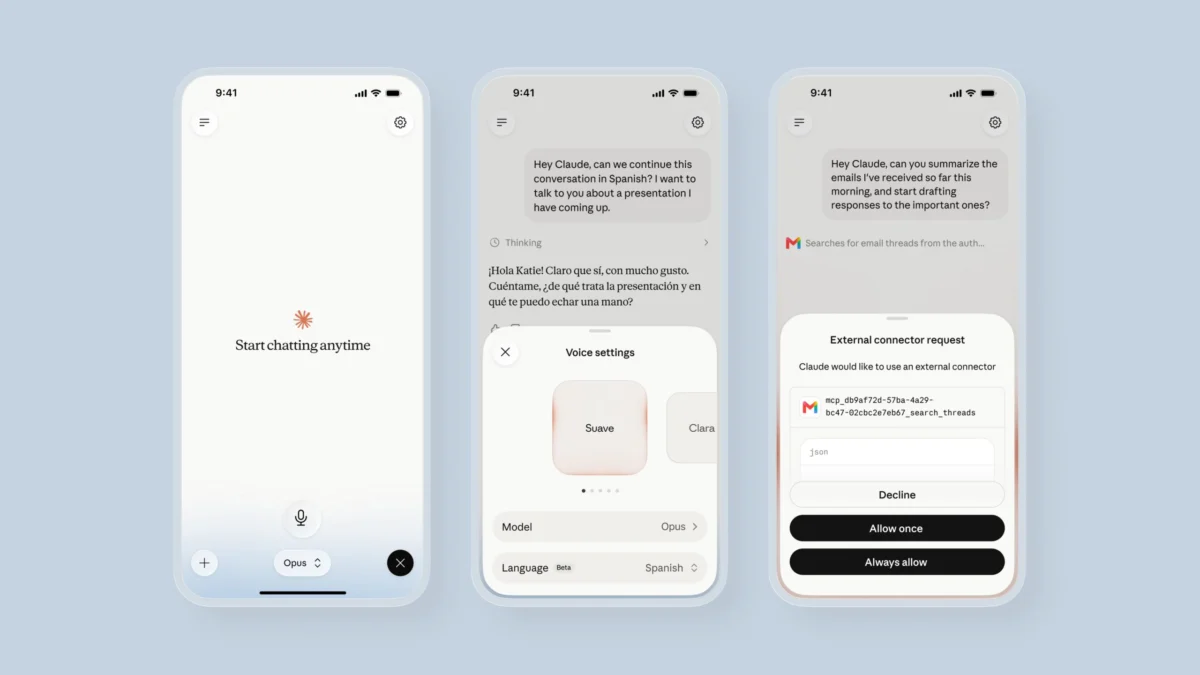
In a significant stride forward for conversational AI, Anthropic, a leading artificial intelligence research company, announced a major update to Claude’s voice mode on Thursday. This enhancement allows users to leverage the full spectrum of Claude’s powerful models—Opus, Sonnet, and Haiku—within voice interactions, moving beyond the previous limitation to just the Haiku model. Crucially, the update introduces robust integration with popular productivity applications such as Gmail, Google Calendar, Slack, Canva, and Notion, positioning Claude as a more versatile and deeply integrated voice assistant than ever before. This strategic move comes weeks after rival OpenAI unveiled its own updated family of conversational models and an improved voice mode for ChatGPT, underscoring the escalating competition in the rapidly evolving landscape of advanced AI interfaces.
The update signifies Anthropic’s commitment to transforming how users interact with large language models (LLMs), shifting from mere text-based queries to dynamic, multi-modal conversations that can directly influence and manage digital workflows. Prior to this release, Claude’s voice mode, initially launched last year and powered exclusively by the Haiku model, offered quick responses suitable for basic interactions but struggled with the complexity required for more nuanced and demanding tasks. Anthropic stated that the new voice mode intelligently defaults to the last model a user engaged with in text chat, utilizing its fastest version by default, thereby ensuring a seamless and contextually aware experience across different interaction modalities.
The Evolving Landscape of Conversational AI and Voice Interfaces
The realm of artificial intelligence has been witnessing an accelerated shift towards more natural and intuitive human-computer interaction. Voice interfaces, once confined to simple commands and basic information retrieval via early digital assistants like Siri, Alexa, and Google Assistant, are now at the forefront of this evolution, largely thanks to the advent of sophisticated LLMs. These advanced models have transcended rule-based systems, enabling AIs to understand context, engage in extended dialogues, and generate coherent, human-like responses. The market for conversational AI is experiencing explosive growth, projected to reach hundreds of billions of dollars within the next decade, driven by increasing consumer and enterprise demand for efficient, intelligent automation.
This burgeoning market has fostered intense competition among tech giants and AI startups alike. OpenAI, with its groundbreaking GPT series and widely adopted ChatGPT platform, has often set the pace, pushing boundaries in natural language understanding and generation. Anthropic, founded by former OpenAI researchers, has emerged as a formidable contender, emphasizing safety, interpretability, and robust performance with its Claude family of models. The current battleground increasingly extends beyond raw processing power and linguistic fluency to include user experience, integration capabilities, and practical utility in everyday tasks. Voice modes, in particular, represent a critical frontier, promising to unlock new levels of productivity and accessibility by allowing users to interact with AI hands-free and more spontaneously.
A Chronology of Voice Mode Advancements
The journey towards sophisticated AI voice interaction has been marked by several key developments:

- Early 2020s: Widespread adoption of basic voice assistants (Siri, Alexa, Google Assistant) for tasks like setting alarms, playing music, and basic web searches. These systems, while convenient, often lacked conversational depth and integration capabilities.
- Mid-2020s (Approx. 2025): The emergence of LLM-powered voice modes. Anthropic first launched its voice mode for Claude in 2025, initially powered by the lightweight and fast Haiku model. This offered users a more natural conversational experience compared to previous generations, albeit with limitations for complex tasks.
- Early 2026: Anthropic introduced multilingual support for Claude’s voice mode in beta, allowing users to converse in a growing list of languages, though requiring manual language specification. This expanded the accessibility and global reach of the feature.
- Weeks Prior to Current Announcement (July 2026): OpenAI rolled out a new family of conversational models and significantly updated ChatGPT’s voice mode. These updates focused heavily on enhancing the naturalness, fluidity, and expressiveness of the AI’s voice, including improvements in interruption handling and emotional nuance, aiming for a more human-like interaction.
- Current Announcement (July 2026): Anthropic’s latest update to Claude’s voice mode, allowing model selection (Opus, Sonnet, Haiku) and deep integration with third-party applications. This represents a strategic pivot towards functional utility and workflow integration as a primary differentiator.
Unlocking New Levels of Productivity with Claude’s Enhanced Voice Mode
The core of Anthropic’s latest update lies in its expanded utility, driven by the ability to select models and integrate with external applications.
Flexible Model Selection: Users can now choose between Claude’s Opus, Sonnet, and Haiku models directly within voice mode.
- Opus: Anthropic’s most intelligent model, ideal for highly complex analyses, strategic planning, and nuanced conversations where accuracy and depth are paramount.
- Sonnet: A balanced model, offering a strong blend of intelligence and speed, suitable for a wide range of general-purpose tasks and everyday productivity.
- Haiku: The fastest and most compact model, perfect for quick interactions, rapid information retrieval, and scenarios where immediate responses are critical.
This flexibility ensures that users can tailor Claude’s capabilities to the specific demands of their voice interactions, whether brainstorming complex product market research with Opus or quickly drafting an email with Haiku.
Transformative App Integrations: The most significant enhancement is Claude’s newfound ability to tap into other widely used applications. This transforms Claude from a passive conversational partner into an active agent capable of performing tasks across a user’s digital ecosystem.
- Gmail: Users can verbally instruct Claude to draft emails, summarize threads, or even schedule follow-ups, streamlining communication workflows. For example, "Claude, draft an email to John confirming our meeting next Tuesday at 10 AM, and attach the project proposal."
- Google Calendar: Scheduling and managing appointments become effortless. "Claude, find an open slot for a team meeting next week and invite the marketing team," or "Reschedule my 3 PM client call to tomorrow morning."
- Slack: Facilitating team collaboration, Claude can be instructed to post updates, share documents, or even summarize recent channel activity. "Claude, post a summary of today’s stand-up in the #dev-team channel."
- Canva: While specific actions might be limited, the integration suggests Claude could assist with creative tasks, perhaps by generating initial ideas, finding relevant templates, or even providing feedback on design concepts. "Claude, help me brainstorm some ideas for a new marketing flyer for our Q3 campaign using Canva."
- Notion: As a versatile workspace, Notion integration allows Claude to create new documents, add tasks to existing databases, or retrieve information, enhancing project management and knowledge organization. "Claude, create a new project brief in Notion for the ‘Website Redesign’ project and add a task for Sarah to review the wireframes."
These integrations move beyond simple information retrieval, enabling users to execute complex, multi-step tasks purely through voice, thereby significantly reducing friction and improving efficiency in professional and personal contexts. Anthropic highlights that this new voice mode is particularly adept at supporting longer conversations, offering feedback on communication style, assisting in practicing a client pitch, or facilitating detailed brainstorming sessions.
Multilingual Capabilities for a Global Audience:
Building on its earlier beta release, Claude’s voice mode now fully supports multilingual conversations. Users can interact in a growing list of languages, including English, French, German, Hindi, Indonesian, Italian, Japanese, Korean, Portuguese (Brazilian), and Spanish (Latin America/Spain). While users still need to manually specify the language, this feature significantly broadens Claude’s appeal and utility for a global user base, making advanced AI tools accessible to a wider demographic.
Competitive Edge: Anthropic’s Strategic Differentiation
The timing of Anthropic’s announcement, following closely on the heels of OpenAI’s voice mode updates, highlights the intense strategic maneuvering within the AI industry. While OpenAI focused on refining the conversational experience itself—making ChatGPT’s voice more natural, expressive, and adept at handling interruptions—Anthropic has chosen to emphasize functional utility and workflow integration.

This presents a clear divergence in strategic priorities. OpenAI aims for an AI that sounds and feels more human in conversation, enhancing the interactive rapport. Anthropic, conversely, is pushing Claude to be a more effective doer, a proactive assistant that can directly manipulate and manage tasks across a user’s digital workspace. The ability for Claude’s voice mode to tap into external applications like Gmail and Slack is a significant differentiator that OpenAI’s current voice mode does not yet offer. This means while ChatGPT might sound more like a human, Claude can actually do more for the user in terms of practical task completion and workflow automation.
However, it is important to note that Anthropic explicitly stated it made no changes to the underlying voice model with this release, nor has it detailed its voice stack. This implies that users might not observe the same level of conversational improvements—such as better interruption handling or more nuanced vocalizations—that OpenAI recently highlighted in its updates. This suggests a trade-off: Anthropic users gain powerful functional integrations, while OpenAI users might experience a more fluid and natural-sounding conversational partner. The choice between the two will likely depend on individual user priorities: do they value a more human-like conversation or a more capable, task-oriented assistant?
Broader Impact and Implications
This update from Anthropic carries significant implications across several dimensions:
- Enhanced Productivity: For professionals, the integration with common workplace tools promises substantial productivity gains. Imagine managing emails, scheduling meetings, and updating project documents all through voice commands, freeing up hands and cognitive load for other tasks. This aligns with the broader industry trend of leveraging AI to automate repetitive tasks and optimize workflows.
- Shifting User Expectations: As AI voice modes become more sophisticated and integrated, user expectations will undoubtedly rise. The ability to not just talk to an AI but also have it act on information across different platforms will become a baseline expectation for advanced conversational agents.
- The Future of Human-Computer Interaction: This move pushes the boundaries of multimodal interaction. Voice, combined with deep application integration, blurs the lines between conversational AI and traditional operating system interfaces. It hints at a future where voice could become a primary control mechanism for our digital lives, extending beyond mobile devices to smart offices and integrated home environments.
- Enterprise Adoption: The productivity-centric features, particularly the integrations with enterprise tools like Slack and Google Calendar, make Claude’s voice mode highly attractive for businesses seeking to empower their workforce with AI-driven efficiencies. This could accelerate the adoption of advanced AI assistants in corporate settings.
- Accessibility: For users with disabilities or those who prefer hands-free interaction, an integrated voice mode offers significant accessibility benefits, making complex digital tasks more manageable and inclusive.
- Intensified AI Competition: The "AI arms race" is clearly accelerating. Each company’s move pushes competitors to innovate faster, leading to rapid advancements beneficial to end-users. This continuous one-upmanship ensures that the capabilities of LLMs and their interfaces will continue to evolve at a breakneck pace.
Limitations and Future Outlook
Despite these impressive advancements, Anthropic’s new voice mode is not without limitations. Currently, it is available to all users in beta across platforms, but free users will face restrictions, limited to using only the Haiku model and with access to just one connected application. This tiered access model is common in the AI industry, encouraging users to subscribe to premium plans for full functionality.
The decision not to update the underlying voice model for conversational improvements, unlike OpenAI, might be a temporary strategic choice. As the AI market matures, companies may need to offer both highly natural conversational experiences and deep functional integrations to remain competitive. Future iterations from Anthropic could very well include enhancements to the voice model itself, focusing on aspects like improved speech synthesis, better interruption handling, and more nuanced emotional responses to match the fluidity offered by competitors.
Ultimately, Anthropic’s enhanced Claude voice mode represents a significant step towards a more functional, integrated, and productive AI assistant. By focusing on practical utility and seamless workflow integration, Anthropic is carving out a distinct competitive advantage in the crowded and rapidly evolving landscape of conversational AI, setting a new benchmark for what users can expect from their AI companions. The ongoing innovation from Anthropic and its rivals promises a future where AI interfaces are not just intelligent but also profoundly capable of transforming daily productivity.