Sisilia Frederika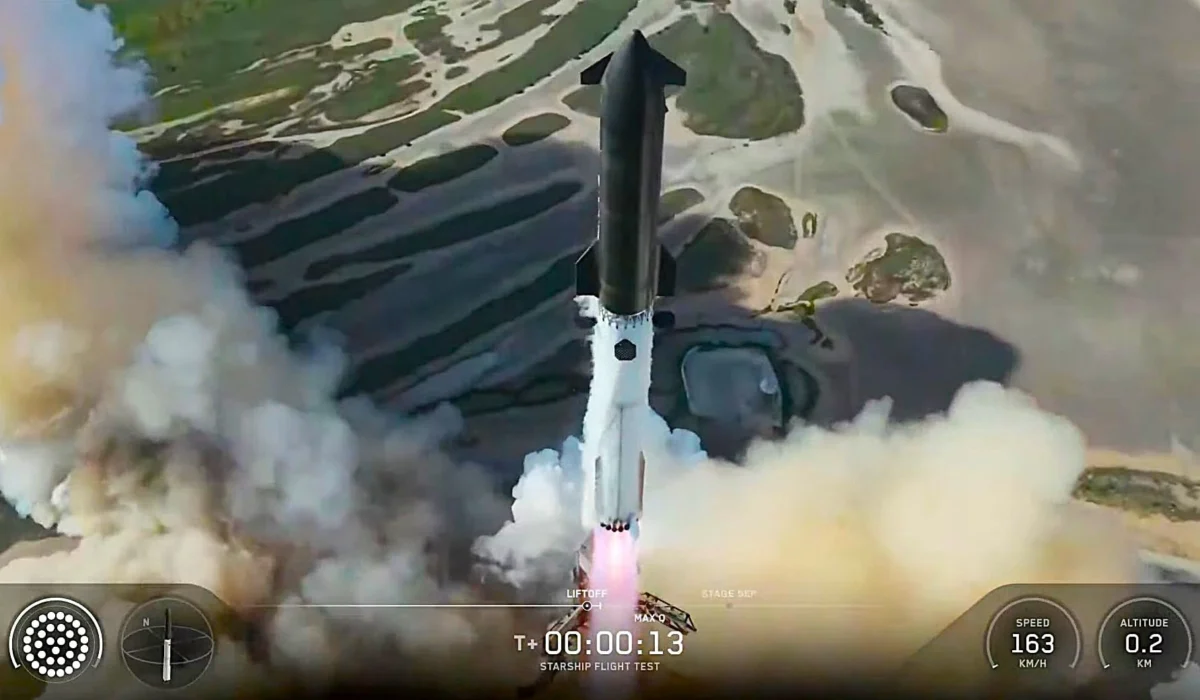
SpaceX successfully executed the 13th flight test of its Starship launch system today, marking a pivotal transition from purely experimental flights to the deployment of operational payloads. The mission, launched from the company’s Starbase facility in Boca Chica, Texas, achieved several critical milestones, including the first orbital release of next-generation Starlink V3 satellites and a record-breaking performance in aerodynamic pressure handling. This flight test was specifically engineered to address technical anomalies observed during previous missions, further refining the reliability of the world’s most powerful rocket as SpaceX moves closer to full reusability and high-cadence orbital operations.
The 407-foot-tall (124-meter) launch vehicle, comprised of the Super Heavy booster and the Starship upper stage (known simply as "Ship"), ascended from the launch pad at 5:51 p.m. CT (10:51 p.m. UTC). All 33 Raptor engines on the Super Heavy booster ignited successfully, providing the necessary thrust to lift the massive stainless-steel structure through the dense lower atmosphere. During the ascent, the vehicle reached a new milestone by setting a record for maximum dynamic pressure, or Max-Q, the point at which the mechanical stress on the rocket is at its peak due to a combination of the vehicle’s velocity and the surrounding atmospheric density.
The Sequence of Flight and Stage Separation
Following a successful ascent, the mission entered its first critical separation phase. Minutes after liftoff, the Starship upper stage executed a "hot-staging" maneuver, a technique where the upper stage engines ignite while still attached to the booster to maximize payload efficiency. Once separated, the Super Heavy booster performed a flip maneuver and initiated a boost-back burn to return toward Earth.
The booster’s objective was a controlled splashdown in the Gulf of Mexico. While the vehicle reached its target coordinates, the final landing burn encountered minor irregularities. SpaceX launch commentator Dan Huot reported that not all of the intended Raptor engines ignited during the final descent sequence. This resulted in what was described as a "spicier" splashdown—indicating a higher velocity or less controlled impact than the ideal "soft" landing—though the company confirmed the maneuver was executed within a safe parameters for the test environment. Despite the engine snags, the booster’s ability to navigate back to a precise location in the Gulf continues to validate SpaceX’s recovery algorithms.
Operational Debut of Starlink V3 Satellites
The primary objective of Flight 13 beyond flight dynamics was the testing of the Starlink V3 satellite deployment system. For the first time, the Starship upper stage carried 20 operational next-generation Starlink V3 units. These satellites were housed within a specialized deployment mechanism colloquially referred to as the "Pez Dispenser" due to its longitudinal ejection method.
Upon reaching the designated orbital trajectory, the Ship successfully deployed all 20 satellites. Following the release, SpaceX engineers conducted an intensive 20-minute testing window. This phase was critical for verifying the mechanical and electronic health of the new hardware. Engineers monitored the deployment of solar arrays and, perhaps most importantly, tested the satellites’ inter-satellite laser communication links. These laser systems allow the satellites to transmit data to one another in the vacuum of space, reducing the reliance on ground stations and lowering latency for end-users.
SpaceX engineer Kate Tice confirmed the success of the communications test, stating that the team established contact with all 20 units and verified the functionality of the laser systems. Although these satellites were fully operational V3 models, they were not intended for permanent orbit. Following the data collection phase, the satellites were commanded to re-enter the Earth’s atmosphere, where they were completely incinerated. This "disposable" deployment allowed SpaceX to gather real-world performance data on the V3 architecture before committing larger batches to permanent orbital slots.
Technical Specifications and the Impact of Starlink V3
The introduction of Starlink V3 represents a massive leap in telecommunications capability. These satellites are designed to support data download speeds of up to 1 terabit per second (Tbps) per satellite. This is a significant upgrade over the V2 and V2 Mini satellites that currently constitute the majority of the Starlink constellation.
The V3 architecture is specifically optimized for "direct-to-device" (D2D) services. This technology aims to provide cellular connectivity directly to standard unmodified smartphones, eliminating dead zones in remote areas without requiring specialized satellite phones. By utilizing the massive payload capacity of Starship, SpaceX intends to populate the orbit with these high-capacity units at a scale that traditional rockets, such as the Falcon 9, cannot match.
Reentry Dynamics and Indian Ocean Splashdown
While the satellites were undergoing their tests, the Starship upper stage continued its coasting phase before preparing for reentry. A key technical objective for this mission was the mid-flight relight of the Raptor engines. The Ship successfully reignited one of its six engines while in space, demonstrating the capability required for future deorbit burns and precision landing maneuvers.
The reentry phase provided some of the most dramatic visuals of the mission. As the Ship descended through the atmosphere at hypersonic speeds, it was enveloped in a superheated plasma field. High-definition video, transmitted in real-time via the Starlink network, showed the vehicle’s heat shield weathering the intense thermal load. SpaceX has made significant modifications to the thermal protection system (TPS) following previous tests, including the use of new adhesive methods and backup "ablative" layers beneath the primary ceramic tiles.
The Ship successfully navigated the "blackout" zone and performed a controlled descent into the Indian Ocean. Unlike previous tests where the vehicle disintegrated or exploded upon impact, Flight 13 concluded with what SpaceX described as its "softest splashdown" to date. The vehicle remained intact as it settled into the water, even as flames were visible from its base—a result of residual propellant.
"This is a dream scenario for the team that’s trying to get this heatshield data," noted Dan Huot. The ability to bring the Ship down intact in the ocean allows SpaceX to analyze how the tiles and the underlying structure survived the heat of reentry without the hardware being destroyed by a high-velocity impact.
Overcoming Previous Technical Hurdles
Flight 13 was the second test of the "Starship V3" rocket iteration, a beefed-up version of the original prototype that features improved structural integrity and updated engine configurations. The path to this launch was not without obstacles. An initial launch attempt scheduled for a week prior was aborted at the T-0 mark during the ignition sequence.
Post-abort telemetry revealed that four Raptor engines on the Super Heavy booster failed to ignite properly. Upon further inspection at the launch mount, SpaceX engineers identified concerns with a total of six engines. In a display of the company’s rapid turnaround capability, all six engines were replaced, and the vehicle was cleared for today’s successful attempt. This iterative "test-fail-fix" approach has been a hallmark of the Starship development program, allowing for faster evolution than traditional aerospace methodologies.
Chronology of SpaceX Starship Flight 13
- T-7 Days: Initial launch attempt scrubbed at ignition due to engine start-up anomalies.
- T-5 Days: Six Raptor engines replaced on the Super Heavy booster.
- T-0 (5:51 p.m. CT): Successful liftoff from Starbase, Texas. All 33 engines operational.
- T+2 Minutes: Vehicle reaches Max-Q, setting a new internal record for aerodynamic stress.
- T+3 Minutes: Hot-staging separation; Ship continues to orbit while Super Heavy begins return.
- T+7 Minutes: Super Heavy booster splashdown in the Gulf of Mexico (minor engine issues noted).
- T+20 Minutes: Ship reaches coasting altitude; "Pez Dispenser" deploys 20 Starlink V3 satellites.
- T+40 Minutes: Successful laser communication and solar array deployment tests completed.
- T+45 Minutes: Starlink V3 satellites begin controlled atmospheric reentry and disposal.
- T+1 Hour: Starship upper stage executes in-space Raptor relight.
- T+1 Hour 5 Minutes: Ship begins atmospheric reentry over the Indian Ocean.
- T+1 Hour 15 Minutes: Successful soft splashdown of the Ship in the Indian Ocean; mission concluded.
Broader Implications for Space Exploration
The success of Flight 13 carries heavy implications for the future of the Artemis program and SpaceX’s long-term goals. NASA has contracted SpaceX to provide a modified version of Starship as the Human Landing System (HLS) for the Artemis III and IV missions, which aim to return astronauts to the lunar surface. The consistent improvement in reentry stability and engine reliability demonstrated in this flight provides critical data for NASA’s safety certifications.
Furthermore, the operational deployment of Starlink V3 satellites signals a shift in the commercial space market. If SpaceX can reliably use Starship to deploy 20 or more high-capacity satellites per launch, the cost-per-bit of satellite internet will likely drop significantly, further solidifying Starlink’s dominant position in the global ISP market.
As SpaceX moves toward its 14th flight test, the focus is expected to shift toward catching the Super Heavy booster and the Starship upper stage using the "Mechazilla" launch tower arms. Today’s mission, by proving the vehicle can survive reentry and reach a precise splashdown point, brings the company one step closer to that goal of full, rapid reusability.