admin
admin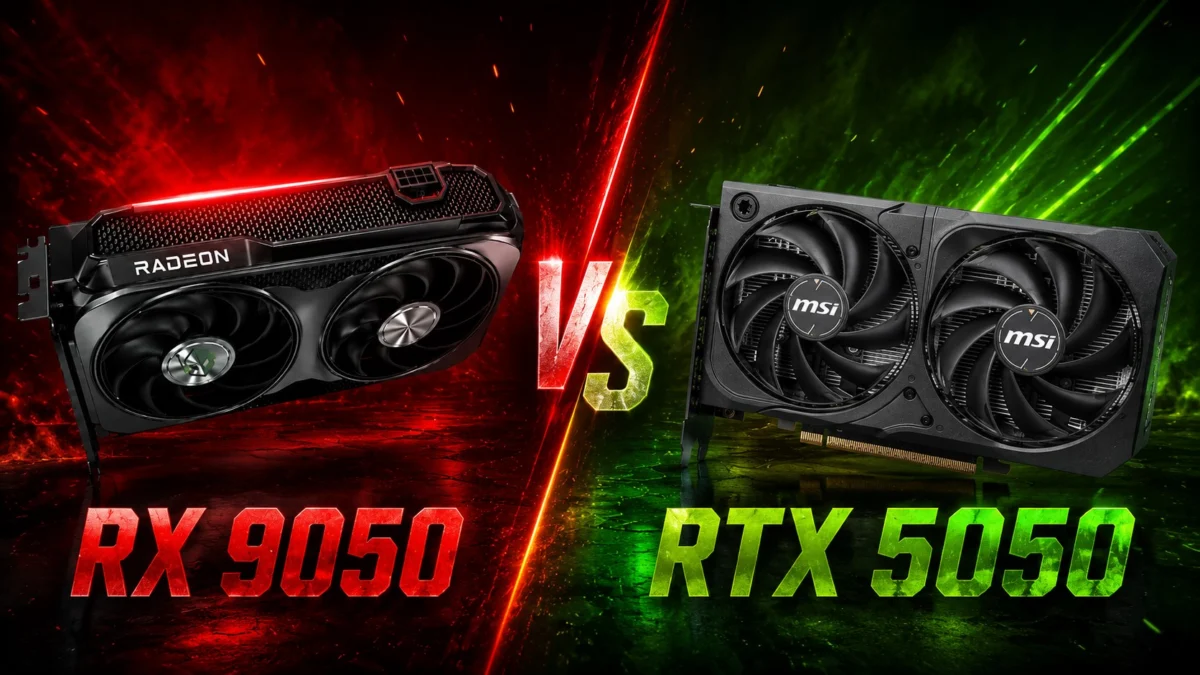
The graphics processing unit market has entered a new era of competition with the release of initial performance data for the entry-level segments of the AMD RDNA 4 and NVIDIA Blackwell architectures. Recent testing conducted by the Japanese technology outlet Hermitage Akihabara, commonly known as Hermita, has shed light on the performance delta between AMD’s newly released Radeon RX 9050 and NVIDIA’s GeForce RTX 5050. The results indicate a challenging start for AMD’s latest budget-oriented offering, as the RX 9050 appears unable to match the frame rates and synthetic scores of its direct NVIDIA counterpart, despite both cards targeting the entry-level consumer base.
Technical Overview and Testing Parameters
AMD recently expanded its RDNA 4 lineup with the introduction of the Radeon RX 9050, positioned as the most affordable entry point into the 9000-series family. To cater to different price points, the RX 9050 was launched in two configurations: a 4 GB VRAM variant and an 8 GB VRAM variant. For the purpose of providing a scientifically valid comparison, the Hermita benchmarks focused on the 8 GB edition of the RX 9050. This decision ensures parity with the NVIDIA GeForce RTX 5050, which also utilizes an 8 GB VRAM buffer, thereby eliminating memory capacity as a primary bottleneck during the comparative analysis.

The testing environment utilized a standardized suite of modern gaming titles and synthetic benchmarks to gauge raw rasterization performance, ray tracing capabilities, and the effectiveness of proprietary upscaling technologies. While entry-level cards are typically optimized for 1080p gaming, the benchmarks also explored 1440p performance to identify the limits of these low-tier architectures.
Comparative Gaming Performance Analysis
The most striking takeaway from the gaming benchmarks is the consistent performance lead maintained by the NVIDIA GeForce RTX 5050. Across a spectrum of popular titles, the AMD Radeon RX 9050 delivered performance that was approximately 20% to 30% lower than that of the RTX 5050.
In Final Fantasy XIV: Golden Legacy, a title often used to measure stability in massively multiplayer online environments, the RX 9050 lagged behind the RTX 5050 by a margin of 23% to 27%. This gap remained relatively consistent across different resolutions, suggesting that the architectural differences between RDNA 4 and Blackwell are significant even in less demanding engines.

The disparity grew more pronounced in fast-paced competitive shooters. In Apex Legends, the RX 9050 recorded average frames per second (FPS) counts that were 26% to 30% lower than the NVIDIA card. Similarly, in Rainbow Six Siege X, the AMD GPU remained roughly 20% slower. An interesting observation noted during the testing was that the performance gap was most expansive when games were run on "Medium" graphical presets. On "Ultra" settings, the RX 9050 managed to narrow the gap slightly, though it never surpassed or equaled the RTX 5050. This suggests that while AMD’s architecture may handle higher-fidelity assets with reasonable efficiency, its raw throughput at lower settings is significantly outmatched by NVIDIA’s Blackwell entry-level silicon.
Synthetic Benchmarks and Ray Tracing Capabilities
Synthetic benchmarks often serve as a "best-case scenario" for GPU architectures, stripping away the variables of game engine optimization. However, even in this controlled environment, the RX 9050 struggled to gain ground. In the 3DMark suite, the differences were stark:
- 3DMark Speed Way and Port Royal: These tests, which focus heavily on ray tracing and advanced lighting techniques, showed a "drastic difference" favoring NVIDIA. This continues a historical trend where NVIDIA’s dedicated RT (Ray Tracing) cores outperform AMD’s integrated Ray Accelerators.
- Steel Nomad and Fire Strike: These rasterization-heavy tests further confirmed the 20-30% performance deficit for the RX 9050.
- Time Spy: This was the only benchmark where the RX 9050 showed competitive proximity to the RTX 5050. In the standard Time Spy test, the AMD card was much closer to its rival, indicating that in certain DirectX 12 workloads, the RDNA 4 architecture can hold its own, even if it does not ultimately win the race.
The Role of Upscaling: FSR 4.1 vs. DLSS 4.X
A critical component of modern GPU performance involves AI-driven upscaling and frame generation. The Hermita report briefly touched upon titles like Cyberpunk 2027 and Doom: The Dark Ages, which utilize AMD’s FidelityFX Super Resolution (FSR) 4.1 and NVIDIA’s Deep Learning Super Sampling (DLSS) 4.X.

When these technologies were engaged, the RTX 5050 pulled significantly further ahead. NVIDIA’s DLSS 4.X, which utilizes specialized Tensor cores for AI-based frame reconstruction, provided a smoother and more visually stable experience compared to AMD’s FSR 4.1. While AMD has made strides in moving FSR toward an AI-based approach with RDNA 4, the initial benchmarks suggest that NVIDIA’s head start in machine learning hardware continues to yield superior real-world results in the entry-level market.
Chronology of the RDNA 4 and Blackwell Launch
The current performance landscape is the result of a multi-year development cycle for both companies.
- Late 2023 – Early 2024: Rumors began circulating that AMD would pivot its RDNA 4 strategy. Unlike RDNA 3, which attempted to compete at the ultra-enthusiast level with the RX 7900 XTX, RDNA 4 was rumored to focus on the "mainstream" and "entry-level" segments to regain market share.
- Q2 2024: NVIDIA officially unveiled the Blackwell architecture, emphasizing massive gains in AI compute and power efficiency.
- Q3 2024: AMD confirmed the RX 9000 series, highlighting the RX 9050 as a "budget champion" designed to bring RDNA 4 features to the masses.
- July 2026 (Benchmark Date): The first independent reviews from outlets like Hermitage Akihabara hit the public, providing the first concrete evidence that the RX 9050 might be underpowered relative to its competition.
Pricing and Market Value Proposition
The most contentious aspect of the RX 9050 launch is its pricing strategy. On paper, the RX 9050 is listed at a Manufacturer’s Suggested Retail Price (MSRP) of $279. In contrast, the NVIDIA GeForce RTX 5050 is currently retailing for approximately $300.

While a $21 price difference might seem appealing to budget-conscious builders, the performance-per-dollar metric favors NVIDIA. With a 20-30% performance advantage for a roughly 7% increase in price, the RTX 5050 offers a significantly better value proposition. Industry analysts have pointed out that for the RX 9050 to be truly competitive, its price point would likely need to drop closer to the $200-$220 range, especially considering the 4 GB variant’s limited utility in modern gaming.
Industry Reactions and Inferred Statements
While official statements from AMD and NVIDIA regarding these specific benchmarks are pending, industry analysts have begun to weigh in on the implications. Analysts from major hardware firms suggest that AMD may be prioritizing power efficiency and manufacturing costs over raw performance in the RDNA 4 entry-level tier.
"AMD’s strategy with the RX 9050 appears to be one of volume and availability," noted one senior hardware analyst. "However, in a market where NVIDIA’s ’50-class’ cards are already criticized for their value, being significantly slower than those cards puts AMD in a difficult position. Gamers at this price point are incredibly sensitive to performance gaps, and a 30% difference is hard to ignore."

On the other hand, NVIDIA supporters point to the RTX 5050 results as a validation of the Blackwell architecture’s scalability. Even at the lowest end of the product stack, the architectural improvements in cache management and AI processing are providing a tangible lead over AMD’s latest efforts.
Broader Impact and Implications for the GPU Market
The underperformance of the RX 9050 has broader implications for the PC gaming ecosystem. For several years, AMD has been the preferred choice for "value" seekers, offering more VRAM and better rasterization performance at lower price points than NVIDIA. If the RX 9050 represents the new standard for AMD’s budget offerings, that "value king" reputation may be at risk.
Furthermore, this performance gap may push more users toward the mid-range segment. If the entry-level cards from both manufacturers fail to provide a compelling upgrade path from previous generations (such as the RX 6600 or RTX 3060), consumers may opt to hold onto their older hardware or save for higher-tier cards like the RX 9700 or RTX 5070.

The emergence of Intel’s "Battlemage" GPUs also looms large. If Intel can position its upcoming discrete graphics cards between the RX 9050 and the RTX 5050 in terms of performance while undercutting them on price, the entry-level market could see a significant shift in market share away from the traditional duopoly.
Conclusion
The early benchmarks for the AMD Radeon RX 9050 paint a picture of a GPU that struggles to find its footing in a competitive landscape. While it brings the benefits of the RDNA 4 architecture—such as improved power efficiency and updated feature sets—to a lower price point, its inability to challenge the NVIDIA RTX 5050 in raw gaming and synthetic performance is a notable setback. As the market stabilizes and more third-party reviews become available, the pressure will be on AMD to either adjust its pricing or rely on software-side optimizations to close the gap with NVIDIA’s Blackwell-based entry-level powerhouse. For now, the RTX 5050 stands as the clear, albeit more expensive, victor in the sub-$300 GPU battle.