Galang Taruna
The compact computing landscape is undergoing a significant transformation, spearheaded by the advent of powerful new platforms that blend desktop-grade performance with miniaturized form factors, critically enhancing capabilities for artificial intelligence tasks. Among the frontrunners in this evolving market is the GMKtec EVO-X2 AI, a mini PC that distinguishes itself with an AMD Ryzen AI Max+ 395 processor and 64 GB of high-speed unified memory. This formidable machine, typically priced at 2,365.46 euros, is currently available on Amazon for an attractive 2,079 euros, representing a substantial saving of approximately 286 euros. This price adjustment positions the EVO-X2 AI as an increasingly compelling option for users seeking robust performance for both traditional computing and the burgeoning field of local AI inference.
The Dawn of the AI PC and AMD’s Strix Halo Platform
The computing industry has been steadily moving towards more integrated and efficient architectures, a trend dramatically accelerated by the growing demand for artificial intelligence capabilities. The "AI PC" concept, once a futuristic vision, is now a tangible reality, with hardware manufacturers racing to incorporate dedicated neural processing units (NPUs) into their silicon. These NPUs are designed to handle AI workloads far more efficiently than traditional CPUs or even general-purpose GPUs, promising faster execution of AI models, improved power efficiency, and enhanced privacy by enabling local AI processing.
AMD’s Strix Halo platform, featuring the Ryzen AI Max+ series of Accelerated Processing Units (APUs), represents a pivotal moment in this evolution. Announced with considerable anticipation, Strix Halo is engineered to deliver an unprecedented blend of CPU, GPU, and NPU performance within a single, highly integrated chip. This platform is not merely an incremental upgrade; it signifies AMD’s strategic pivot towards deeply embedding AI acceleration into mainstream computing, making high-performance AI accessible in smaller, more power-efficient devices like mini PCs and laptops. The Ryzen AI Max+ 395, at the heart of the GMKtec EVO-X2 AI, is a flagship component of this new architecture, showcasing the pinnacle of AMD’s current APU technology. It promises to redefine expectations for what a compact computer can achieve, especially in demanding AI and graphics-intensive applications.
Unpacking the Power: Ryzen AI Max+ 395 and Radeon 8060S
The GMKtec EVO-X2 AI’s core strength lies in its AMD Ryzen AI Max+ 395 APU. This isn’t just a powerful processor; it’s a complete system-on-a-chip designed for the modern era of computing. The CPU component boasts 16 Zen 5 cores, AMD’s latest high-performance microarchitecture, capable of reaching boost clock speeds of up to 5.1 GHz. The Zen 5 architecture brings significant improvements in instructions per cycle (IPC), meaning each core can perform more work per clock cycle, leading to superior overall responsiveness and processing power for multi-threaded applications, intensive productivity tasks, and complex simulations. Complementing these cores is a substantial 64 MB of L3 cache, which minimizes latency by providing rapid access to frequently used data, further boosting the CPU’s efficiency.
Crucially, the Ryzen AI Max+ 395 integrates a dedicated Neural Processing Unit (NPU) delivering a formidable 50 TOPS (Tera Operations Per Second) of AI performance. This NPU is specifically designed to accelerate AI workloads, from real-time language translation and advanced image processing to sophisticated generative AI tasks. By offloading these computations from the CPU and GPU, the NPU ensures greater efficiency, lower power consumption, and significantly faster execution of AI-driven applications. For users engaged in machine learning development, data science, or simply leveraging AI-enhanced software, this dedicated hardware accelerator translates into a tangible performance advantage.
Beyond the CPU and NPU, the EVO-X2 AI integrates the Radeon 8060S iGPU. This powerful integrated graphics solution features 40 RDNA 3.5 compute units, representing the latest iteration of AMD’s renowned graphics architecture. The RDNA 3.5 architecture brings advancements in ray tracing, shading, and overall graphics rendering capabilities. The manufacturer’s claim that its performance is comparable to a desktop-grade NVIDIA GeForce RTX 4060 is particularly striking for an integrated solution. This level of graphical prowess means that the EVO-X2 AI is not merely an AI powerhouse but also a highly capable gaming machine, comfortably delivering solid framerates in recent titles at 1080p resolution without the need for a separate, often bulky, dedicated graphics card. For creative professionals, this translates to smooth performance in video editing suites, 3D rendering applications, and graphic design software, making the mini PC a versatile tool for a wide range of demanding visual tasks.
Unified Memory: The AI Advantage and Its Implications
One of the most defining characteristics of the AMD Strix Halo platform, and consequently the GMKtec EVO-X2 AI, is its unified memory architecture. Unlike traditional systems where the CPU and GPU have separate pools of RAM and VRAM, unified memory allows both components to share a single, high-speed memory pool. In the case of the EVO-X2 AI, this involves 64 GB of LPDDR5X memory clocked at an impressive 8,000 MHz. This memory operates on an 8-channel interface, providing a theoretical bandwidth of approximately 256 GB/s. This immense bandwidth is critical for AI workloads and high-resolution graphics, as it enables rapid data transfer between the CPU, GPU, and NPU, eliminating bottlenecks and improving overall system responsiveness.
The 64 GB unified memory configuration is particularly well-suited for local AI inference. It allows the integrated GPU to dynamically allocate up to 32 GB of this memory as VRAM, a substantial amount for an integrated solution. This capacity is more than sufficient for running medium-sized large language models (LLMs) with up to 7 billion parameters at very good speeds. Users looking to experiment with open-source LLMs, perform local data analysis, or leverage AI for content generation will find this configuration highly capable. For those aiming to tackle more demanding models, such as LLMs with 70 billion parameters or more, the article suggests opting for the 128 GB version of the EVO-X2 AI, which offers even greater VRAM allocation potential.
However, the unified memory architecture, while offering significant performance benefits, comes with a crucial trade-off: the memory is soldered directly to the motherboard. This design choice, common in compact and high-performance integrated systems, enables faster speeds and a smaller physical footprint but renders future memory upgrades impossible. Buyers must therefore carefully consider their long-term needs for memory capacity at the point of purchase. For most users, 64 GB is a generous allocation, offering ample headroom for multitasking, gaming, and a broad spectrum of AI applications. Yet, for specialized professionals or AI researchers who anticipate working with increasingly massive datasets and models, the 128 GB variant might be a more prudent, albeit costlier, investment. This pre-purchase decision underscores the importance of understanding the specific demands of one’s intended use cases.
The inclusion of a 1 TB NVMe SSD in the configuration currently on offer further enhances the machine’s capabilities. High-speed storage is paramount for quick boot times, rapid application loading, and efficient handling of large files, which are common in AI model training, game installations, and multimedia projects. The combination of fast storage and abundant unified memory ensures a fluid and responsive user experience across all tasks.
Thoughtful Design, Advanced Cooling, and Comprehensive Connectivity
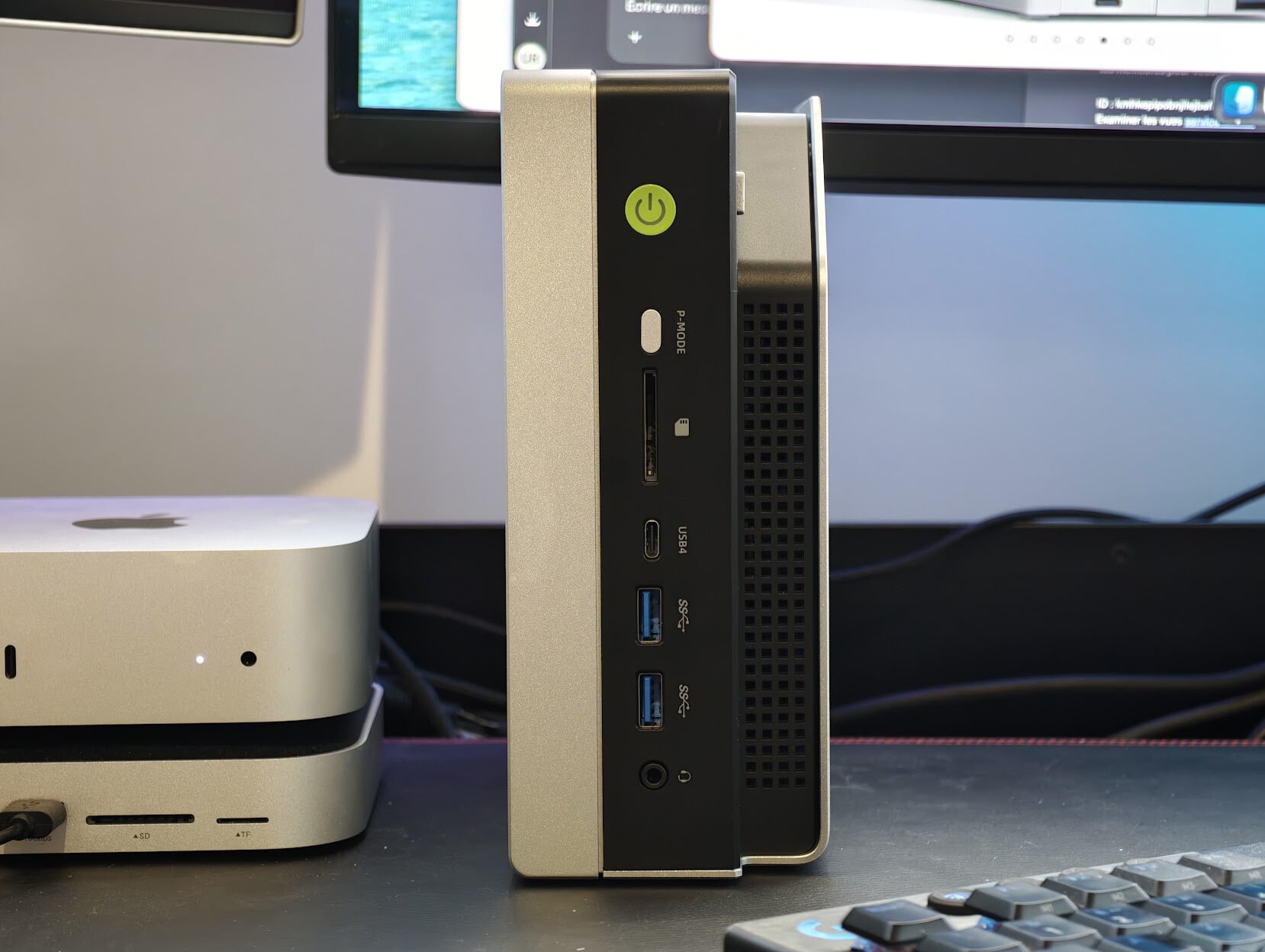
Despite its powerful internals, the GMKtec EVO-X2 AI maintains a relatively compact footprint, albeit slightly larger than some other mini PCs on the market. This increased volume is a deliberate design choice, necessitated by the advanced cooling system required to manage the heat generated by the high-performance Ryzen AI Max+ 395 APU. The device features a dual-fan cooling solution, meticulously engineered to dissipate heat efficiently while keeping acoustic levels in check. In typical daily use, such as web browsing, office applications, or light media consumption, the EVO-X2 AI operates with minimal fan noise, contributing to a comfortable user environment. However, when pushed to its limits in "Performance" mode during sustained heavy workloads—such as intensive gaming sessions, video rendering, or prolonged AI model inference—the fans can become more audible. This is a common characteristic of high-performance compact systems, where thermal management is a critical balancing act between size, power, and acoustics.
Connectivity is another area where the EVO-X2 AI excels, offering a comprehensive suite of ports to cater to a wide range of peripherals and display configurations. It includes two USB-C ports with USB4 capabilities, delivering an impressive 40 Gbit/s bandwidth. These versatile ports support high-speed data transfer, external displays, and even external GPU enclosures, significantly expanding the mini PC’s potential. For display output, the machine is equipped with an HDMI 2.1 port and a DisplayPort 2.0, allowing for connectivity to up to four simultaneous displays. Critically, these outputs support resolutions up to 8K, enabling users to create expansive and incredibly sharp multi-monitor workstations, ideal for professional content creation, financial analysis, or immersive gaming setups.
Network connectivity is equally robust, with a 2.5 Gbit/s Ethernet port providing ultra-fast wired internet access, crucial for online gaming, large file transfers, and stable network environments. For wireless connectivity, the EVO-X2 AI supports Wi-Fi 7, the latest standard offering significantly faster speeds, lower latency, and greater capacity than previous generations, future-proofing the device for evolving network infrastructures. Bluetooth 5.4 is also integrated, ensuring seamless and efficient connection to a wide array of wireless peripherals, from keyboards and mice to headphones and game controllers. This extensive and modern connectivity suite ensures that the GMKtec EVO-X2 AI can serve as the central hub for a sophisticated and high-performance computing ecosystem.
Market Positioning and the Value of the Discount
The introduction of the GMKtec EVO-X2 AI with the AMD Strix Halo platform marks a significant moment in the mini PC market. For years, mini PCs were often seen as compromises, trading raw power for compactness. However, the EVO-X2 AI, along with its contemporaries leveraging similar integrated architectures, shatters this perception. It directly competes with high-end desktop systems in many aspects of performance, particularly where AI and integrated graphics are concerned, while maintaining a footprint that allows it to disappear behind a monitor or sit unobtrusively on a desk.
Industry analysts suggest that the growing demand for local AI processing, driven by privacy concerns, latency requirements, and the sheer volume of data, will continue to fuel the growth of the AI PC segment. The EVO-X2 AI is strategically positioned to capture a significant share of this emerging market, appealing to developers, creative professionals, and tech enthusiasts who want to harness the power of AI without relying solely on cloud services.
The current Amazon promotion, dropping the price from 2,365.46 euros to 2,079 euros, represents a compelling opportunity. A reduction of approximately 286 euros makes this cutting-edge AMD Strix Halo mini PC considerably more accessible. For a system offering 16 Zen 5 cores, an NPU with 50 TOPS, an iGPU comparable to an RTX 4060, and 64 GB of unified LPDDR5X memory, this discounted price begins to enter a "reasonable" territory for early adopters of this high-performance technology. Such price adjustments can often be attributed to several factors: strategic market penetration, inventory management, or perhaps anticipation of future product iterations. Regardless of the underlying reason, it presents a tangible benefit for consumers looking to invest in a top-tier AI-ready mini PC.
Broader Implications and Future Outlook for AI Mini PCs
The capabilities demonstrated by the GMKtec EVO-X2 AI and the AMD Strix Halo platform have profound implications for the future of personal computing. By democratizing access to powerful AI processing at the edge, these mini PCs enable a host of new applications and workflows. Developers can iterate on AI models locally without incurring cloud computing costs, artists can leverage generative AI tools with enhanced privacy, and researchers can conduct experiments on their personal machines with unprecedented speed. This shift away from exclusive reliance on cloud infrastructure empowers individual users and small businesses to integrate AI more deeply into their operations.
The emphasis on unified memory is also a harbinger of future architectural trends. As CPUs, GPUs, and NPUs become increasingly intertwined in their functions, a shared, high-bandwidth memory pool becomes essential for optimal performance. While the soldered nature of the memory presents a decision point for consumers, it is a trade-off that enables the compact form factor and high-speed operation that define this new generation of mini PCs. Future iterations of these platforms are likely to push the boundaries further, with even higher core counts, more potent NPUs, and potentially greater memory capacities, all while striving for improved power efficiency.
The market for AI mini PCs is poised for significant growth, with manufacturers like GMKtec at the forefront of delivering these advanced solutions. The EVO-X2 AI stands as a testament to what is achievable when innovative silicon architecture meets thoughtful product design, offering a powerful, versatile, and increasingly affordable gateway to the world of high-performance local AI. As the technology matures and becomes more widespread, we can expect to see an explosion of creativity and productivity fueled by these compact powerhouses.
In conclusion, the GMKtec EVO-X2 AI, powered by the AMD Ryzen AI Max+ 395 and featuring 64 GB of unified LPDDR5X memory, is more than just another mini PC; it is a leading example of the next generation of AI-enabled computing. Its blend of raw processing power, advanced graphics capabilities, dedicated AI acceleration, and comprehensive connectivity, all housed in a relatively compact form factor, makes it a highly attractive proposition. The current promotional price on Amazon further solidifies its position as a compelling choice for anyone looking to invest in a future-proof, high-performance machine for gaming, productivity, and, crucially, the rapidly expanding universe of local artificial intelligence applications.