admin
admin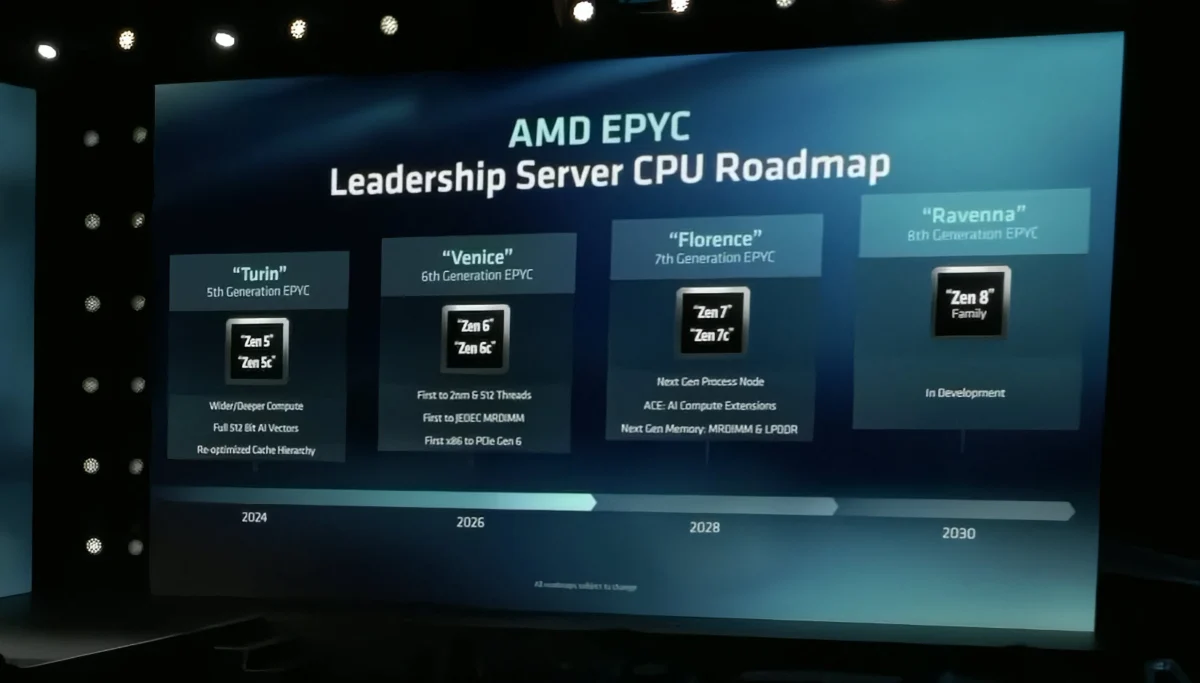
Advanced Micro Devices (AMD) has formally disclosed its long-term roadmap for the server and high-performance computing sectors, announcing the development of the Zen 7 and Zen 8 CPU architectures. During the company’s "Advancing AI 2026" event, Chair and CEO Dr. Lisa Su detailed the strategic trajectory that will carry the company’s enterprise offerings through the end of the decade. The announcement marks a significant milestone in AMD’s effort to maintain its momentum in the data center market, specifically targeting the burgeoning "Agentic AI" era. The roadmap outlines a biennial cadence for major architectural shifts, with Zen 7-based "Florence" processors expected in 2028 and Zen 8-based "Ravenna" chips slated for a 2030 release.
Architectural Evolution: The Path to Zen 7 and Zen 8
The unveiling of the Zen 7 and Zen 8 architectures follows the recent introduction of EPYC processors based on the Zen 6 core. By providing a clear timeline for the next four to five years, AMD aims to provide enterprise clients and cloud service providers with the predictability required for large-scale infrastructure planning.
The Zen 7 architecture, which will power the 7th Gen EPYC family codenamed "Florence," is designed to address the increasing demands of autonomous AI systems. According to the technical disclosures provided during the summit, Zen 7 will continue AMD’s successful strategy of offering specialized core variants. The lineup will include "Classic" cores designed for maximum per-core performance and "Compute-optimized" (Zen 7C) cores tailored for high-density cloud environments and scale-out workloads.
Looking further ahead, the Zen 8 architecture and its corresponding "EPYC Ravenna" family represent the company’s vision for the turn of the decade. While specific technical details for Zen 8 remain preliminary, the commitment to a 2030 launch window underscores AMD’s confidence in its internal design pipeline and its partnership with foundry leader TSMC.
EPYC Florence: Technical Innovations and Process Nodes
The 7th Gen EPYC "Florence" processors are expected to represent a major leap in manufacturing technology. AMD has indicated that these chips will be fabricated on next-generation process nodes, likely entering the sub-2nm or "Angstrom" era. Industry analysts suggest that AMD will utilize TSMC’s A16 or A14 process technologies. These nodes are expected to incorporate Backside Power Delivery Networks (BSPDN) and nanosheet transistor architectures, providing significant improvements in power efficiency and transistor density over the 3nm and 2nm processes used for Zen 5 and Zen 6.

Beyond the silicon fabrication, EPYC Florence will introduce support for next-generation memory standards. The architecture is slated to support Multi-Rank Dual In-line Memory Modules (MRDIMM) and LPDDR series memory, with a transition toward the DDR6 standard anticipated. This shift is critical for AI and machine learning workloads, where memory bandwidth often becomes a primary bottleneck. By integrating DDR6 and MRDIMM support, AMD aims to provide the necessary data throughput to feed the massive core counts expected in the Florence family.
Platform Strategy: SP7 and SP8 Sockets
AMD’s platform strategy for the Zen 7 era involves a dual-socket approach to balance performance and cost-effectiveness. The EPYC Florence family will be supported on the SP7 and SP8 platforms:
- SP7 Platform: Designed for leadership performance, this platform will likely house the highest core-count models and offer the maximum number of I/O lanes. It is positioned for flagship enterprise servers and high-performance computing (HPC) clusters where raw computational power is the primary metric.
- SP8 Platform: Focused on optimized performance per system dollar, the SP8 platform is intended for broader enterprise adoption and cost-sensitive data center deployments. This tiering allows AMD to address a wider range of market segments while maintaining a unified architectural foundation.
The Agentic Era and AI Compute Extensions (ACE)
One of the most significant technical revelations of the Advancing AI 2026 event was the introduction of "AI Compute Extensions" (ACE). AMD has designated EPYC Florence as the first CPU family to natively support ACE, which is developed as part of the x86 Ecosystem Advisory Group (EAG).
The x86 EAG, a collaborative initiative involving industry giants like AMD, Intel, Broadcom, and Dell, aims to standardize and enhance the x86 instruction set architecture (ISA) to better compete with ARM-based solutions in the AI space. ACE is expected to introduce new instructions specifically designed to accelerate matrix operations and AI-related mathematical functions directly on the CPU. This capability is intended to complement discrete GPU accelerators, allowing the host CPU to handle "Agentic" tasks—autonomous decision-making processes where low latency and complex branching logic are required.
System-Level Solutions: Ferrara and Fidenza
AMD is expanding its role from a component supplier to a full-stack systems provider. The EPYC Florence processors will serve as the foundational "Host CPU" for a new generation of integrated AI infrastructure:

- Ferrara: Codenamed "Ferrara," this is AMD’s next-generation AI Rack solution. It is designed to integrate EPYC Florence CPUs with the latest Instinct GPU accelerators, high-speed networking, and advanced cooling solutions into a pre-configured, rack-scale deployment. Ferrara is aimed at organizations looking to deploy massive AI training and inference clusters with minimal integration overhead.
- Fidenza: Building upon the Ferrara hardware, AMD introduced "Fidenza," described as an "Agentic Sandbox." This solution is optimized for large-scale AI deployments where the focus is on performance-per-watt. Fidenza is specifically tuned for running autonomous AI agents, providing a software and hardware environment where these entities can operate in a secure, high-efficiency sandbox.
Industry Context and Competitive Landscape
The announcement of Zen 7 and Zen 8 comes at a time of intense competition in the data center market. Intel, AMD’s primary rival in the x86 space, has been aggressive with its "Falcon Shores" and "Clearwater Forest" roadmaps, emphasizing its own advancements in 18A process technology. Simultaneously, the rise of custom ARM-based silicon from cloud providers like Amazon (Graviton), Google (Axion), and Microsoft (Azure Cobalt) has challenged the traditional x86 dominance.
By committing to a roadmap through 2030, AMD is signaling to investors and partners that the x86 architecture remains the premier choice for the most demanding workloads. The collaboration within the x86 EAG is a strategic move to ensure software compatibility and architectural innovation across the ecosystem, mitigating the fragmentation that has occasionally hindered x86 in the mobile and low-power sectors.
Projected Impact on the Global Data Center Market
The shift toward Zen 7 and Zen 8 is expected to have profound implications for the global data center economy. As AI workloads shift from simple LLM (Large Language Model) inference to complex, autonomous agents, the requirements for the underlying hardware are changing.
- Energy Efficiency: The transition to sub-2nm nodes is essential for meeting global sustainability targets. Data centers currently consume a significant portion of global electricity, and the efficiency gains promised by EPYC Florence and Ravenna will be vital for scaling AI operations without proportional increases in power consumption.
- Standardization: The adoption of ACE and the work of the x86 EAG could lead to a more unified software development environment for AI. This reduces the "porting tax" that developers face when moving workloads between different hardware architectures.
- Market Share: AMD’s consistent execution over the past decade has seen its server market share grow from near-zero to over 30% in many segments. A clear, long-term roadmap provides the "stability" that conservative enterprise buyers require to commit to AMD-based infrastructure for the next decade.
Chronology of the Zen Architecture
To understand the significance of the Zen 7 and Zen 8 announcement, it is useful to review the progression of the architecture:
- Zen 1 (2017): The "Naples" EPYC chips marked AMD’s return to the server market, introducing a chiplet-based design.
- Zen 2 (2019): "Rome" introduced the 7nm process and the centralized I/O die, significantly increasing core counts.
- Zen 3 (2021): "Milan" focused on IPC (Instructions Per Clock) improvements and cache hierarchy optimization.
- Zen 4 (2022): "Genoa" brought 5nm technology, DDR5, and PCIe 5.0 support.
- Zen 5 (2024): "Turin" further refined AI performance and increased density with 4nm/3nm nodes.
- Zen 6 (2026): Currently the state-of-the-art, focusing on massive throughput for AI-heavy environments.
- Zen 7 (2028): "Florence" will introduce the sub-2nm era and ACE instructions.
- Zen 8 (2030): "Ravenna" will represent the culmination of a decade and a half of Zen-based innovation.
Conclusion
The "Advancing AI 2026" event has clarified AMD’s long-term vision for the enterprise. By detailing the Zen 7 and Zen 8 architectures years in advance, AMD is positioning itself not just as a chip manufacturer, but as the primary architect of the hardware foundations for the next era of computing. The integration of advanced process nodes, next-generation memory standards, and the new AI Compute Extensions suggests that the company is prepared to meet the rigorous demands of the "Agentic Era." As the industry moves toward 2028 and 2030, the EPYC Florence and Ravenna platforms will likely be the benchmarks against which all other data center solutions are measured.