admin
admin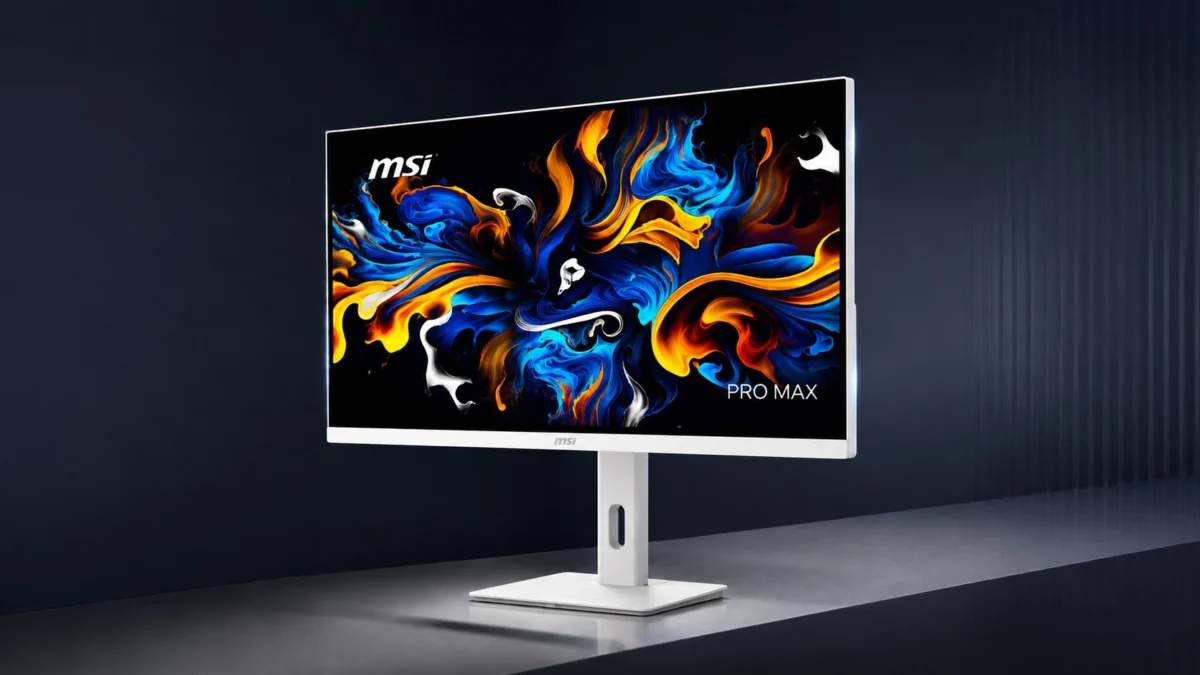
The Evolution of OLED Manufacturing: From Evaporation to Inkjet Printing
To understand the significance of the MSI PRO MAX OLED 271UPJW12, one must examine the traditional methods used to produce Organic Light Emitting Diode (OLED) panels. For over a decade, the industry has relied heavily on a process known as Fine Metal Mask (FMM) thermal evaporation. In this method, organic materials are heated until they evaporate and then pass through a thin metal mask to deposit onto a substrate. While effective for small-scale screens like those found in smartphones, FMM faces significant scalability challenges. As the size of the panel increases, the metal masks are prone to sagging or deforming under their own weight, which can lead to misaligned pixels and lower manufacturing yields. These inefficiencies inevitably drive up the retail price of large OLED displays.
In contrast, the Inkjet Printing (IJP) technology utilized in the MSI 271UPJW12 represents a radical departure from evaporation. This process involves "printing" organic OLED materials directly onto the glass substrate using microscopic nozzles, much like a high-precision industrial inkjet printer. Because the material is applied in liquid form exactly where it is needed, there is significantly less waste compared to evaporation, where material often coats the mask itself.
The partnership between MSI and TCL CSOT (China Star Optoelectronics Technology) is the culmination of years of research and development. TCL CSOT has been a vocal proponent of IJP OLED, investing billions into their production lines to prove that this method can produce panels with superior color accuracy and longevity at a lower cost per unit. The introduction of the 271UPJW12 serves as a commercial proof-of-concept for this technology, demonstrating that IJP can meet the rigorous standards required for 4K resolution at a 27-inch form factor.
Technical Specifications and Performance Metrics
The MSI PRO MAX OLED 271UPJW12 is built around a 27-inch panel that delivers a native 4K resolution (3840 x 2160). This results in a pixel density of approximately 163 pixels per inch (PPI), a specification that is highly coveted by creative professionals who require sharp imagery and expansive screen real estate. Unlike many gaming-oriented OLEDs that utilize a 1440p resolution to achieve higher refresh rates, the 271UPJW12 is "capped" at 120 Hz. While this may seem modest compared to 360 Hz competitive monitors, 120 Hz remains the "sweet spot" for high-end productivity and smooth casual gaming, offering a significant upgrade over standard 60 Hz office displays.
One of the most critical advantages of the IJP OLED panel is its true RGB subpixel layout. Traditional OLED monitors, particularly those using WOLED (White OLED) or certain QD-OLED (Quantum Dot OLED) configurations, often use non-standard subpixel arrangements that can cause "color fringing" around text and fine lines. This has been a long-standing complaint among users who use OLED monitors for coding, writing, or graphic design. By utilizing a vertical RGB structure enabled by the precision of inkjet printing, the 271UPJW12 promises significantly sharper text rendering and better edge definition, effectively neutralizing one of OLED’s few remaining weaknesses in a professional environment.

In terms of luminance and color, the monitor is rated for the VESA DisplayHDR True Black 500 standard. This certification ensures that the display can achieve deep, inky blacks with a minimum brightness of 0.0005 nits, while also reaching a peak brightness of up to 1000 nits in small highlights. For color-critical work, MSI ships each unit with factory calibration, ensuring a Delta E (color difference) of less than 2. This level of accuracy means that the colors seen on the screen are nearly indistinguishable from their real-world counterparts, making it a viable tool for photographers and video editors.
Enhancing Durability and Professional Workflow
Beyond the panel technology, MSI has integrated several features designed to enhance the daily user experience. A notable physical upgrade is the monitor’s surface treatment. The PRO MAX OLED 271UPJW12 features an advanced anti-glare coating that increases the surface hardness from the industry-standard 2H to 3H. According to MSI, this results in approximately 2.5 times better scratch resistance. This is a vital improvement for OLED panels, which have historically been more delicate than their LCD counterparts. The harder coating ensures that the monitor can withstand the rigors of a busy office or studio environment without suffering from permanent micro-abrasions.
For users who manage multiple workstations, the inclusion of a built-in KVM (Keyboard, Video, Mouse) switch is a major productivity boon. This allows a user to connect two separate PCs—such as a high-powered desktop and a mobile workstation—to the monitor and control both using a single set of peripherals. By simply toggling a button, the user can switch their mouse and keyboard focus between devices, streamlining complex workflows and reducing desk clutter.
Strategic Positioning and Market Context
The launch of the PRO MAX OLED 271UPJW12 comes at a time when the monitor market is undergoing a period of rapid diversification. For the past two years, the "OLED War" has been fought primarily between LG’s WOLED and Samsung’s QD-OLED. MSI’s decision to adopt TCL CSOT’s IJP OLED technology introduces a third major contender into the space.
Industry analysts suggest that this move is part of a broader strategy by MSI to capture the "prosumer" market—users who demand the visual benefits of OLED (infinite contrast, vibrant colors) but require the reliability and text clarity of professional-grade IPS panels. By capping the refresh rate at 120 Hz, MSI is likely aiming for a more competitive price point than the ultra-high-refresh gaming monitors, potentially making 4K OLED technology accessible to a wider demographic.
Furthermore, the environmental implications of IJP technology cannot be overlooked. As global regulations on electronic manufacturing tighten, the reduced material waste associated with inkjet printing makes it a more sustainable choice for long-term production. TCL CSOT has previously stated that IJP OLED consumes less energy during the manufacturing phase and utilizes organic materials more efficiently than evaporation methods, aligning with the growing corporate emphasis on ESG (Environmental, Social, and Governance) standards.

Industry Reactions and Future Outlook
While MSI has yet to disclose the official pricing and global availability dates, the announcement has already generated significant buzz among hardware enthusiasts and industry insiders. The consensus among technical reviewers is that the success of the 271UPJW12 will depend largely on its price-to-performance ratio. If MSI can leverage the cost-savings of IJP technology to undercut the current 4K OLED market, it could force competitors to accelerate their own adoption of next-generation manufacturing processes.
TCL CSOT, for its part, has signaled that the 27-inch 4K panel is just the beginning. At recent display trade shows, the company showcased prototypes of 31.5-inch 4K and even larger IJP OLED panels intended for the television market. The release of the MSI PRO MAX OLED 271UPJW12 serves as the "canary in the coal mine" for the display industry, testing consumer appetite for printed OLEDs.
In a statement accompanying the reveal, MSI emphasized that the "Modernity, Acceleration, eXperience" (MAX) branding reflects a commitment to bringing cutting-edge technology to everyday professionals. The company stated, "With the PRO MAX OLED 271UPJW12, we are not just launching a monitor; we are debuting a new era of display manufacturing that prioritizes the user’s visual health and professional efficiency through the world’s first IJP OLED integration in this class."
Conclusion
The MSI PRO MAX OLED 271UPJW12 stands as a testament to the rapid pace of innovation in the display sector. By moving away from traditional evaporation methods and embracing the precision of inkjet printing, MSI and TCL CSOT have addressed long-standing issues regarding manufacturing yields and text clarity. With its combination of 4K resolution, 120 Hz refresh rate, HDR True Black 500 certification, and professional-grade color accuracy, the 271UPJW12 is positioned to be a formidable competitor in the professional monitor space. As the industry awaits final pricing details, one thing is certain: the era of the printed OLED has officially arrived, promising a future where high-end display technology is more efficient, more accurate, and ultimately more accessible to the global market.