Sonny Valindra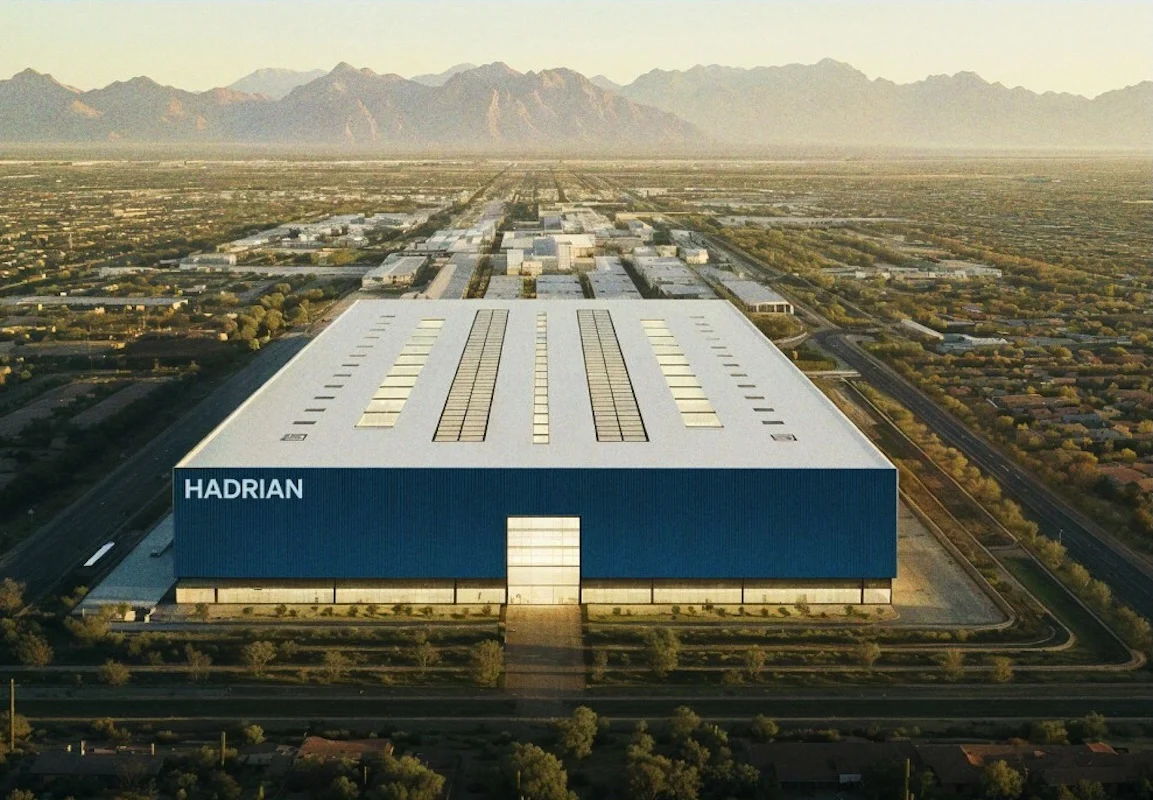
Hadrian, a pioneering defense technology company focused on revolutionizing manufacturing through advanced automation, announced on Thursday that it has successfully closed a substantial $1.37 billion Series D funding round. This latest infusion of capital propels the company’s valuation to an impressive $7.87 billion, underscoring significant investor confidence in its mission to accelerate America’s industrial renewal. The round was led by a consortium of prominent investment firms, including WCM Investment Management, Washington Harbour Partners, Valor Equity Partners, 137 Ventures, and Baillie Gifford. A broad spectrum of other notable investors also participated, such as 1789 Capital, Morgan Stanley Wealth Management, funds managed by Apollo and T. Rowe Price, CapitalG, Andreessen Horowitz, Founders Fund, Lux Capital, and Altimeter, among others.
This substantial Series D financing builds upon Hadrian’s strong track record of capital acquisition. Approximately one year prior, the company raised $260 million in a Series C round, which was notably led by Founders Fund and Lux Capital. With the addition of this new funding, Hadrian’s total capital raised to date is estimated to be around $2 billion, according to data compiled by PitchBook. This consistent and significant investment highlights the growing recognition of Hadrian’s unique approach within the defense sector.
Hadrian distinguishes itself in the defense technology landscape by not focusing on the development of novel AI-powered weaponry. Instead, the company’s core mission is to establish highly automated manufacturing facilities designed for the mass production of critical components for existing military platforms. This strategic focus on the foundational elements of defense supply chains addresses a pressing need for increased domestic production capacity and reduced reliance on potentially volatile international supply networks. The company’s ambition is to create a more resilient and responsive industrial base capable of meeting the evolving demands of national security.
The company’s expansion strategy has been marked by strategic facility openings and significant partnerships. In March, Hadrian inaugurated its fourth facility in Alabama, dedicated to the mass production of parts essential for submarine manufacturing. This Alabama facility represents a significant expansion, building on the company’s existing infrastructure and capabilities. The deal to establish this advanced manufacturing site was structured as a public/private partnership and was valued at an impressive $2.4 billion, as confirmed by Hadrian. This substantial valuation for a single facility underscores the immense scale and strategic importance of Hadrian’s manufacturing initiatives. The company’s third planned facility, as depicted in renderings, is slated for Mesa, Arizona, further demonstrating its commitment to establishing a distributed and robust manufacturing network across the United States.
The Strategic Imperative: Automating Defense Manufacturing
The recent funding round arrives at a critical juncture for the defense industrial base. Geopolitical tensions and the increasing pace of technological advancement have highlighted vulnerabilities in existing supply chains and manufacturing capabilities. Hadrian’s model of building highly automated factories addresses several key challenges:
- Increased Production Capacity: Traditional manufacturing methods often struggle to scale rapidly to meet surge demands or to produce complex components in the quantities required for modern defense systems. Hadrian’s automated facilities are designed for high-volume output, significantly reducing lead times.
- Enhanced Efficiency and Cost Reduction: Automation, when effectively implemented, can lead to more consistent quality, reduced waste, and lower labor costs per unit, thereby making defense production more economically viable.
- Reshoring and Domestic Production: By investing in domestic manufacturing capabilities, Hadrian contributes to the national goal of reducing reliance on foreign suppliers, thereby enhancing national security and economic resilience.
- Technological Modernization: The company’s integration of AI and advanced robotics into manufacturing processes not only boosts efficiency but also positions the U.S. defense industry at the forefront of industrial innovation.
The decision to focus on components for existing, proven platforms is a pragmatic approach. It allows Hadrian to address immediate production bottlenecks without the long development cycles and uncertainties associated with entirely new weapon systems. By ensuring a steady and abundant supply of critical parts for submarines, aircraft, and other key military assets, Hadrian plays a vital role in maintaining and enhancing the operational readiness of the U.S. armed forces.

A Timeline of Growth and Expansion
Hadrian’s journey from its inception to its current standing as a multi-billion dollar valuation company has been characterized by rapid growth and strategic execution.
- Early Stages and Seed Funding: While specific details of Hadrian’s earliest funding rounds are not provided in the initial report, the company’s subsequent significant capital raises indicate a strong initial vision and early-stage investor backing.
- Series C Financing (Approx. 2025): The $260 million Series C round, led by Founders Fund and Lux Capital, marked a significant acceleration in Hadrian’s growth trajectory. This funding likely enabled the company to scale its operations, expand its engineering teams, and begin the construction of its advanced manufacturing facilities. The opening of the Alabama facility in March of this year (2026) was a direct outcome of this strategic expansion.
- Series D Financing (August 2026): The recently closed $1.37 billion Series D round represents a major validation of Hadrian’s business model and its impact on the defense sector. The substantial valuation of $7.87 billion reflects the market’s perception of Hadrian as a critical enabler of national security objectives. This funding is expected to fuel further expansion, including the development of its planned third facility in Mesa, Arizona, and potentially the acquisition of new technologies or companies to bolster its manufacturing ecosystem.
The progression from a Series C round of $260 million to a Series D of $1.37 billion within approximately a year signifies exceptional investor appetite and a clear market demand for Hadrian’s solutions. This rapid scaling is often indicative of a company addressing a critical, unmet need with a robust and scalable solution.
Supporting Data and Industry Context
The defense manufacturing sector has historically been characterized by long production cycles, complex supply chains, and significant capital requirements. The U.S. Department of Defense has repeatedly emphasized the need to modernize its industrial base and ensure the security of its supply chains. Reports from defense think tanks and government agencies consistently highlight the challenges posed by aging infrastructure, a shortage of skilled labor in traditional manufacturing, and the increasing complexity of defense systems.
Hadrian’s approach directly addresses these concerns. The company’s emphasis on automation and AI is not merely a technological upgrade; it is a fundamental reimagining of how defense components are produced. By leveraging advanced robotics and intelligent systems, Hadrian aims to achieve production rates that are orders of magnitude higher than conventional methods for certain components. For example, the $2.4 billion valuation for the Alabama submarine parts facility suggests an annual production output or capability that is highly significant in the context of national defense needs. While specific production numbers are proprietary, the scale of investment indicates a capacity to contribute substantially to programs like the Columbia-class and Virginia-class submarines, which are critical for naval power projection and national security.
The investors participating in Hadrian’s funding rounds are a testament to the company’s strategic importance. The inclusion of established financial institutions like Morgan Stanley Wealth Management and major venture capital firms with deep ties to the technology and defense sectors, such as Andreessen Horowitz and Founders Fund, signals broad confidence. The presence of CapitalG, Alphabet’s growth equity investment fund, also suggests a belief in Hadrian’s potential for long-term, disruptive growth, possibly hinting at future integrations or synergies with broader technological ecosystems.
Potential Implications and Broader Impact
The success of Hadrian’s funding round has several significant implications for the defense industry and the broader U.S. economy:
- Accelerated Defense Modernization: By ensuring the rapid and efficient production of critical components, Hadrian can significantly shorten the timelines for fielding new defense systems and maintaining the readiness of existing ones. This is crucial in an era of rapid technological change and evolving global threats.
- Economic Growth and Job Creation: While focused on automation, Hadrian’s expansion will also create jobs in highly skilled areas such as robotics engineering, software development, advanced manufacturing operations, and supply chain management. Furthermore, its facilities represent significant local economic investments.
- Strengthened National Security: A robust domestic manufacturing base is a cornerstone of national security. Hadrian’s efforts to reshore and automate critical production lines reduce vulnerabilities associated with foreign dependencies and enhance the nation’s ability to respond to crises.
- Benchmark for Industrial Innovation: Hadrian’s model could serve as a blueprint for other industries facing similar challenges of modernization and supply chain resilience. Its success may spur further investment and innovation in automated manufacturing across various sectors.
The company’s stated goal of "accelerating America’s industrial renewal" is ambitious, but the substantial backing it has received suggests that investors believe Hadrian is well-positioned to achieve this objective. The integration of advanced manufacturing techniques into the defense sector is not just about building more equipment; it’s about building a more agile, resilient, and technologically advanced industrial ecosystem capable of supporting national defense objectives for decades to come. The ongoing development of its third facility in Mesa, Arizona, will be a key indicator of the company’s continued execution and its commitment to expanding its footprint in strategically important industrial regions.