Sisilia Frederika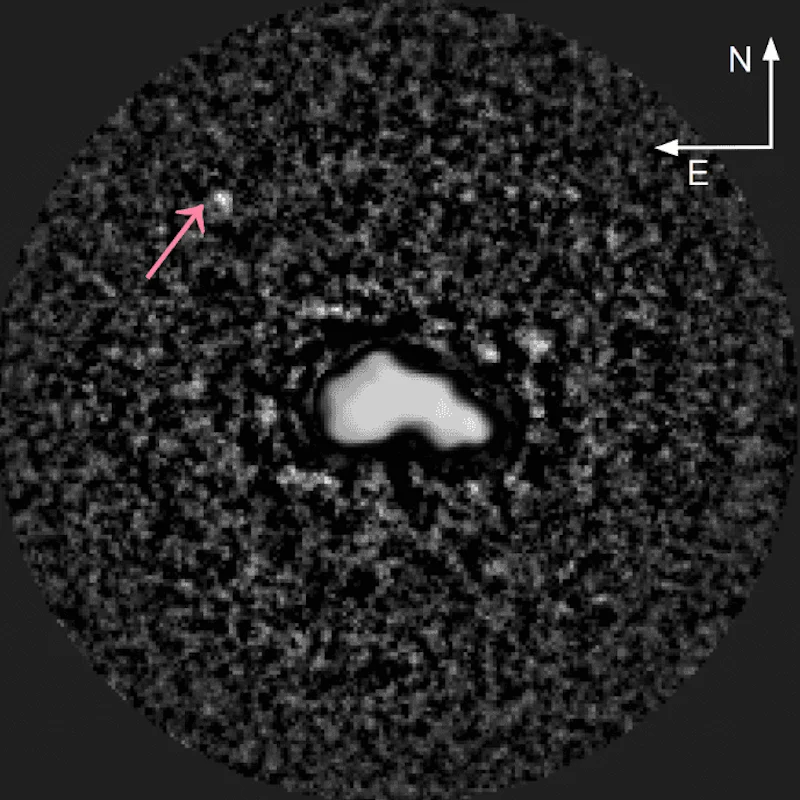
For over 160 years, the asteroid known as (44) Nysa has remained one of the most enigmatic objects in the Main Belt. Located between Mars and Jupiter, this exceptionally bright celestial body has long teased astronomers with its unusual light curves and shifting brightness, suggesting a shape far more complex than a simple sphere. Now, an international team of astronomers led by Kate Minker of the Lowell Observatory has utilized the world’s most advanced ground-based telescopes to produce images of unprecedented clarity. These findings suggest that (44) Nysa is not merely a single elongated rock, but potentially the first "contact trinary" ever identified—a world formed by three distinct bodies that drifted together and fused into a single, three-lobed entity.
The breakthrough was made possible through the combined power of the Large Binocular Telescope (LBT) in Arizona and the Very Large Telescope (VLT) in Chile. By employing cutting-edge adaptive optics and high-contrast imaging, the research team has effectively bridged the gap between ground-based observation and deep-space robotic exploration. The results, which reveal two deep "necks" or valleys wrapping around the asteroid’s circumference, provide a new window into the violent yet delicate processes that shaped our solar system’s infancy.
A Century of Uncertainty: The Profile of (44) Nysa
(44) Nysa was first discovered on May 27, 1857, by the German-French astronomer Hermann Goldschmidt. From the outset, it stood out due to its high albedo (reflectivity). It is the namesake and largest member of the Nysa asteroid family, a group of objects believed to have originated from the catastrophic disruption of a larger parent body billions of years ago.
Categorized as an E-type asteroid, Nysa is rich in enstatite, a magnesium-rich pyroxene mineral. E-type asteroids are rare, representing only a small fraction of the asteroid belt, and are thought to be the source of aubrite meteorites found on Earth. Because of their high reflectivity, these asteroids are often studied to understand the composition of the inner solar system’s early building blocks.
Despite its prominence, Nysa’s physical form remained elusive. For decades, "light curve" analysis—measuring how an object’s brightness changes as it rotates—suggested that Nysa was highly elongated. Some models proposed a "bone-like" shape, while others speculated it might be a contact binary, similar to the "rubber duck" shape of Comet 67P/Churyumov–Gerasimenko. However, ground-based telescopes typically see asteroids as mere points of light, leaving the true topography of Nysa to the realm of mathematical conjecture until now.
High-Resolution Imaging: Ground-Based "Spacecraft Quality"
The resolution achieved by Minker’s team represents a milestone in observational astronomy. The team utilized two specific instruments: SHARK-VIS, a visible-light high-contrast imager on the Large Binocular Telescope, and SPHERE/ZIMPOL, a high-resolution polarimetric imager on the European Southern Observatory’s Very Large Telescope.
The primary challenge of ground-based imaging is the Earth’s atmosphere, which acts like a thick, turbulent lens, blurring the light from distant stars and planets. To overcome this, the team used Extreme Adaptive Optics (ExAO). This technology uses deformable mirrors that adjust thousands of times per second to cancel out atmospheric distortion in real-time.
When combined with sophisticated post-processing algorithms, the resulting images of Nysa reached a level of detail previously reserved for flyby missions like NASA’s New Horizons or Lucy. "These images are close to spacecraft quality," Minker noted, highlighting that the 75-kilometer-wide asteroid could now be seen as a tangible world with distinct geographical features rather than a blurry pixel.
The Contact Trinary Hypothesis: Three Worlds as One
The most striking revelation from the new imagery is the presence of two prominent, pinched valleys that appear to divide the asteroid into three distinct sections. In planetary science, these "necks" are often the tell-tale signs of a contact binary—where two separate objects have moved toward each other at very low velocities, eventually touching and sticking together due to mutual gravity.
If the team’s interpretation is correct, (44) Nysa would be the first documented "contact trinary." This formation suggests a three-stage or simultaneous merger:
- Initial Formation: Three separate planetesimals or fragments formed in the early solar system.
- Gravitational Capture: Through a process of dynamical friction or gas drag in the early solar nebula, these three bodies began to orbit one another.
- The Gentle Merger: Instead of a high-speed collision that would have shattered the rocks, the bodies drifted together at speeds slower than a human walk.
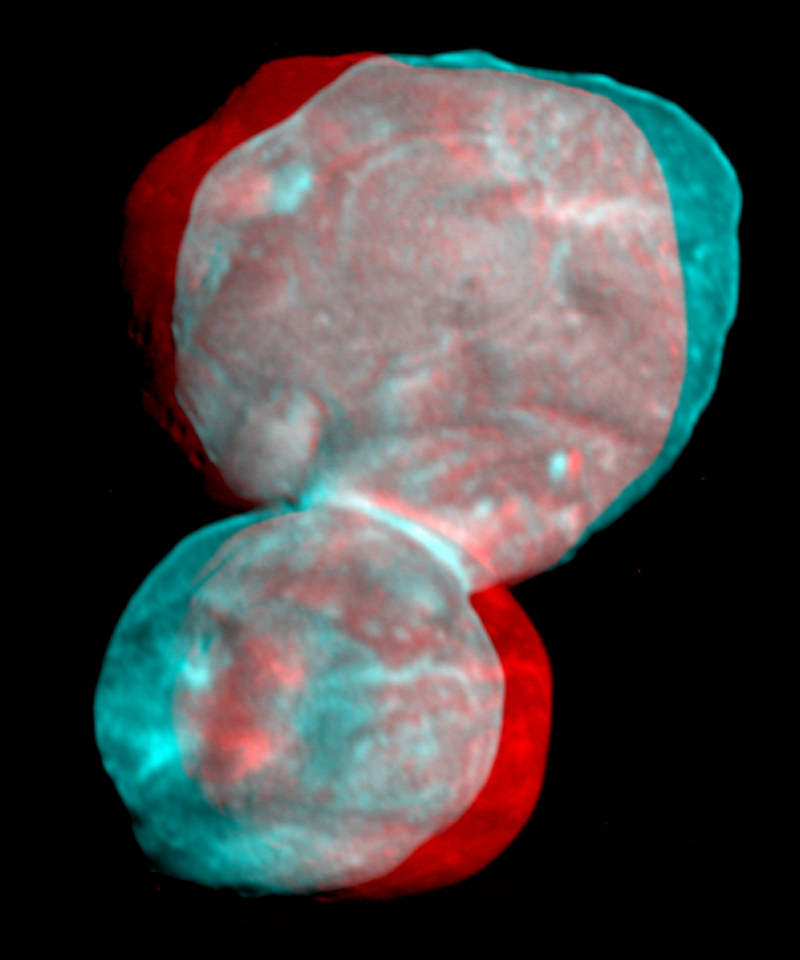
This "gentle welding" process has been seen before. The Kuiper Belt object Arrokoth, visited by New Horizons in 2019, famously looks like a flattened snowman made of two lobes. Similarly, Comet 67P and the asteroid Dinkinesh (recently visited by the Lucy mission) show binary structures. However, Nysa represents a more complex "triple-scoop" configuration, suggesting that such mergers might be more common in the Main Belt than previously theorized.
The Discovery of Satellite S/2026 (44) 1
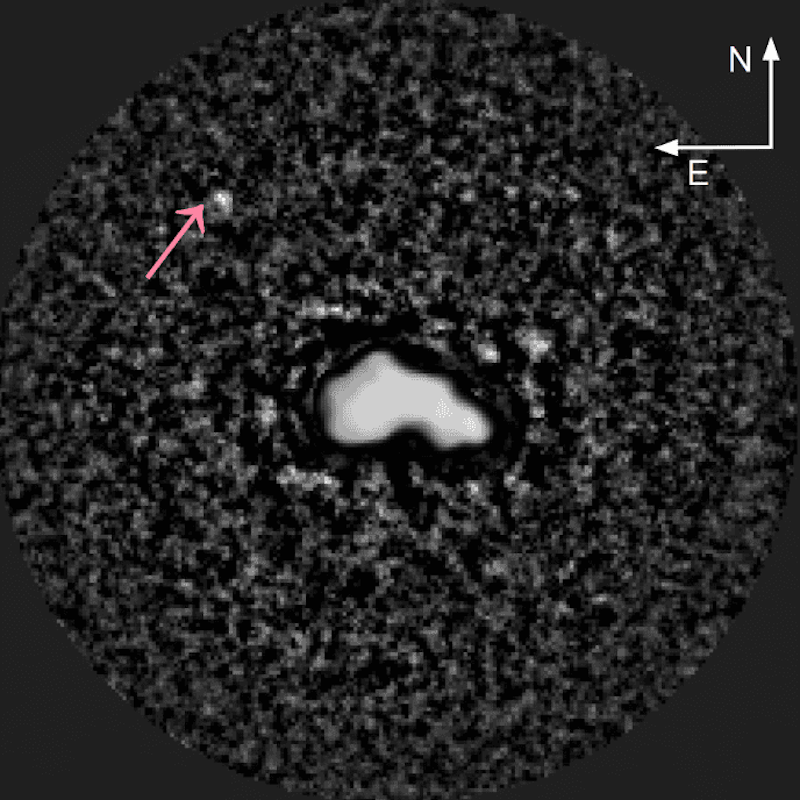
While the shape of Nysa provided the primary headline, the discovery of a companion moon has provided the scientific community with the tool needed to confirm the asteroid’s nature. Using high-contrast imaging techniques—originally designed to find faint exoplanets next to bright stars—the team identified a small satellite orbiting the primary body.
Now designated S/2026 (44) 1, the moon is estimated to be approximately one kilometer in diameter. It orbits Nysa at a distance of at least 170 kilometers. The moon was spotted independently during two separate observing runs, confirming its existence and stable orbit.
The discovery of a moon is scientifically invaluable because of the laws of orbital mechanics. By tracking the time it takes for the moon to complete an orbit and measuring its distance from Nysa, astronomers can calculate the total mass of the system with high precision. Once the mass is known, and the volume is estimated from the new high-resolution images, scientists can determine Nysa’s bulk density.
Density is the "smoking gun" in asteroid science. A high density would suggest that Nysa is a solid, coherent piece of rock—perhaps a single body that was heavily eroded by impacts to look like three lobes. A low density, conversely, would suggest a "rubble pile" or a contact trinary structure, where the interior is full of voids and the body is held together loosely by gravity.
Chronology of Observation and Data Analysis
The path to this discovery involved a multi-year effort of coordination and technological refinement:
- Late 20th Century: Light curve data from various observatories suggests Nysa is non-spherical, leading to the "Nysa-Polana" complex theory.
- 2010s: Development of SPHERE and SHARK-VIS instruments begins, aiming to push the limits of diffraction-limited imaging.
- 2023-2024: Kate Minker’s team secures observing time on the LBT and VLT during periods of optimal "seeing" (atmospheric stability).
- Observation Phase: The team captures multiple rotations of Nysa, allowing them to construct a 3D-like understanding of its surface.
- 2026 (Projected/Reported): The official designation of the satellite S/2026 (44) 1 and the publication of the "contact trinary" hypothesis.
Scientific Implications: Building Planets Piece by Piece
The study of (44) Nysa is not merely an exercise in celestial cartography; it has profound implications for our understanding of how planets like Earth were formed. E-type asteroids are believed to be the remnants of the innermost part of the solar system’s original protoplanetary disk. Because they are rich in enstatite—a mineral that forms at high temperatures—they are thought to be the "primitive" building blocks that either never merged into a planet or are fragments of the crust of a destroyed protoplanet.
If Nysa is indeed a contact trinary, it proves that the early solar system was a place where gentle mergers were as significant as violent collisions. It suggests that the "accretion" phase of planet formation—where small rocks grow into larger ones—involved complex, multi-body interactions that could survive for billions of years.
Furthermore, the ability to study such objects from Earth reduces the immediate need for multi-billion-dollar space missions to every interesting asteroid. While spacecraft provide ground-truth data, the refinement of ground-based adaptive optics allows for a "census" of the asteroid belt, identifying the most peculiar objects for future robotic visitation.
Alternative Theories and Future Verification
Despite the compelling evidence for a three-lobed structure, the research team remains cautious. An alternative hypothesis is that Nysa is a single, monolithic body that has suffered massive "craters on top of craters." In this scenario, two massive impacts could have gouged out the valleys, leaving behind a shape that merely mimics a contact trinary.
However, the team notes that no other known asteroid in the solar system exhibits such a symmetrical, deeply indented "fake" trinary shape. The contact merger theory remains the more statistically and physically likely explanation given the dynamics of the asteroid belt.
The next steps for Minker and her colleagues involve more precise tracking of S/2026 (44) 1. Refined orbital data will allow for a definitive density calculation within the next few years. Additionally, as the SHARK-VIS instrument continues its operations, other large asteroids will be subjected to the same scrutiny, potentially revealing that "multilobed" worlds are a standard feature of our solar system’s architecture rather than an anomaly.
In the broader context of planetary defense and resource exploration, understanding the structural integrity of objects like Nysa is vital. Whether an asteroid is a solid rock or a collection of "welded" lobes dictates how it would respond to a kinetic impactor or how it might be mined in the future. For now, (44) Nysa stands as a testament to the power of modern optics, turning a distant speck of light into a complex, three-part puzzle from the dawn of time.