Sisilia Frederika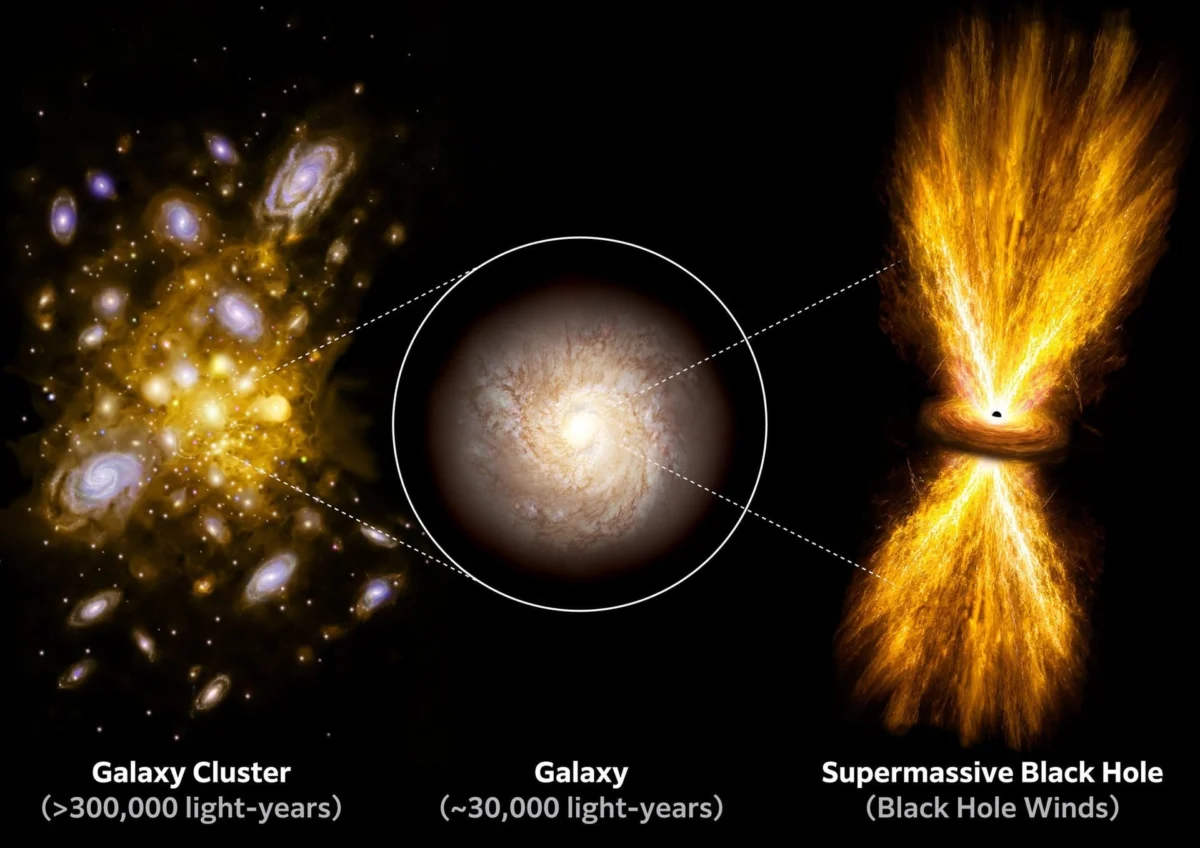
The universe is home to cataclysmic phenomena capable of altering the trajectory of entire galaxies, yet for the moment, Earth remains shielded from the most violent outbursts of our own galactic center. While the supermassive black hole at the heart of the Milky Way, Sagittarius A*, is currently in a state of relative dormancy, new research into distant cosmic engines suggests that such stability is not a universal constant. A landmark study conducted by an international team of astronomers has revealed that active supermassive black holes, known as quasars, possess the power to eject energetic winds that travel far beyond the boundaries of their host galaxies, influencing the cosmic web on a scale previously thought impossible.
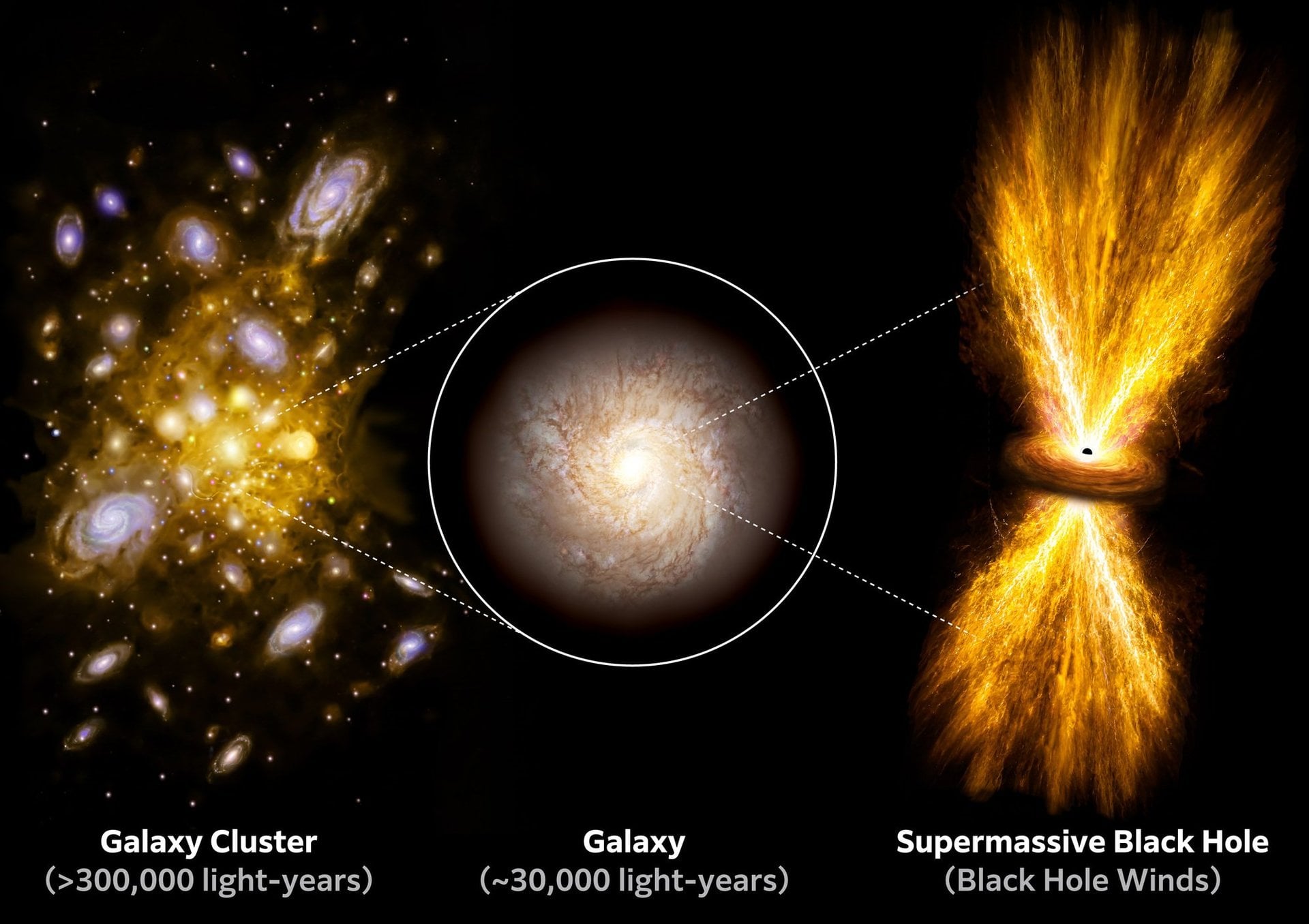
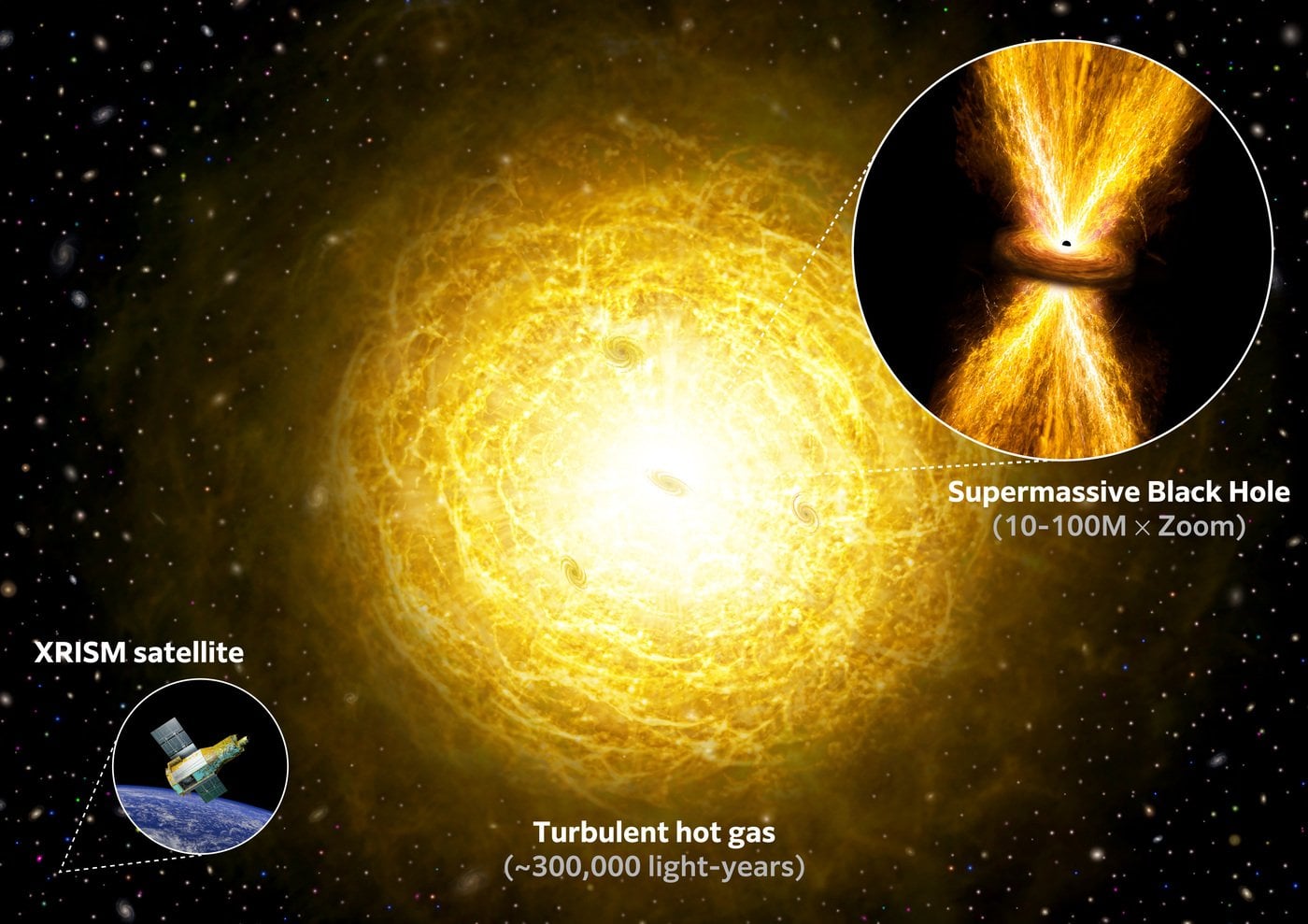
The research, spearheaded by scientists from Tohoku University, Tokyo Metropolitan University, and Kanazawa University in Japan, focused on the formidable quasar H1821+643. Situated approximately 3.4 billion light-years from Earth in the constellation Draco, this quasar serves as a primary example of "quasar-mode feedback," a process where the energy released by a central black hole dictates the thermal and structural evolution of its surrounding environment. The team’s findings, published in the journal Nature Astronomy, demonstrate that the explosive winds generated by H1821+643 carry enough kinetic energy to reach distances of 300,000 light-years—roughly three times the diameter of the Milky Way—effectively reshaping the gas dynamics of the entire galaxy cluster.
The Engine of Quasar H1821+643
To understand the magnitude of this discovery, one must first understand the nature of a quasar. At the core of H1821+643 lies a supermassive black hole with a mass billions of times that of our Sun. As gravity draws vast quantities of gas and dust toward the event horizon, the material forms an accretion disk. The intense friction and gravitational compression within this disk heat the matter to millions of degrees, causing it to glow with a luminosity that can outshine all the stars in its host galaxy combined.
However, not all material that approaches a black hole is consumed. A significant portion is accelerated by magnetic fields and radiation pressure, then hurled back into space at relativistic speeds. In the case of H1821+643, this process creates a "blast" or "wind" of ionized gas. While astronomers have long known that black holes eject matter, the prevailing consensus was that these winds were largely contained within the host galaxy’s interstellar medium.
Satoshi Yamada, an Assistant Professor at Tohoku University’s Frontier Institute for Interdisciplinary Sciences (FRIS) and lead author of the study, noted that the observed power of these winds challenges existing models. "Black holes are largely known for sucking matter in, but they also eject gas in the form of powerful winds," Yamada explained. "These winds were thought to be contained within the galaxy, but our study revealed that the force is immensely more powerful than previously understood."
Mapping Cosmic Turbulence with XRISM
The breakthrough in mapping these winds came via the X-ray Imaging and Spectroscopy Mission (XRISM), a collaborative satellite project between the Japan Aerospace Exploration Agency (JAXA) and NASA. XRISM is equipped with high-resolution spectrometers capable of detecting the chemical signatures and velocities of high-temperature plasma that emits X-rays.
By analyzing the spectra of the hot gas cloud surrounding H1821+643, the research team focused on the movement of ionized iron. Because iron atoms in these extreme environments lose most of their electrons, they emit specific X-ray signatures that act as "markers" for the movement of the gas. The Doppler shifting of these iron lines allowed the astronomers to calculate the velocity and turbulence of the gas cloud with unprecedented precision.
The data revealed a state of constant, violent motion. The energy injected by the quasar’s wind creates shock waves that ripple through the intra-cluster medium—the thin, hot gas that fills the space between galaxies in a cluster. This turbulence prevents the gas from cooling and sinking toward the center of the cluster, a process that would otherwise lead to the runaway formation of new stars. Instead, the quasar acts as a cosmic thermostat, maintaining the temperature of the cluster and regulating its growth.
Chronology of Discovery and Historical Context
The study of H1821+643 is the culmination of decades of X-ray astronomy. In the late 20th century, early X-ray satellites identified "cooling flows" in galaxy clusters, where gas appeared to be losing energy and falling toward the center. However, observations consistently showed fewer young stars than these cooling flows should have produced. This discrepancy, known as the "cooling flow problem," suggested that some heating mechanism must be at work.
- 1990s-2000s: Observations by the Chandra X-ray Observatory and XMM-Newton identified cavities in the hot gas of clusters, likely carved out by jets from central black holes.
- 2010s: Theoretical models began to distinguish between "radio-mode feedback" (low-energy jets) and "quasar-mode feedback" (high-energy winds from rapidly accreting black holes).
- 2023-2024: The launch and commissioning of XRISM provided the spectral resolution necessary to move beyond static images and actually measure the velocity of these winds.
- Present Day: The Tohoku University study confirms that quasar-mode feedback is a dominant force capable of transporting energy across intergalactic distances, equivalent to the energy of several billion supernova explosions.
Implications for Galactic Evolution and the Milky Way
The discovery that a black hole can influence space up to 300,000 light-years away has profound implications for our understanding of how the universe evolved. In the "Early Universe," roughly 10 billion years ago, quasars were far more common than they are today. During this epoch, the feedback from these objects likely played a critical role in "quenching" star formation, effectively determining the maximum size a galaxy could reach.
This raises questions about our own galaxy’s history. While Sagittarius A* is currently "quiet," consuming only a tiny amount of matter, evidence suggests it was not always so. In 2010, the Fermi Gamma-ray Space Telescope discovered two massive structures, known as the Fermi Bubbles, extending 25,000 light-years above and below the Milky Way’s center. These bubbles are thought to be the remnants of a major eruptive event that occurred approximately 6 million years ago.
While the Fermi Bubbles are significant, they pale in comparison to the 300,000-light-year reach of H1821+643. If the Milky Way had experienced a full quasar phase during its infancy, the resulting winds would have stripped much of the gas required to form new stars, potentially resulting in a much smaller or more diffuse galaxy than the one we inhabit today.
Analysis of Global Scientific Reactions
The international astronomical community has responded to the Japanese team’s findings with a mixture of validation and renewed inquiry. The consensus among astrophysicists is that the "shock wave" mentioned by Professor Yamada represents a missing link in cosmological simulations. Previously, many simulations struggled to replicate the observed temperatures of galaxy clusters without manually injecting "artificial" energy. The H1821+643 data provides a physical basis for these energy injections.
Dr. Elena Rossi, an astrophysicist not involved in the study, noted that the "spatial extent of the feedback is the most striking aspect." She suggested that if winds can reach 300,000 light-years, they are not just affecting the host galaxy, but are actively "polluting" the intergalactic medium with heavy elements like iron and carbon, which are forged inside stars and then ejected by the black hole’s blast.
Future Research and Multi-Messenger Astronomy
The study of H1821+643 is only the beginning of a new era in high-energy astrophysics. Yamada and his colleagues intend to expand their research using "multi-messenger" observations. This involves combining X-ray data with observations from radio telescopes (which see the jets), optical telescopes (which see the stars and host galaxy), and potentially neutrino or gravitational wave detectors.
By observing these objects across the entire electromagnetic spectrum, scientists hope to answer several lingering mysteries:
- Efficiency: Exactly what percentage of the matter falling into a black hole is converted into wind energy?
- Duration: How long does a quasar "blast" last, and what triggers its eventual shutdown?
- Connectivity: How do these winds interact with the "Cosmic Web," the large-scale structure of dark matter and gas that connects galaxies?
As the XRISM satellite continues its mission, astronomers expect to catalog dozens of other active quasars. Each observation will refine our understanding of the delicate balance between the destructive power of black holes and their role as essential architects of the cosmos. While the blast from H1821+643 serves as a reminder of the universe’s violent potential, it also highlights the intricate mechanisms that allow galaxies to form, grow, and eventually settle into the stable configurations necessary for life to emerge. For now, the Milky Way remains a quiet corner of the universe, but the "shocks of astonishing power" found 3.4 billion light-years away provide a window into the turbulent history of the stars.