Chandra Wibowo
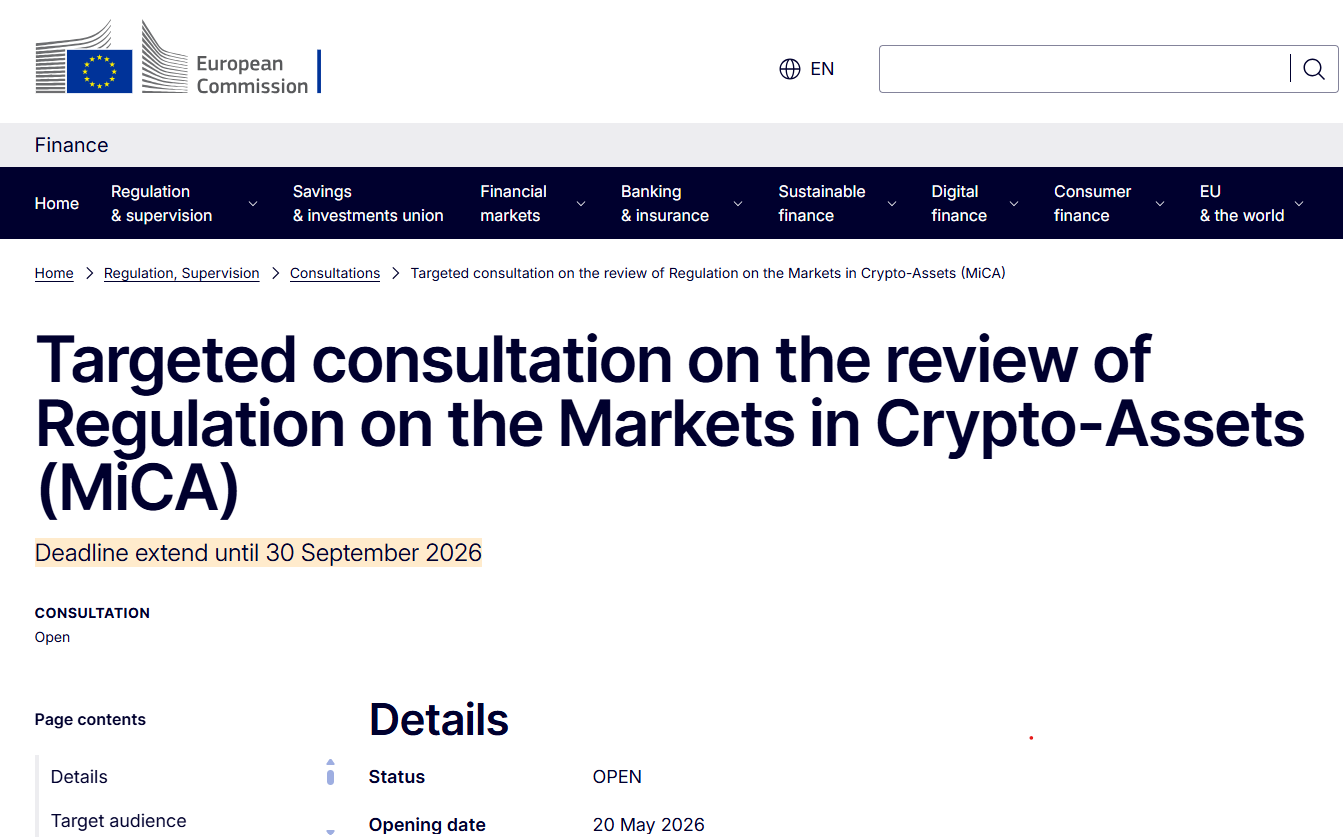
The European Union’s landmark Markets in Crypto Assets (MiCA) regulation, designed to bring order to the burgeoning digital asset landscape, is now facing a critical juncture as the European Commission considers extending its reach to encompass crypto lending and decentralized finance (DeFi). While MiCA’s initial framework deliberately excluded these complex areas, a recent targeted consultation launched in May 2024 signals a significant shift in regulatory intent, prompting stakeholders to weigh in on the potential inclusion of these previously uncharted territories. This move has ignited debate within the crypto industry and among legal experts, as it raises profound questions about how to effectively regulate innovative financial mechanisms that defy traditional categorization.
The core of the current debate revolves around "lending vaults," sophisticated on-chain mechanisms that can manage billions of dollars in digital assets without necessarily resembling conventional lending institutions. These vaults operate through smart contracts and a distributed network of participants, channeling liquidity into on-chain credit markets. Their legal status under existing EU law is ambiguous, largely relying on non-binding interpretations that they fall outside the scope of both MiCA and EU fund regulations. This regulatory vacuum creates uncertainty and poses a challenge for both innovators and regulators alike.
"EU law has no category called a ‘vault’," explains Yuriy Brisov, an EU digital assets lawyer and partner at Digital & Analogue Partners. "A lawyer therefore defines it the way a regulator would qualify it: by function, not by label." This fundamental challenge underscores the difficulty of applying existing legal constructs to novel financial instruments that perform traditional economic functions through entirely new technological architectures. The complexity is further amplified by the fact that vaults can distribute functions typically handled by a single entity across multiple smart contracts and participants, making it difficult to pinpoint a single responsible party for regulatory oversight.
The European Commission’s targeted consultation, which closed on September 30, 2024, invited input on precisely these contentious areas, including decentralized finance (DeFi) and crypto lending and borrowing. The outcome of this consultation could fundamentally reshape the regulatory landscape for digital assets in Europe, determining whether lending vaults and other DeFi lending protocols will be brought under the MiCA umbrella or remain in a state of regulatory ambiguity.
Morpho: A Case Study in Regulatory Ambiguity
The decentralized lending protocol Morpho provides a compelling illustration of the challenges Brussels faces. Its Vault V2 architecture, designed to facilitate lending on-chain, offers a glimpse into why classifying these operations under existing regulatory frameworks is so arduous. The protocol’s structure intentionally distributes responsibilities among various actors: an owner who configures strategy and risk parameters, a curator responsible for strategy and risk, an allocator that executes transactions, and a sentinel with powers to mitigate risk.

This division of labor, while efficient from a decentralized finance perspective, does not neatly align with traditional notions of a regulated lending service. Under MiCA, identifying a specific "provider" of a regulated service is a cornerstone of oversight. However, in Morpho’s system, no single participant or entity unequivocally fulfills this role in the conventional sense. This distributed control mechanism challenges the very premise of how financial services are typically regulated, where a clear identifiable entity is responsible for compliance and consumer protection.
Jonathan Galea, a partner at Cahill Gordon & Reindel, has extensively explored the complexities of lending vaults and their position within EU financial regulation. In a recent client alert, Galea highlighted how these structures can intersect with MiCA, stablecoin regulations, and European fund law, underscoring the intricate legal tapestry regulators must navigate. He advises caution against treating all lending vaults as a monolithic category, emphasizing their diverse functionalities and the potential for overregulation.
"Lending vaults solve more practical problems than they create," Galea asserts, distinguishing between vaults primarily focused on directing liquidity for lending and those involved in the broader buying and selling of crypto assets. He warns that a broad regulatory label for "DeFi lending" could inadvertently capture protocols with vastly different economic functions, leading to unintended consequences and potentially stifling innovation. This nuanced approach is crucial if Brussels decides to regulate lending, as a one-size-fits-all solution could ensnare protocols that do not pose the same systemic risks as traditional financial intermediaries.
The Decentralization Divide: A Spectrum of Control
A central question in the MiCA review is whether decentralization itself should serve as a regulatory dividing line. MiCA currently excludes crypto asset services provided in a "fully decentralized manner," but it can apply to activities where only a partial aspect is decentralized. This exclusion, while intended to foster innovation, creates a grey area for many DeFi protocols.
However, relying solely on decentralization as a determinant for regulatory application presents its own set of challenges. Galea argues that such an approach could disadvantage newer, more innovative protocols. "Decentralization is a spectrum and a function of time," he explains. "A test built on it would penalize newer, more novel protocols while entrenching mature incumbents that have had years to distribute control." This perspective suggests that a rigid decentralization test could inadvertently favor established players and hinder the emergence of genuinely decentralized, next-generation financial systems.
Brisov proposes an alternative focus on the underlying structure of the vault and the degree of control individuals exert over it. "The safer ground is structural," he suggests. "There is no undertaking, no appointed manager, the holder has a direct coded claim on the pool, and the user can exit before any parameter change takes effect." This functional and structural analysis offers a more pragmatic approach, emphasizing the verifiable attributes of a protocol rather than a subjective assessment of its decentralization.
Brisov further recommends that if lending and borrowing activities are deemed to warrant regulation, they should be explicitly added to the list of regulated crypto asset services within MiCA. This targeted approach would avoid the broader, and potentially more problematic, expansion of the definition of a crypto asset service provider itself. Such a move would provide clarity and allow for the development of specific rules tailored to the unique risks and characteristics of crypto lending.
Navigating the Future of DeFi Lending Regulation
The implications of the European Commission’s decision extend far beyond regulatory compliance. For DeFi lending protocols, a potential inclusion under MiCA could bring both opportunities and significant challenges. On one hand, regulatory clarity could boost institutional adoption and provide greater certainty for investors and users. It might also lead to enhanced consumer protection measures, which are often seen as a prerequisite for mainstream acceptance.
However, the specific nature of any new regulations will be critical. Michael Egorov, founder of Curve Finance, emphasizes the need for distinct regulatory treatment for DeFi lending compared to traditional finance. "If DeFi lending is ever brought into the scope of regulation, it should be treated completely differently," Egorov states. "DeFi doesn’t need some of the safeguards which traditional lending requires, and yet, at the same time, it may need others." This highlights the unique characteristics of DeFi, such as its transparency, composability, and rapid innovation cycles, which may necessitate tailored regulatory approaches.
Egorov advocates for a cautious and nuanced regulatory strategy. "Regulation should be approached ‘really carefully’," he advises. He suggests that a dedicated framework could enhance security and open DeFi lending to a wider user base, while simultaneously avoiding rules that certain protocols, by their very design, cannot comply with. This perspective underscores the importance of co-designing regulations with industry participants to ensure their feasibility and effectiveness.
The current consultation represents a pivotal moment for the European Union’s approach to digital assets. The Commission’s challenge is not merely to decide whether to regulate DeFi lending, but how to craft rules that can effectively distinguish between the diverse forms of on-chain lending and identify the individuals, if any, who truly exercise control over these systems. The breadth of responses to the consultation, encompassing legal analyses, technical considerations, and industry perspectives, will be instrumental in shaping the future regulatory landscape.
As of the close of the consultation on September 30, 2024, the industry awaits the European Commission’s next steps. The decision will have significant ramifications for the growth and evolution of DeFi in Europe, potentially setting a precedent for other jurisdictions grappling with similar regulatory questions. The path forward will require a delicate balance between fostering innovation, ensuring financial stability, and protecting consumers in the rapidly evolving world of decentralized finance. The regulatory journey for crypto lending under MiCA is far from over, and the choices made in Brussels will undoubtedly resonate across the global digital asset ecosystem.