
 George Chandra Eka
The pervasive integration of digital platforms into daily life has brought unprecedented convenience, but also a growing awareness of how personal data fuels the digital economy. Instagram, a flagship platform under Meta Platforms, Inc., stands at the forefront of this data-driven landscape, often delivering advertising experiences so precisely tailored they can feel eerily prescient. Users frequently encounter advertisements for products or services they recently viewed on unrelated websites, leading to common — though often mistaken — assumptions about how these platforms gather information. This article delves into the intricate mechanisms Instagram employs for data collection and personalization, offering a detailed guide on the available controls to manage one’s digital footprint, particularly concerning advertising and artificial intelligence (AI) recommendations.
The Architecture of Algorithmic Personalization: Beyond the Microphone Myth
The phenomenon of an ad for a specific product appearing in one’s Instagram feed minutes after browsing it elsewhere is a common user experience. While many users attribute this uncanny accuracy to their phone’s microphone actively listening to conversations, Meta has consistently and explicitly denied using microphone audio for advertising purposes. Instead, the sophisticated personalization is a product of a vast and multi-faceted data collection strategy that aggregates information from various sources.
At its core, Instagram’s personalization engine relies on a blend of first-party and third-party data. First-party data encompasses all interactions occurring directly within the Instagram app: what users search for, watch, like, follow, post, and click. This internal activity provides a rich stream of signals about individual interests and behaviors. Complementing this is a significant volume of device and network information, including location-related signals (though not necessarily GPS tracking, but often derived from IP addresses and network connections) and data shared across connected accounts within Meta’s ecosystem (such as Facebook).
The "telepathic" quality of ads often stems from third-party data. Retailers, other applications, and businesses frequently send Meta information about user visits to their websites, purchases made, or other interactions. This is typically facilitated through tools like the Meta Pixel, an analytics JavaScript snippet installed on websites, or the Conversions API, which allows direct server-to-server communication of customer actions. When a user visits an e-commerce site that employs the Meta Pixel, for instance, details of their browsing session or items viewed can be transmitted back to Meta, which then uses this information to inform targeted advertising on Instagram and Facebook.
The advent of Meta AI further complicates this landscape. Meta has explicitly stated that its AI capabilities leverage existing Facebook and Instagram activity to tailor recommendations, extending the personalization beyond ads to content suggestions and AI responses. This holistic approach means that nearly every digital interaction within the Meta ecosystem, and many outside of it, can contribute to a comprehensive user profile designed to enhance engagement and advertising efficacy.
A Shifting Timeline of Privacy Controls and AI Integration

The evolution of Instagram’s data collection practices and user controls has been a dynamic process, often influenced by regulatory pressures and technological advancements. Historically, social media platforms offered limited transparency or control over data used for personalization. However, a growing global emphasis on data privacy, spearheaded by regulations like the European Union’s General Data Protection Regulation (GDPR) and California’s Consumer Privacy Act (CCPA), has prompted platforms like Meta to introduce more granular user settings.
A significant development in this chronology is the planned rollout of a broader "Activity from other businesses" control by Meta, which is set to begin in July 2026. This new setting is designed to replace previous, more fragmented controls such as "Your activity off Meta technologies" and to expand upon older ad settings like "Activity information from ad partners." The objective of this consolidated control is to empower users to decide whether businesses can utilize the information they send to Meta for the personalization of ads, Feed content, and AI responses. This move reflects an ongoing effort by Meta to centralize privacy settings within its Accounts Center, offering a more unified management portal for users across its platforms.
Parallel to the enhancement of ad personalization controls, Meta also began integrating AI interactions into its data collection for content and ad personalization. Effective December 16, 2025, in most regions, interactions with Meta AI features will serve as signals for content and ad personalization. This means that a conversation with Meta AI about a specific hobby, like hiking, could contribute to subsequent recommendations for hiking-related posts, Reels, or products in the user’s feed. This integration underscores the platform’s strategy to leverage every facet of user engagement to refine its personalization algorithms, aiming for an even more immersive and tailored user experience.
These timelines highlight a continuous adaptation by Meta, balancing its business model, which heavily relies on targeted advertising, with the increasing demand for user privacy and control. The staggered implementation of these features and controls across different regions and platforms reflects the complexity of global data regulations and the sheer scale of Meta’s operations.
Navigating Off-Platform Activity Controls: The ‘Activity from Other Businesses’ Update
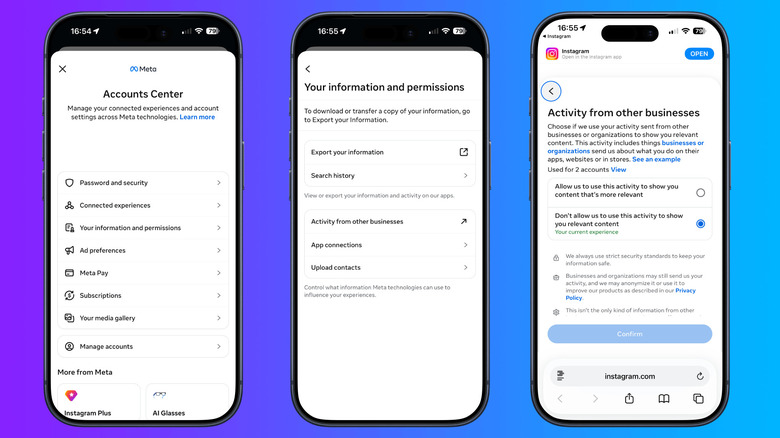
One of the most impactful steps users can take to limit Instagram’s data utilization for personalized ads and AI recommendations is to manage the "Activity from other businesses" control. This forthcoming feature, anticipated to be fully rolled out by July 2026, represents a more consolidated approach to managing third-party data.
To adjust this setting, users will typically navigate through Instagram’s interface: open the Instagram app, go to your profile, tap the three-line menu (often referred to as the "hamburger menu"), and then select "Accounts Center." Within the Accounts Center, users should look for the "Activity from other businesses" option. It is important to note that due to the phased rollout by country, some accounts might temporarily still display the older path: "Ad preferences" > "Ad settings" > "Activity information from ad partners." Regardless of the specific naming convention, the goal is to locate and choose the option that prevents Meta from using this activity for personalization.
The introduction of this control is a direct response to the massive scale of Meta’s advertising operations. Meta’s ad network is one of the largest globally, with millions of businesses leveraging its tools to reach potential customers. These businesses routinely transmit data about customer interactions—ranging from website visits to product views and purchases—back to Meta. By disabling "Activity from other businesses," users can effectively reduce the influence of these external interactions on their personalized ad experience and content recommendations.

However, it is crucial to understand the limitations of this setting. Disabling this control does not prevent businesses from sending data to Meta in the first place. Businesses can continue to use tools like the Meta Pixel to track website visitors and report actions. Furthermore, this setting specifically addresses off-Meta platform activity. It does not stop Meta from collecting and utilizing data generated inside Instagram itself. This means ads and content recommendations can still be heavily influenced by your in-app behavior, such as the accounts you follow, the posts or Reels you engage with, your search queries, ad clicks, profile details, and even customer lists that advertisers may upload directly. Therefore, while this control is a significant step towards greater user privacy, it does not function as a "master switch" to completely disable all forms of ad personalization.
For users within the European Region, Meta offers an additional layer of control under "Ad preferences" > "Ad settings" > "Ad experience" within the Accounts Center, allowing them to choose between "personalized" or "less-personalized" ads. Opting for less-personalized ads means Meta will use fewer signals to tailor ads. Nevertheless, Meta explicitly states that even with this option, certain fundamental details like age, general location, device information, ad interactions, and content viewed during the current session may still be used to inform advertising. This illustrates the inherent challenge in achieving complete data isolation from platforms whose business models are predicated on data-driven advertising.
Fortifying Your Device: Limiting Instagram’s Direct Access
Beyond in-app settings, operating system-level permissions offer another critical layer of control over the data Instagram can access directly from a user’s device. These permissions dictate Instagram’s ability to interact with sensitive device features and track activity across other applications.
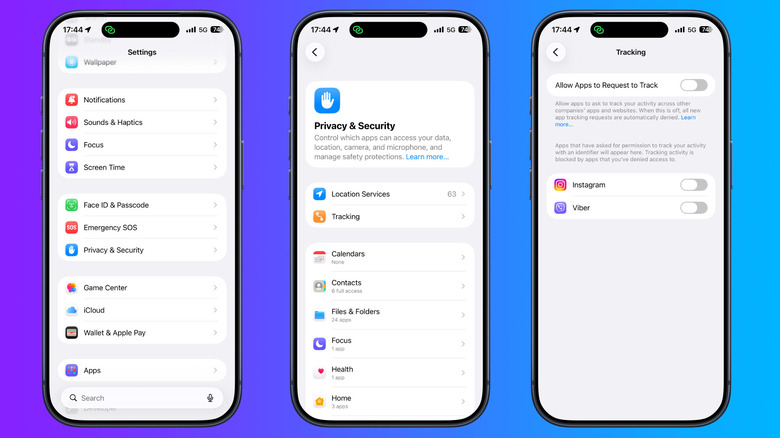
For iPhone users, Apple introduced its App Tracking Transparency (ATT) framework, which significantly shifted the landscape of cross-app tracking. Users can manage Instagram’s tracking permission by navigating to Settings > Privacy & Security > Tracking. Here, they can explicitly turn off Instagram’s permission to track. Activating Apple’s "Ask App Not to Track" control prevents Instagram from tracking a user’s activity across other companies’ apps and websites for advertising purposes or sharing information with data brokers. This move by Apple has had substantial implications for Meta’s ad revenue, underscoring the effectiveness of such direct OS-level controls. However, it is vital to remember that this control does not prevent Instagram from recording and utilizing activity occurring within its own app. In-app behavior remains fair game for personalization.
Android users have similar controls, though the navigation path can vary slightly depending on the device manufacturer and Android version. Generally, the path is Settings > Apps > Instagram > Permissions. Within this section, users can review and manage Instagram’s access to various sensitive device features, including location, contacts, photos and videos, camera, and microphone. It is highly recommended to deny any permissions that are not strictly necessary for the app’s core functionality. For instance, if a user rarely posts stories or Reels, denying camera and microphone access might be appropriate.
One of the most frequently targeted permissions is location access. While turning off direct location access to Instagram is a prudent step, it does not completely eliminate Meta’s ability to infer a user’s general whereabouts. Meta can still estimate location from other signals, such as an IP address, network information, device signals, and even patterns in account activity. This highlights the sophisticated nature of data aggregation and the persistent challenge of achieving full location privacy in a connected world.
Managing Your Network: Contact Syncing and Connected Accounts
Two additional avenues through which Instagram gathers and utilizes personal data involve a user’s contact list and connections across other Meta accounts. Managing these requires specific attention within the Accounts Center.
Contact syncing is a feature designed to help users find friends on Instagram by uploading their phone’s contact list to Meta’s servers. While seemingly innocuous, this process can expose information about individuals who may not even be Instagram users themselves. To prevent future contact syncing, users should navigate to Accounts Center > Your information and permissions > Upload contacts, select the Instagram account in question, and then turn off "Connect contacts" on every device where Instagram is installed. It’s important to understand that disabling future syncing does not automatically delete contacts that have already been uploaded. To remove previously uploaded contacts, users must access Manage contacts within the Accounts Center on Instagram.com. Meta states that the deletion process for these contacts can take up to 90 days, reflecting the complexity of data removal from large-scale systems. Privacy advocates have long criticized contact syncing features across social platforms, citing concerns about privacy infringement for non-users and the potential for broad data aggregation without explicit consent from all parties involved.
Meta also leverages information across accounts added to the same Accounts Center. This cross-account data sharing is used to personalize ads and suggest accounts to follow, creating a more interconnected and personalized experience across Facebook, Instagram, and other Meta properties. For users seeking to limit this interconnectedness, removing an account under Accounts Center > Accounts will take it out of that specific Accounts Center. However, this action may disable shared logins and other connected features that enhance convenience. Crucially, removing an account from the Accounts Center does not delete the account itself or its existing information; it merely severs the direct link for cross-platform data utilization within that specific Accounts Center configuration.
Understanding Meta AI and Your Data: Chat Interactions and Model Training
The integration of artificial intelligence into Meta’s platforms, particularly through conversational AI features, introduces a new frontier for data collection and personalization. As of December 16, 2025, Meta began using interactions with its AI features as signals for content and ad personalization in most regions. This means that a user’s conversations with Meta AI—whether asking for recommendations, brainstorming ideas, or simply chatting—can influence the types of content they see and the advertisements they receive. For example, discussing travel plans with Meta AI could lead to an increase in travel-related ads or destination suggestions in the Instagram feed.
A significant point of concern for privacy-conscious users is the absence of a direct setting that allows users to continue interacting with Meta AI while simultaneously opting out of using those conversations for personalization. This lack of a granular control means that users must assume their AI interactions will contribute to their personalized profile.
However, Meta has provided certain cleanup commands within Instagram AI chats. Users can type /reset-ai within a specific AI chat to delete that AI’s copy of the conversation and the details it saved. For a broader reset, typing /reset-all-ais will clear the saved context for every AI chat within the app. While these commands are useful for clearing saved context and preventing the AI from "remembering" past conversations, they are not universal opt-outs from advertising, ordinary data collection, or the broader process of model training. They primarily serve to reset the conversational memory of the AI rather than to fundamentally alter data collection policies.
Model training represents another distinct but related aspect of Meta’s AI strategy. Separate from personalization, Meta utilizes public posts and comments from adult accounts, alongside interactions with its AI features, to improve its generative AI models. In regions where Meta relies on "legitimate interests" as a legal basis for data processing, users in the European Union and the United Kingdom have the right to object to this use of their data for model training through Meta’s Privacy Center. This right, however, is not a universal Instagram setting and underscores the varying privacy landscapes across different global jurisdictions.
Given these practices, a critical recommendation for all users is to exercise extreme caution when interacting with Meta AI. Users should never input sensitive personal information such as names, addresses, financial details, medical information, or anything else they would not publicly post into a Meta AI chat. Following any conversation containing potentially sensitive, even if not strictly confidential, information, it is advisable to use the reset commands to clear the AI’s memory. Where available, utilizing the objection form in Meta’s Privacy Center for model training is also a proactive step.
Broader Implications and the Regulatory Landscape
The continuous evolution of Instagram’s data collection and personalization mechanisms, alongside the introduction of new AI features, highlights an ongoing tension between user privacy, platform profitability, and the global regulatory landscape. Meta’s business model is inherently reliant on the collection and analysis of vast quantities of user data to deliver highly targeted advertisements, which command premium rates from advertisers. This economic imperative often conflicts with user desires for greater privacy and control over their digital information.
Regulatory bodies worldwide, including those overseeing GDPR in Europe and CCPA in the United States, have played a crucial role in pushing platforms like Meta towards greater transparency and offering users more granular controls. These regulations impose strict requirements on how personal data is collected, processed, and used, often necessitating explicit consent for certain types of data processing. The staggered rollout of new privacy controls and the regional variations in available options (such as the EU/UK-specific objection to AI model training) are direct consequences of navigating this complex and fragmented regulatory environment.
The concept of "privacy by design," where privacy considerations are integrated into the initial design of systems and services, remains an aspirational goal for many tech companies. Instead, much of the current approach involves users actively configuring settings and understanding intricate data flows. The sheer complexity of these settings, spread across multiple menus and requiring a nuanced understanding of their implications, places a significant burden on the average user.
Looking ahead, the debate surrounding data privacy on social media is unlikely to diminish. As AI technologies become even more sophisticated and integrated into daily digital interactions, the questions of data ownership, algorithmic transparency, and ethical data use will intensify. The ongoing challenge for platforms like Instagram will be to innovate and deliver engaging experiences while simultaneously respecting user privacy and adhering to an increasingly stringent global regulatory framework. For users, a proactive and informed approach to managing their digital privacy settings will remain essential in navigating the evolving digital landscape.
In conclusion, while a single "master switch" for Instagram’s data collection remains elusive, users possess a growing array of tools and settings to limit the extent of personalization. From managing off-platform activity controls to restricting device permissions, disabling contact syncing, and carefully handling AI chat interactions, a multi-pronged strategy is necessary. Understanding the nuances of each setting and its limitations is paramount for users seeking to reclaim a degree of control over their digital footprint in an era defined by ubiquitous data and advanced AI.







