Sisilia Frederika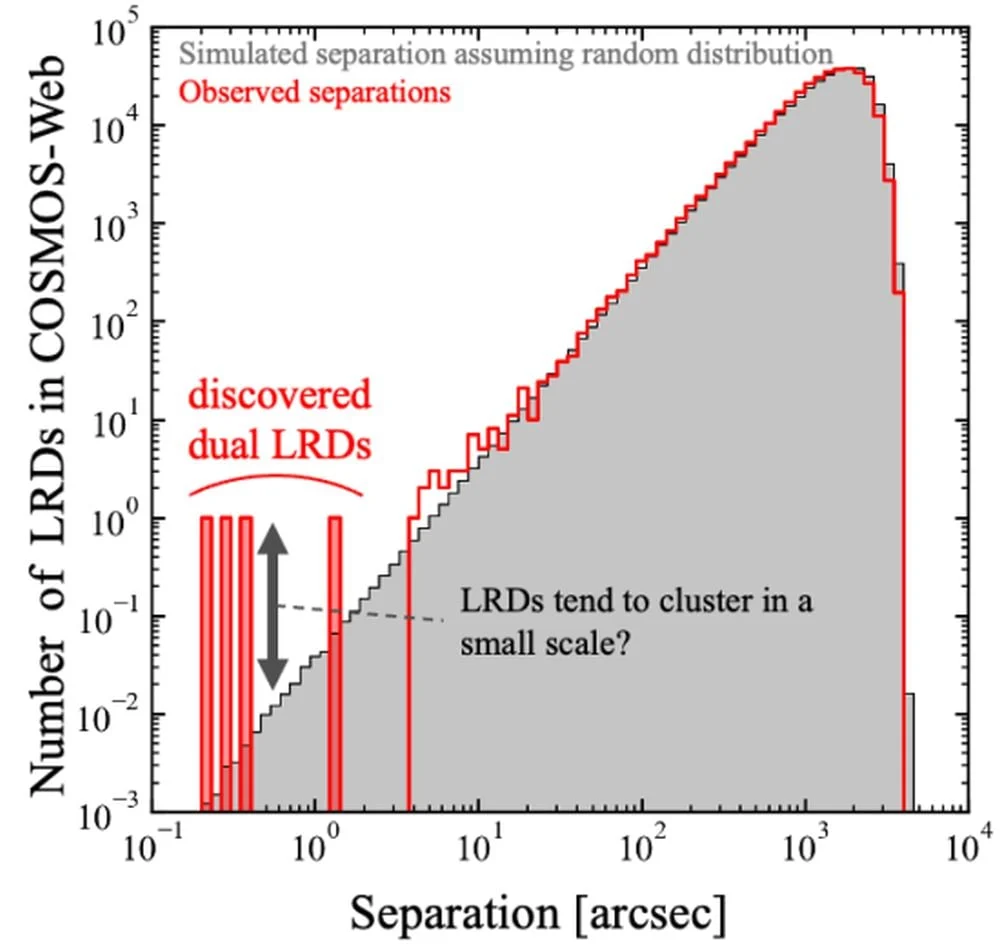
The James Webb Space Telescope (JWST) has fundamentally altered the landscape of modern cosmology by revealing a population of objects that challenge existing models of the early universe. Among the most perplexing of these discoveries are the "Little Red Dots" (LRDs)—compact, extremely red objects that appear in the first billion years of cosmic history. A new study led by Takumi Tanaka, a graduate researcher at the University of Tokyo’s Kavli Institute for the Physics and Mathematics of the Universe, provides compelling evidence that these dots are not merely isolated anomalies but are the precursors to the supermassive black holes (SMBHs) that anchor large galaxies today. By identifying dual LRDs in close proximity, the research suggests that mergers are a primary driver of black hole growth during the universe’s infancy, offering a potential solution to one of astrophysics’ most enduring mysteries: how black holes reached millions or billions of solar masses so quickly after the Big Bang.
The Conundrum of Supermassive Black Hole Evolution
For decades, astrophysicists have struggled to explain the presence of supermassive black holes in the early universe. Observations of distant quasars have shown that black holes with masses exceeding a billion suns existed as early as 700 million years after the Big Bang. Under standard accretion models, where a black hole consumes matter at a rate limited by radiation pressure—known as the Eddington limit—there simply was not enough time for a stellar-mass black hole to grow into a billion-solar-mass behemoth.
The Milky Way’s own central black hole, Sagittarius A (Sgr A), possesses roughly 4.1 million solar masses. While impressive, it is dwarfed by the giants found in the centers of elliptical galaxies, some of which reach 10 billion solar masses. The process of reaching such scales involves two primary mechanisms: the steady accretion of surrounding gas and the cataclysmic merger of two existing black holes. While mergers have long been theorized to play a role, direct evidence of "pre-merger" systems in the very early universe has been elusive until the deployment of the JWST.
The Emergence of Little Red Dots
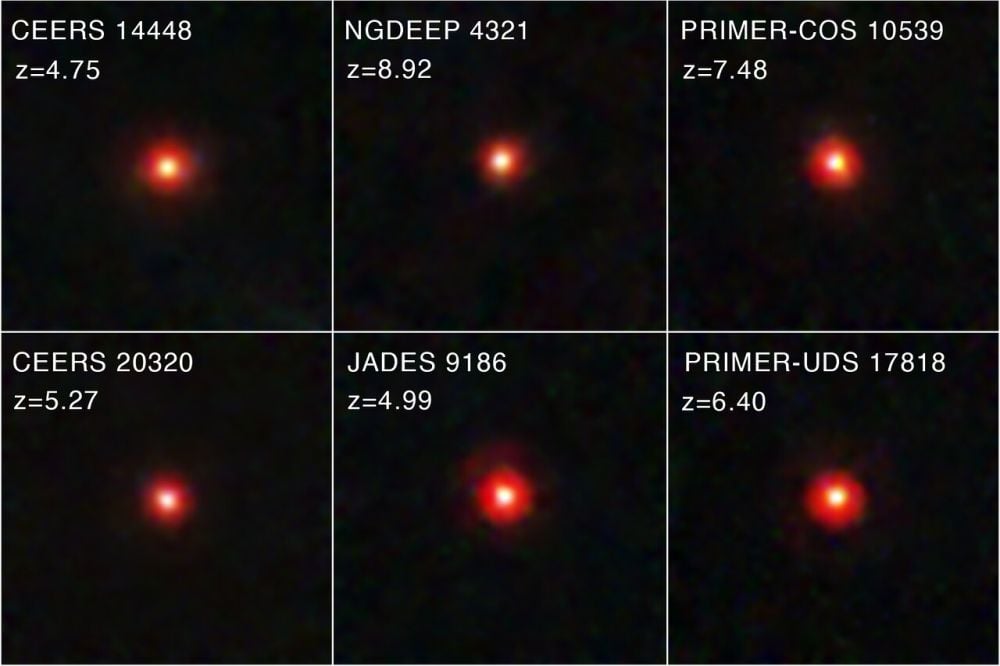
The JWST’s Near-Infrared Camera (NIRCam) and Mid-Infrared Instrument (MIRI) were designed to peer through cosmic dust and observe the first light in the universe. Shortly after its commissioning, astronomers began noticing small, ruby-colored specks in deep-field images. These "Little Red Dots" are characterized by their extreme compactness and their distinct red hues, which indicate either a massive amount of obscuring dust or an incredibly high redshift, placing them in the ancient past.
Initially, the nature of LRDs was a subject of intense debate. Some researchers hypothesized they were "monstrous" galaxies packed with old stars, while others suggested they were heavily obscured Active Galactic Nuclei (AGN)—the brilliant centers of galaxies powered by accreting black holes. The consensus has shifted toward the latter, with LRDs being viewed as the early growth phase of SMBHs. However, the discovery of LRDs in pairs, as detailed in the recent study published in the Publications of the Astronomical Society of Japan, adds a new dimension to this theory.
Methodology: Pixel-by-Pixel Analysis
The research team, led by Tanaka, utilized data from the COSMOS-Web survey, the largest observer program conducted during the JWST’s first year of operations. To identify dual LRDs, the researchers moved beyond traditional object-detection algorithms, which often consolidate closely spaced light sources into a single "blob." Instead, they employed a rigorous pixel-by-pixel color selection method.
By analyzing the specific infrared signatures of individual pixels, the team was able to "unmix" light sources that were separated by only a fraction of an arcsecond. They relaxed the standard compactness criteria typically used to identify LRDs, allowing them to spot "extended" or "double" structures that would otherwise be filtered out as errors or foreground stars. This approach led to the discovery of four dual LRD candidates with projected separations ranging from 0.2 to 1.2 arcseconds.
Spatial Proximity and Statistical Significance
The discovery of these pairs is statistically significant. In the two most prominent cases, the researchers identified spectroscopic redshifts of z = 5.822 and z = 5.464. At these redshifts, the universe was approximately 1 billion years old. The physical distances between these pairs were calculated to be 1.64 kiloparsecs (kpc) and 7.36 kpc—roughly 5,300 and 24,000 light-years, respectively.
To put these distances in perspective, the visible disk of the Milky Way spans approximately 100,000 light-years. The dual LRDs are located within distances comparable to the internal structure of a single large galaxy. This proximity makes a future merger between the two black holes almost inevitable.
Crucially, the team addressed the possibility that these pairs were simply "chance projections"—two unrelated objects at different distances that happen to line up from Earth’s perspective. By comparing their findings with mock data and existing LRD samples, the researchers concluded that the probability of such a random alignment is extremely low. The clustering is real, suggesting that LRDs tend to form in dense environments where galactic interactions are frequent.
The Role of AGN Feedback and Galactic Co-evolution
The study emphasizes that understanding LRDs is essential for understanding the history of galaxies themselves. In the local universe, there is a well-documented correlation between the mass of a central black hole and the properties of its host galaxy, such as the velocity of its stars and the total mass of its central bulge. This relationship suggests a "co-evolution" driven by AGN feedback.
As a black hole accretes matter, it releases tremendous amounts of energy in the form of radiation and powerful jets. This energy can heat or expel the surrounding gas, effectively "quenching" star formation. By identifying LRDs as precursors to these massive black holes, the Tanaka study provides a snapshot of the moment before this feedback begins to dominate the galaxy’s evolution. If LRDs are indeed merging at high rates, it would explain how black holes could gain mass rapidly enough to trigger feedback mechanisms early in cosmic time.
Competing Theories: Super-Eddington Accretion vs. Mergers
While the discovery of dual LRDs supports the merger hypothesis, it does not rule out other growth mechanisms. Some theorists argue that LRDs represent "super-Eddington" black holes. In these scenarios, black holes bypass the standard growth limits by swallowing matter so quickly that the resulting radiation is trapped within the inflow, preventing it from pushing gas away.
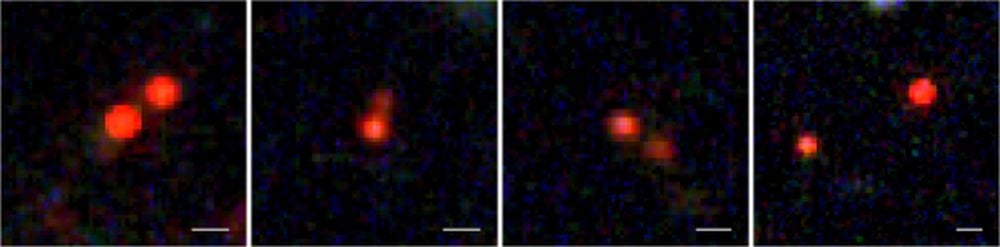
Another theory suggests that LRDs are not black holes at all, but rather "dark stars" or extremely dense stellar clusters. However, the broad Hα emission lines detected in the spectroscopic data of the dual LRDs strongly point toward the presence of high-velocity gas swirling around a central singularity—a classic hallmark of an AGN. The finding of pairs reinforces the idea that these objects are part of a hierarchical growth process where small black holes merge to form larger ones, which then merge again.
A Timeline of Discovery
The journey to identifying dual LRDs has been a rapid progression of technological and theoretical milestones:
- October 2021: The James Webb Space Telescope launches, carrying instruments capable of unprecedented infrared sensitivity.
- Early 2023: Initial deep-field images reveal a population of "Little Red Dots," sparking intense debate regarding their origin.
- Late 2023: Spectroscopic analysis of LRDs confirms high redshifts, placing them in the era of reionization.
- 2024: The COSMOS-Web survey provides a massive dataset, allowing for the search for rare, dual-object systems.
- Present: The Tanaka study identifies the first dual LRD candidates, providing evidence of clustering and imminent mergers.
Implications for Future Research
The current sample size of four dual LRD candidates is small, a fact the authors openly acknowledge. To move from "candidates" to a confirmed population, larger spectroscopic surveys are required. The researchers intend to expand their search using data from other JWST programs and potentially the upcoming Nancy Grace Roman Space Telescope, which will have a field of view 100 times larger than Webb’s.
"Investigating the environments of LRDs with larger spectroscopic samples and comparing them to other AGNs and galaxies will also be critical for understanding their nature," the authors concluded in their paper. By mapping the "neighborhoods" of these dots, astronomers can determine if they reside in the massive dark matter halos that eventually become the centers of galaxy clusters.
Furthermore, these findings have implications for gravitational wave astronomy. Merging supermassive black holes are expected to be the strongest sources of low-frequency gravitational waves in the universe. While current detectors like LIGO are tuned to smaller black hole mergers, future space-based observatories like LISA (Laser Interferometer Space Antenna) will be able to detect the ripples in spacetime created by the very mergers Tanaka’s team is now observing visually.
Conclusion
The discovery of dual Little Red Dots represents a significant step forward in our quest to map the "cosmic dawn." It suggests that the path to becoming a supermassive black hole is a violent and social one, characterized by frequent collisions in the crowded environments of the early universe. As the James Webb Space Telescope continues to peel back the layers of the deep past, the mystery of how objects like Sgr A* came to be is slowly being solved, pixel by pixel. The "Little Red Dots" may be small in the telescope’s view, but their role in the grand architecture of the universe is undeniably massive.