Sisilia Frederika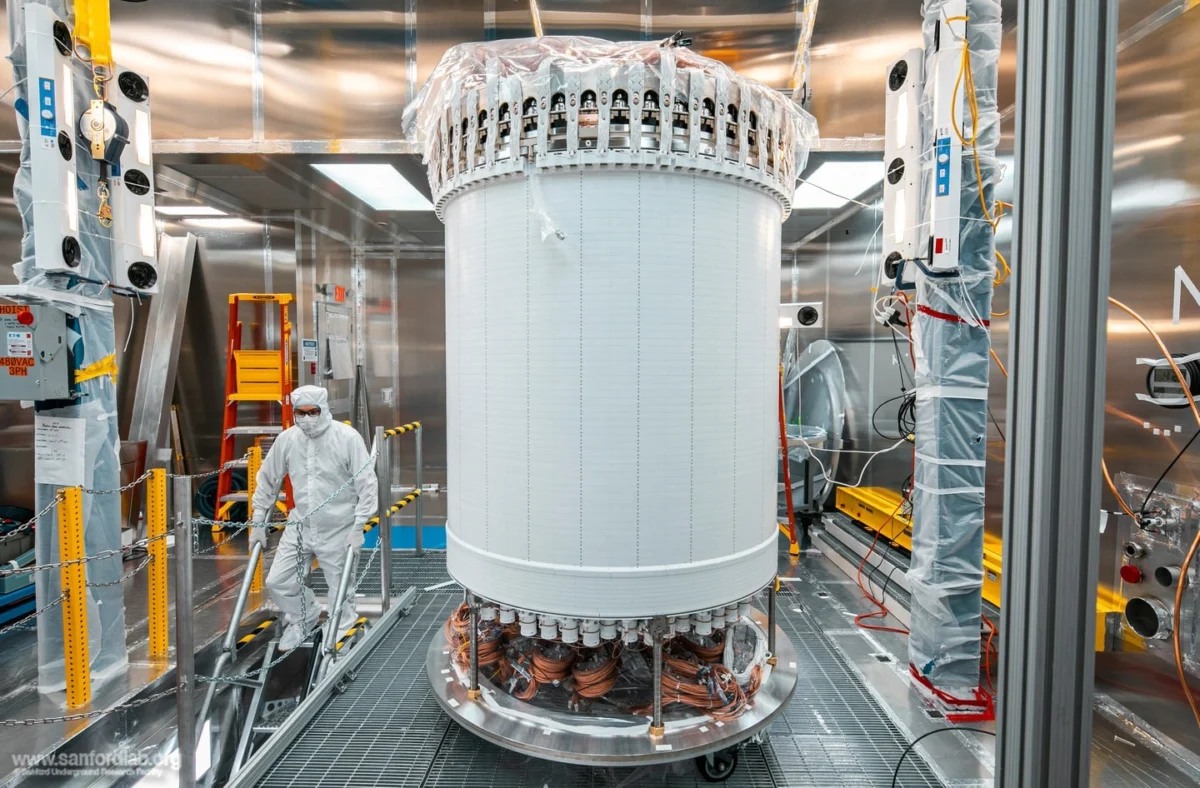
In the silent, lightless depths of a converted gold mine nearly a mile beneath the Black Hills of South Dakota, an international team of physicists has recorded a singular subatomic interaction that has the potential to reshape our understanding of the cosmos. The event, captured by the LUX-ZEPLIN (LZ) Dark Matter Experiment, involves a particle collision that does not align with the established behaviors of ordinary matter. While the scientific community remains cautious, the detection has ignited a flurry of analysis among researchers seeking to identify dark matter, the elusive substance believed to constitute approximately 85% of the total mass of the universe.
The anomaly was detected at the Sanford Underground Research Facility (SURF), which currently houses the most sensitive dark matter detector ever constructed. Since its activation in 2021, the LZ experiment has been monitoring a 10-ton tank of ultra-pure liquid xenon for the rarest of physical events: the collision of a Weakly Interacting Massive Particle (WIMP) with a xenon nucleus. This recent observation, identified during a retrospective analysis of data collected between March 2023 and April 2024, represents a significant departure from expected background noise, though researchers stop short of claiming a definitive discovery.
Technical Overview of the LUX-ZEPLIN Detection
The LUX-ZEPLIN experiment is a collaboration of 250 scientists and engineers from 39 institutions across the globe, managed by the U.S. Department of Energy’s Lawrence Berkeley National Laboratory. The detector functions as a "time projection chamber," utilizing a massive cylindrical vessel filled with liquid xenon. When a particle enters the tank and strikes a xenon atom, it produces two distinct signals: a primary flash of scintillation light (S1) and a secondary release of electrons that are drifted to the top of the chamber by an electric field, where they produce a second, delayed flash (S2).
During the 220-day observation window ending in April 2024, the team conducted a specialized review of high-energy interactions. While previous searches focused on the lower-energy thresholds where simple WIMPs were expected to appear, this follow-up analysis expanded the search parameters to include more energetic nuclear recoils. The result was a single event that exhibited a recoil energy spectrum that is difficult to reconcile with known background signals, such as those produced by neutrinos or trace amounts of radioactivity in the detector materials.
If the particle responsible for this event is indeed a constituent of dark matter, the LZ team’s preliminary analysis suggests it would possess a mass exceeding 200 times that of a proton. This would place it in a category of "heavy" dark matter candidates that have long been theorized but never observed. However, the statistical significance of the event currently sits at 2.6 sigma. In the world of particle physics, a 5-sigma result is required to claim an official discovery. At 2.6 sigma, there remains a roughly 0.5% probability that the event was a statistical fluctuation or an unmodeled background interaction.
The Evolution of the Dark Matter Mystery
The search for dark matter is one of the longest-running quests in modern science, dating back nearly a century. In the 1930s, Swiss astronomer Fritz Zwicky observed the Coma Cluster of galaxies and realized that the visible matter—stars and gas—was insufficient to provide the gravitational pull necessary to hold the cluster together. He termed this missing influence "dunkle Materie" (dark matter).
The theory gained substantial ground in the 1970s through the work of American astronomer Vera Rubin. By studying the rotation curves of spiral galaxies, Rubin and her colleagues demonstrated that the outer stars of galaxies were moving just as fast as those near the center. According to the laws of Newtonian gravity, these outer stars should have been flung into intergalactic space unless the galaxies were surrounded by a massive, invisible halo of matter that provided additional gravitational anchoring.
For decades, the leading candidate for this missing mass has been the WIMP. The WIMP hypothesis is attractive because it emerges naturally from extensions of the Standard Model of particle physics, such as supersymmetry. WIMPs are theorized to interact with normal matter only through gravity and the weak nuclear force, making them nearly impossible to detect. However, as decades of experiments have failed to find a definitive WIMP signal, some physicists have begun to explore alternative theories, including Axions (extremely light particles), SIMPs (Strongly Interacting Massive Particles), and even primordial black holes.
Analysis of Experimental Data and Background Noise
The primary challenge in dark matter detection is the elimination of "noise." Earth is constantly bombarded by cosmic rays and radiation from the sun, which would overwhelm a sensitive detector at the surface. By placing the LZ experiment 4,850 feet underground at SURF, the rock of the Black Hills acts as a natural shield, filtering out the majority of cosmic interference.
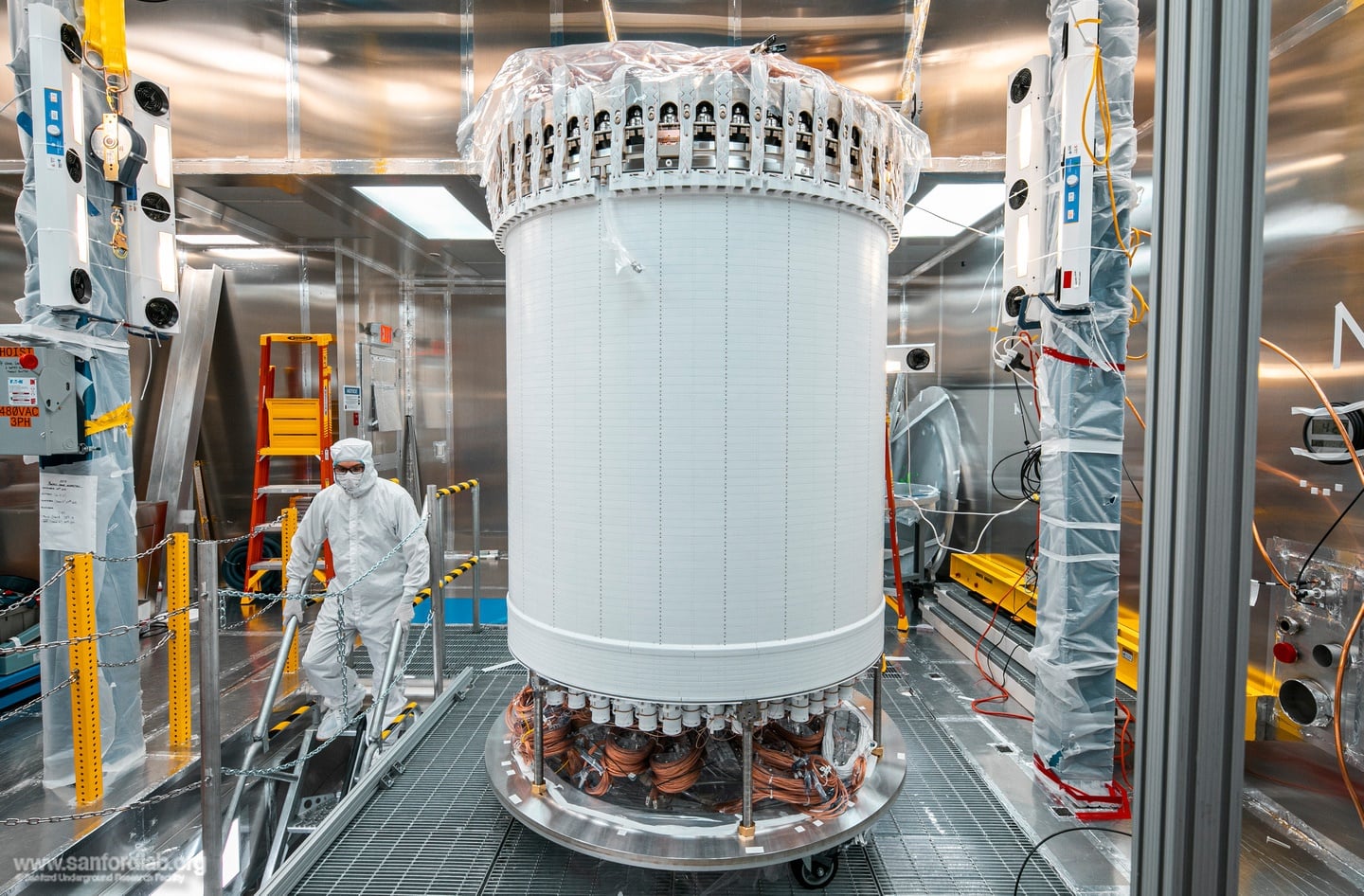
To further ensure the purity of the data, the 10-ton xenon tank is surrounded by a "veto" system—a layer of liquid scintillator and ultra-pure water designed to detect and discard signals from neutrons or gamma rays that manage to penetrate the underground facility. The xenon itself is purified to an unprecedented degree, removing almost all traces of krypton, a radioactive isotope that occurs naturally in xenon.
"We’re very intrigued to see this event in the data, in the region where we expect dark matter to show up and the competing backgrounds are very low," said Rick Gaitskell, a professor at Brown University and the spokesperson for LUX-ZEPLIN, in a news release following the 2026 TeV Particle Astrophysics conference in Japan. "With only one event, we don’t want to get ahead of ourselves. We are not claiming to have seen dark matter. But we have seen something interesting that we want to share with the scientific community for their input."
The data from the LZ experiment is currently being prepared for submission to Physical Review Letters. The peer-review process will involve independent physicists scrutinizing the LZ team’s background models to ensure that the 2.6-sigma event cannot be attributed to more mundane sources, such as a rare interaction with a solar neutrino or an unexpected decay from the detector’s own structural components.
Broader Impact and the Global Race for Detection
The LZ experiment is not alone in this hunt. In Italy, the XENONnT experiment at the Gran Sasso National Laboratory is conducting similar searches with a multi-ton liquid xenon detector. In China, the PandaX-4T experiment at the Jinping Underground Laboratory is also operational. The emergence of a potential signal at LZ will likely prompt these other facilities to re-examine their own datasets for similar high-energy anomalies.
The timing of the LZ announcement coincides with a new era of space-based observation. Earlier this week, NASA successfully launched the Nancy Grace Roman Space Telescope. While LZ looks for dark matter through direct detection (watching for collisions in a lab), the Roman telescope will search for dark matter through indirect observation, mapping how its gravity bends light from distant galaxies—a phenomenon known as gravitational lensing. Together, these terrestrial and orbital efforts aim to pin down the properties of the "dark sector," which includes both dark matter and dark energy.
Dark energy, which accounts for approximately 68% of the universe’s mass-energy content, is the force driving the accelerated expansion of the universe. Ordinary matter, the atoms that make up stars, planets, and people, accounts for a mere 5%. If the LZ event is confirmed to be dark matter, it would represent the first time humanity has directly interacted with the other 95% of reality.
Future Prospects and Verification Requirements
Despite the excitement, the scientific community emphasizes that a single "bump" in the data is only the beginning. Daniel Akerib, a physicist at the SLAC National Accelerator Laboratory and a member of the LZ science team, noted that verification will require multiple lines of evidence.
"You would want to see the result confirmed, learn its coupling to matter by seeing it in another isotope—possibly liquid argon," Akerib stated. He also highlighted the need for laboratory production, suggesting that if such a particle exists, it might eventually be produced in high-energy collisions at facilities like the High-Luminosity Large Hadron Collider (HL-LHC) at CERN. "Seeing something go ‘bump’ is quite different from being able to determine its cosmological abundance."
If the signal persists and the statistical significance grows with more data, the next step for the global physics community may be the construction of the XLZD observatory—a proposed "ultimate" dark matter detector that would utilize 60 to 100 tons of liquid xenon. Such a machine would have the sensitivity to either definitively confirm the LZ finding or reach the "neutrino floor," a point where the background signal from solar and atmospheric neutrinos becomes so thick that direct dark matter detection becomes nearly impossible.
For now, the single event at SURF remains a tantalizing mystery. Whether it is the first true glimpse of the invisible architecture of the universe or simply a rare whisper of background noise, it has provided the most specific target for dark matter detectives in over a decade. The scientific world now waits for the next year of data to see if the anomaly repeats, or if the dark remains as silent as ever.