Sisilia Frederika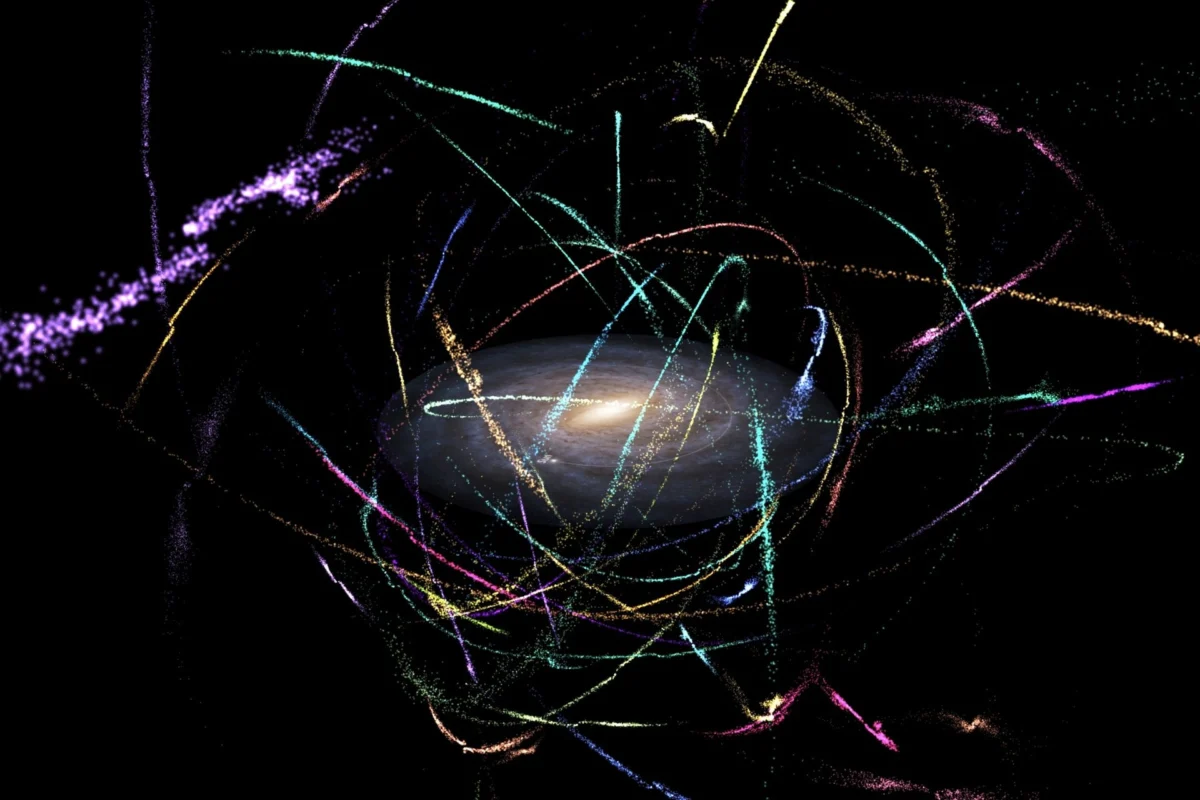
The pursuit of dark matter remains one of the most significant challenges in modern astrophysics, characterized by a persistent gap between theoretical necessity and direct observation. While dark matter is estimated to constitute approximately 85 percent of the matter in the universe, it does not emit, absorb, or reflect light, rendering it invisible to traditional telescopic methods. Consequently, researchers have long relied on indirect evidence—such as the rotational speeds of galaxies and the gravitational lensing of distant light—to map its distribution. However, a landmark study published in The Astrophysical Journal, titled "No Stream Left Unscathed: The Imprint of a Host Galaxy," has introduced a critical complication into this search. By utilizing advanced computer simulations, a research team led by Arpit Arora has demonstrated that the visible, "regular" matter within a galaxy is far more disruptive than previously understood, creating structural anomalies in stellar streams that were once thought to be exclusive signatures of dark matter.
The Role of Stellar Streams in Galactic Archaeology
To understand the implications of the study, one must first define the role of stellar streams within the context of galactic evolution. These celestial structures are essentially the remnants of smaller dwarf galaxies or globular clusters that have been gravitationally disrupted by a larger host galaxy, such as the Milky Way. As these smaller entities are pulled into the gravitational well of the larger galaxy, they undergo a process known as tidal stripping. This process stretches the smaller system into long, thin ribbons of stars that continue to orbit the galactic center.
Stellar streams are frequently described by astronomers as "galactic fossils." Because they are sensitive to the gravitational field of the host galaxy, their trajectories and internal structures provide a historical record of the galaxy’s mass distribution. For decades, the prevailing theory suggested that any "kinks," "gaps," or "twists" found within these otherwise smooth streams were caused by interactions with invisible clumps of dark matter, known as subhalos. The Arora study, however, challenges this assumption by focusing on the impact of baryonic—or regular—matter.
Methodology: Simulating the Baryonic Influence
The research team, including Arpit Arora and colleagues, utilized high-resolution simulations to model the behavior of stellar streams around galaxies similar in size and composition to the Milky Way. Unlike traditional simulations that prioritize dark matter fluctuations to observe cosmic web formation, this study intentionally treated dark matter as a "smooth" and uniform halo. By neutralizing the potential for dark matter clumping within the simulation, the researchers could isolate the effects of regular matter—such as the galactic disk, the central bulge, and the rotating galactic bar—on the morphology of stellar streams.
This methodological "twist" allowed the team to establish a baseline for what regular matter can achieve on its own. The simulations tracked the evolution of numerous streams over billions of years, observing how they responded to the complex gravitational environment of a rotating, barred spiral galaxy. The results revealed that the gravitational influence of the galactic bar and the spiral arms is sufficiently powerful to induce significant deformations. Even without the presence of dark matter subhalos, the simulated streams developed the same types of kinks and clumps that have been observed in real-world telescopic data.
Key Findings: The Mimicry of Regular Matter
The most striking discovery of the study is that "smooth" streams are an anomaly rather than the norm. The team found that nearly every stream in their simulation was "unscathed"—a play on the title of their paper, meaning that virtually all were subjected to structural changes caused by the host galaxy’s regular matter.
- Inner-Galaxy Deformations: Streams that orbit closer to the galactic center are subject to the most intense gravitational shear. The rotating central bar of the galaxy acts as a massive "stirrer," creating frequent and significant kinks in the stellar ribbons.
- Persistence at Distance: While the effects are most pronounced near the center, the study found that even distant streams—those located in the outer reaches of the galactic halo—showed signs of deformation. These results suggest that the reach of the galactic disk’s gravity is more extensive than previously modeled in simplified dark matter studies.
- Observation Matching: When comparing their simulated data to the two dozen known stellar streams in the Milky Way, the researchers found a high degree of correlation. The twists and clumps found in the real-world GD-1 or Jhelum streams, for instance, could potentially be explained entirely by the gravitational influence of the Milky Way’s visible components.
A Chronology of Dark Matter Research and Stellar Stream Observation
The evolution of this field has been marked by several key milestones that set the stage for the Arora study:
- 1933: Fritz Zwicky first proposes the existence of "dunkle Materie" (dark matter) after observing the Coma Cluster.
- 1970s: Vera Rubin and Kent Ford provide strong evidence for dark matter through galaxy rotation curves.
- 1994: The discovery of the Sagittarius Stream provides the first major evidence of ongoing tidal stripping in the Milky Way.
- 2000s: The Sloan Digital Sky Survey (SDSS) begins mapping the "Field of Streams," identifying dozens of new stellar ribbons.
- 2013–Present: The European Space Agency’s Gaia mission provides unprecedented 3D mapping of more than a billion stars, allowing for the precise measurement of stellar stream velocities.
- 2026: The publication of "No Stream Left Unscathed" necessitates a recalibration of how astronomers distinguish between baryonic and dark matter influences.
Implications for the Lambda-CDM Model
The findings have significant implications for the Lambda Cold Dark Matter (ΛCDM) model, the current standard model of cosmology. The ΛCDM model predicts that large galaxies like the Milky Way should be surrounded by thousands of small dark matter subhalos. If these subhalos exist, they should leave "holes" or gaps in stellar streams when they pass through them.
By proving that regular matter can create similar gaps and kinks, the Arora study raises the "burden of proof" for dark matter detection. It suggests that many of the features previously attributed to dark matter subhalos may simply be the result of the complex, noisy environment of the host galaxy. This does not disprove the existence of dark matter subhalos, but it does mean that astronomers must develop more sophisticated filtering techniques to separate the "baryonic noise" from the "dark matter signal."
Industry and Academic Reactions
While the study serves as a cautionary note, it has been received by the astrophysical community as a necessary step toward more rigorous science. Inferred reactions from the broader scientific community suggest a consensus that "galactic archaeology" must become more multidisciplinary.
"We can no longer treat stellar streams as isolated systems in a dark vacuum," notes the logic of the study’s conclusion. "To find the fingerprint of dark matter, we must first perfectly understand the fingerprint of the galaxy itself."
The research indicates that the "low-hanging fruit" of dark matter detection in the inner Milky Way may have already been picked, and what remains is a much more difficult task of discernment. Analysts suggest that this study will likely lead to a shift in computational resources, with future simulations requiring higher-resolution baryonic physics to complement dark matter modeling.
Future Outlook: The Vera C. Rubin Observatory
The next phase of this research will rely heavily on the Vera C. Rubin Observatory, currently nearing completion in Chile. The observatory’s Legacy Survey of Space and Time (LSST) is expected to revolutionize the study of stellar streams.
Unlike current surveys that are limited to the brighter, closer streams, the Vera Rubin telescope will have the sensitivity to capture incredibly faint streams on the extreme outskirts of the Milky Way. These distant streams are crucial because they reside in regions where the influence of the galactic disk and bar is significantly weakened. If these distant streams show the same kinks and twists observed in the inner galaxy, it would provide much stronger evidence for the existence of dark matter subhalos, as regular matter would no longer be a viable explanation for the deformations.
Conclusion: Refined Baselines for Discovery
The study "No Stream Left Unscathed" represents a pivotal shift in the strategy of dark matter hunting. By demonstrating that regular matter is a "noisy" contributor to galactic structure, Arpit Arora and his team have provided a new set of baselines for the scientific community. The discovery that "smooth" streams are rare suggests that the universe is a far more turbulent place than simple gravitational models once suggested.
As the search for dark matter continues, the focus will likely move toward the "pristine" environments of the outer galactic halo. Only by looking where the "shouting" of regular matter fades to a whisper can astronomers hope to hear the subtle signal of the dark matter that holds the universe together. For now, the study serves as a reminder that in the complex dance of galactic evolution, every player—no matter how small or visible—leaves an indelible mark on the cosmic record.