Sisilia Frederika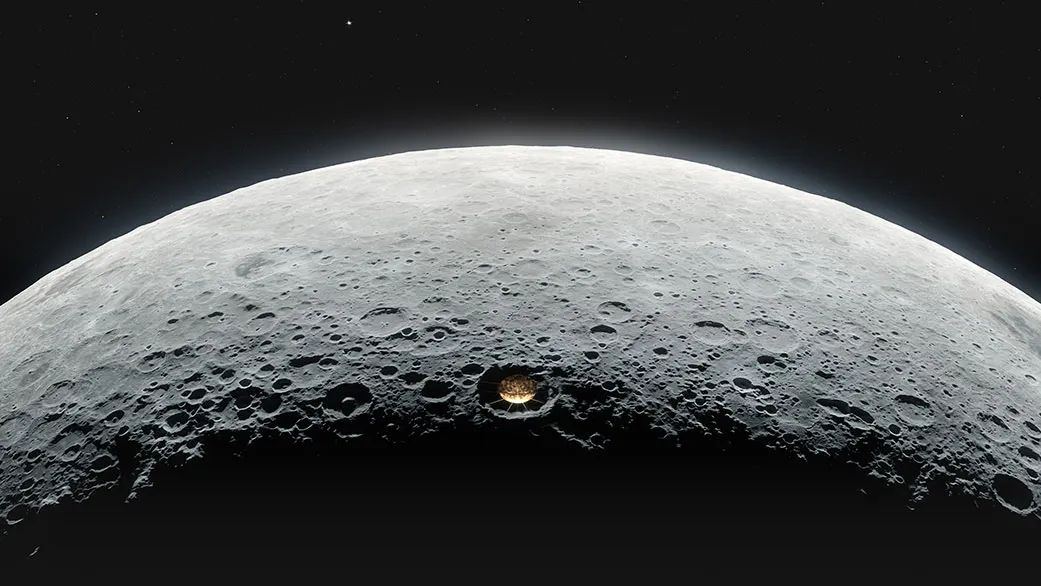
The search for extraterrestrial intelligence and the study of the universe’s most elusive radio phenomena are facing an unprecedented existential crisis. In 1977, the "Wow!" signal—a 72-second burst of high-intensity radio energy—captured the world’s imagination and remains one of the most compelling pieces of evidence for potential technosignatures. However, in the decades since that discovery, Earth has become a "noisy" planet. The proliferation of cellular networks, satellite constellations, and global radar systems has created a shroud of radio frequency interference (RFI) that effectively drowns out the faint whispers of the cosmos. Astronomers now warn that the last remaining "radio-quiet" zone in the inner solar system—the far side of the Moon—is under immediate threat from human expansion.
A new proposal led by David DeBoer of the University of Oxford, detailed in a pre-print paper on arXiv, outlines a critical initiative to safeguard our ability to listen to the universe. The Lunar Farside Transients and Technology Telescope (LFT3) is designed to capitalize on the unique geography of the Moon’s hidden hemisphere before a surge in lunar exploration introduces permanent interference to that pristine environment.
The Closing Window of Radio Silence
For nearly a century, the ionosphere has served as both a shield and a barrier. While it protects Earth from certain types of solar radiation, it also reflects and absorbs low-frequency radio signals, preventing ground-based telescopes from observing the universe at frequencies below 30 MHz. To bypass this, scientists have long eyed the far side of the Moon. Because the Moon is tidally locked to Earth, the far side always faces away from our planet, using 3,474 kilometers of solid lunar rock as a natural shield against the "chatter" of human civilization.
However, this sanctuary is temporary. The next decade marks the beginning of a "Lunar Gold Rush." Between NASA’s Artemis program, the International Lunar Research Station (ILRS) led by China and Russia, and a multitude of private ventures, the lunar environment is about to become crowded. By 2030, a projected fleet of orbiters, landers, and relay satellites will establish a permanent presence around and on the Moon. These missions will rely on radio for navigation and communication, effectively ending the era of absolute radio silence on the lunar far side.
The DeBoer paper emphasizes that the window to deploy a pure radio astronomy mission is closing. If the LFT3 or similar projects are not established by the end of the 2020s, the background noise generated by lunar infrastructure may become as restrictive as the RFI currently experienced on Earth.
Mission Architecture and the CLPS Advantage
The LFT3 mission is proposed as a high-impact, low-cost solution to this looming problem. With an estimated price tag of approximately $150 million, the project aims to leverage NASA’s Commercial Lunar Payload Services (CLPS) program. CLPS allows NASA to contract private companies to deliver scientific instruments to the lunar surface, significantly reducing the overhead costs associated with traditional bespoke mission launches.
The mission’s design focuses on a sophisticated, deployable radio antenna system capable of operating across the High Frequency (HF), Very High Frequency (VHF), and Ultra High Frequency (UHF) bands. The primary goal is to conduct a continuous scan of the deep cosmos for a period of approximately 20 weeks. This duration is dictated by the extreme environmental challenges of the lunar surface, where instruments must survive 14-day periods of intense sunlight followed by 14-day periods of total darkness.
The engineering requirements for such a mission are formidable. During the lunar day, surface temperatures can soar to 120°C (248°F), while the lunar night brings a plummeting drop to -130°C (-202°F). To survive these fluctuations, the LFT3 will require advanced thermal management systems and specialized materials that can maintain structural integrity and electronic functionality under thermal stress.
Scientific Objectives: Technosignatures and Exoplanetary Weather
The LFT3 mission is built upon three primary scientific pillars, each addressing fundamental questions about the nature of the universe and our place within it.
1. The Search for Technosignatures
Supported by the Breakthrough Listen initiative—the largest scientific program ever dedicated to finding signs of intelligent life beyond Earth—the LFT3 would serve as a dedicated ear for "Wow!"-style signals. In the quiet of the lunar far side, the telescope could detect narrow-band radio signals that would be impossible to distinguish from terrestrial noise if observed from Earth. This mission represents a significant leap in our capability to monitor nearby star systems for technological leakage or intentional broadcasts.
2. Exoplanet Auroras and Habitability
One of the most innovative goals of the LFT3 is the detection of radio emissions from auroras on exoplanets. On Earth, auroras are caused by the interaction between the solar wind and our planet’s magnetic field. Many gas giants in our solar system, such as Jupiter, produce powerful radio bursts through similar processes. By detecting these signals from planets orbiting other stars, scientists can infer the presence of a magnetosphere. A magnetic field is considered a crucial component of habitability, as it protects a planet’s atmosphere from being stripped away by stellar winds. LFT3’s ability to monitor low-frequency bands makes it uniquely suited for this "planetary weather" reporting.
3. Fast Radio Bursts (FRBs) and Transients
Fast Radio Bursts are millisecond-long, high-energy pulses of radio waves originating from distant galaxies. While hundreds have been detected since their discovery in 2007, their origins remain a subject of intense debate, with theories ranging from magnetars to black hole collisions. The LFT3 would observe these transients with unprecedented clarity, free from the atmospheric distortion and man-made interference that plague Earth-based arrays.
Engineering Challenges: The Data Bottleneck and Radiation
While the far side of the Moon offers the advantage of silence, it presents a significant logistical hurdle: communication. Because there is no direct line of sight to Earth, the LFT3 cannot transmit its findings directly to ground stations. Instead, the mission must rely on a relay satellite in lunar orbit to "bounce" data back to Earth.
Current lunar communication infrastructure is severely limited. Experts estimate that a standard relay setup might only support a data transfer rate of roughly 100 GB per month. For a high-resolution radio telescope, which can generate terabytes of raw data in a single day, this creates a massive bottleneck.
To solve this, the LFT3 team proposes the use of "edge computing"—performing high-level data processing on the lunar surface itself. The telescope would be equipped with radiation-hardened processors designed to filter out "uninteresting" data and background noise, transmitting only the most significant signals back to Earth. This requires a delicate balance of power consumption and computational muscle, as the hardware must survive the constant bombardment of cosmic rays and solar particles without the protection of a thick atmosphere.
Chronology of Lunar Radio Astronomy Concepts
The push for a lunar radio telescope is not a new phenomenon, but rather the culmination of decades of theoretical work:
- 1960s-1970s: During the Apollo era, scientists first proposed the far side of the Moon as an ideal site for low-frequency astronomy.
- 2019: China’s Chang’e 4 mission landed on the far side, carrying a small low-frequency radio spectrometer (NCLE), proving the technical feasibility of landing and operating in the region.
- 2021-2023: NASA and various international bodies began formalizing the "Lunar Surface Science Strategy," identifying the far side as a "protected" zone for science.
- 2024: The LFT3 proposal emerges as a concrete, cost-effective plan to utilize the CLPS framework before the 2030 "noise" threshold.
Broader Implications and the Future of Astronomy
The LFT3 mission is more than just a scientific endeavor; it is a test case for how humanity will balance exploration with preservation. As we move toward becoming a multi-planetary species, the tension between industrial/commercial expansion and scientific observation will only increase.
If LFT3 is funded and successful, it will pave the way for larger, more permanent installations, such as the proposed Lunar Crater Radio Telescope (LCRT), which would turn an entire lunar crater into a massive parabolic dish. However, if the mission fails to gain traction, astronomers fear that the "Great Silence" of the lunar far side will be lost forever, replaced by the same electronic fog that has already obscured our view of the heavens from Earth.
As of late 2024, the LFT3 remains a proposal awaiting formal funding and a flight manifest. Its proponents argue that the $150 million investment is a small price to pay for a "one-time-only" opportunity to capture the universe’s most elusive signals before the window of opportunity slams shut. The scientific community now waits to see if space agencies will prioritize this silent frontier or if the next "Wow!" signal will be lost in the noise of our own making.