Sisilia Frederika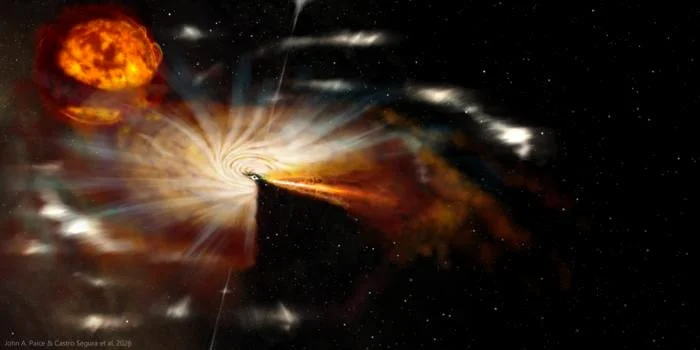
The traditional perception of black holes as insatiable cosmic vacuum cleaners, from which nothing—not even light—can escape, is being fundamentally challenged by new astronomical data. An international collaboration of researchers, spearheaded by the University of Warwick, has published a study in the Monthly Notices of the Royal Astronomical Society that provides a more nuanced view of these celestial enigmas. By observing the binary black hole system known as Swift J1727.8−1613, scientists have uncovered evidence that black holes may function more like complex digestive systems than bottomless pits. The study reveals that a significant portion of the material a black hole "consumes" is actually expelled back into space through violent eruptions of winds and jets, suggesting that these objects are far less efficient at accretion than previously theorized.
The Mechanics of the Swift J1727.8−1613 Binary System
Swift J1727.8−1613 is classified as a low-mass X-ray binary (LMXB), a system located within our own Milky Way galaxy. It consists of two primary components: a stellar-mass black hole, estimated to be approximately ten times the mass of our Sun, and a "normal" companion star. In such a configuration, the gravitational pull of the black hole is so immense that it actively strips the outer layers of gas from its orbiting companion. This stolen material does not fall directly into the black hole; instead, it forms an accretion disk—a swirling, flattened structure of superheated plasma that spirals inward.
As the material in the accretion disk moves closer to the event horizon—the theoretical "point of no return"—it reaches extreme temperatures, emitting high-energy X-rays that allow astronomers to detect the system despite the black hole itself being invisible. Swift J1727.8−1613 is particularly notable for its relatively low level of activity compared to the supermassive black holes found at the centers of galaxies. However, its proximity and the clarity of its recent eruptive phase have provided a rare laboratory for studying the "feeding" habits of these objects in unprecedented detail.
Chronology of the 2023 Eruptive Event
The breakthrough in understanding Swift J1727.8−1613 came during a massive eruption first detected in 2023. While many black hole observations are captured as static "snapshots," the research team utilized the European Southern Observatory’s Very Large Telescope (VLT), located in the Atacama Desert of Chile, to conduct a time-series analysis. This allowed the team to track the evolution of the system over a continuous period, observing the sequence of events from the initial consumption of stellar matter to the subsequent discharge of energy and mass.
The 2023 event began when a surge of material from the companion star hit the accretion disk, causing it to brighten significantly across the electromagnetic spectrum. As the black hole processed this sudden influx of matter, the VLT’s sensitive instruments detected the signature of powerful "winds"—outflows of ionized gas moving at thousands of kilometers per second. Simultaneously, the system produced relativistic jets, which are highly collimated beams of matter ejected from the poles of the black hole at speeds approaching the speed of light. The chronology of the event showed that the expulsion of material was not a momentary reaction but a sustained process that continued long after the initial "meal" had been processed.
Technical Methodology: The Role of the Very Large Telescope
The University of Warwick-led team relied on the VLT’s advanced spectroscopic capabilities to differentiate between the material falling into the black hole and the material being cast out. Spectroscopy involves breaking down the light from the system into its constituent wavelengths, creating a "fingerprint" of the chemical elements and physical conditions present.
By analyzing the Doppler shifts in the light—where the movement of gas causes the light to shift toward the red or blue ends of the spectrum—researchers could measure the velocity and direction of the outflows. These observations confirmed that the "winds" were being driven by the intense radiation pressure and magnetic fields generated within the accretion disk. This data provided the empirical foundation for the team’s conclusion: black holes are messy eaters. Rather than absorbing 100% of the material funneled toward them, they appear to reach a saturation point where excess matter is violently rejected.
Challenging the "Endless Pit" Narrative
The findings regarding Swift J1727.8−1613 suggest a paradigm shift in how astrophysicists model black hole evolution. Dr. Noel Castro Segura, a Postdoctoral Fellow at the University of Warwick and the study’s lead author, emphasized that the "vacuum cleaner" metaphor is scientifically misleading. "People often imagine black holes simply swallowing everything around them," Segura noted. "What we’re seeing is a much more complex process. Matter falls in, the system processes it, and a surprising amount is expelled again."
The study posits that if black holes continue to shed material even after their largest outbursts, their role in galactic ecosystems must be reevaluated. This "inefficiency" means that black holes may grow more slowly than current models predict. Furthermore, the material expelled by these systems—rich in heavy elements and energy—is returned to the interstellar medium, where it can influence the formation of new stars and planets. This feedback loop suggests that even small black holes like Swift J1727.8−1613 play a vital role in "recycling" matter within their host galaxies.
Evolutionary Context of Binary Stars
To understand why Swift J1727.8−1613 behaves the way it does, one must look at its likely history. Astronomers believe the system began as two massive stars orbiting one another. The more massive of the two reached the end of its life cycle first, collapsing under its own gravity in a supernova explosion. This cataclysmic event left behind the 10-solar-mass black hole.
The second, smaller star survived the explosion but remained gravitationally locked to the remnant. As the companion star entered the later stages of its own life, it began to expand, allowing the black hole to begin its current phase of "vampiric" consumption. The research suggests that the evolution of such binary systems is dictated by this constant tug-of-war between accretion and expulsion. If a significant fraction of the companion star’s mass is being blown away by winds rather than being swallowed by the black hole, the lifespan of the binary system may be extended, as the black hole takes longer to "finish" its companion.
Broader Implications for Astrophysics
The implications of the Warwick study extend beyond this single binary system. The mechanisms observed in Swift J1727.8−1613—specifically the relationship between accretion disks, winds, and jets—are thought to be scalable. This means that the "digestion" process seen in a 10-solar-mass black hole likely mirrors the processes occurring in supermassive black holes, which can be billions of times the mass of the Sun and reside at the centers of galaxies like our own.
If supermassive black holes are also "inefficient eaters," it would explain why many galaxies appear to have a self-regulating mechanism for star formation. The energy and matter expelled by a central black hole can heat up surrounding gas clouds, preventing them from collapsing to form new stars. By studying Swift J1727.8−1613, scientists are essentially observing a miniature version of the forces that shape the entire universe.
Future Research and the Next Frontier
The discovery has opened several new avenues for inquiry. One of the primary questions remaining is what determines the "efficiency" of a black hole’s meal. Does the spin of the black hole affect how much material is expelled? Does the chemical composition of the companion star play a role in the strength of the resulting winds?
The international scientific community is now looking toward next-generation observatories to build on the Warwick team’s findings. Instruments like the Extremely Large Telescope (ELT), currently under construction in Chile, and the James Webb Space Telescope (JWST) will provide even higher resolution data on the infrared and optical signatures of these eruptions. By combining X-ray data from space-based observatories with high-resolution ground-based spectroscopy, astronomers hope to create a comprehensive "digestive map" of the various classes of black holes.
In the final analysis, the study of Swift J1727.8−1613 serves as a reminder of the dynamic and often counterintuitive nature of the cosmos. As researchers move away from the image of the "endless pit" and toward the model of a "cosmic engine," our understanding of the life cycles of stars and the evolution of galaxies continues to deepen. The 2023 eruption of this small binary system has provided a significant piece of the puzzle, proving that in the vastness of space, even the most mysterious objects have stories to tell about where matter goes, and more importantly, where it returns.