Chandra Wibowo
China’s Ministry of State Security (MSS) has intensified its public discourse regarding the perceived risks associated with cryptocurrencies, labeling them as “accomplices” in espionage activities and asserting that their transactional anonymity is often overstated. This sharpened rhetoric signals a continued hardening of Beijing’s stance on digital assets, aligning with its long-standing comprehensive ban on cryptocurrency-related businesses. The MSS’s pronouncements, disseminated through social media channels, highlight the alleged use of cryptocurrencies in facilitating money laundering, enabling cyberattacks, and ultimately serving as tools for foreign adversaries seeking to undermine national security.
The ministry explicitly stated that cryptocurrencies are frequently exploited by “overseas anti-China hostile forces” with the objective of disrupting China’s financial order and compromising its national security interests. This assertion implies a sophisticated understanding and monitoring capability by Chinese intelligence agencies, suggesting that transactions, while often perceived as untraceable, are subject to scrutiny. The warning regarding the illusion of cryptocurrency anonymity appears to be a direct message aimed at potential foreign operatives. The MSS articulated that intelligence agencies might attempt to allay the concerns of individuals they are attempting to recruit as spies by falsely claiming that the circulation of virtual currencies is difficult to verify. This statement serves as a thinly veiled warning: “We are watching the blockchain.” While this caution is particularly pertinent to widely used cryptocurrencies like Bitcoin and Ethereum, which offer varying degrees of transparency on their public ledgers, it is acknowledged that privacy-focused cryptocurrencies such as Monero or Zcash, when utilized with proper operational security, can offer a higher degree of anonymity.
China’s regulatory history with cryptocurrencies has been characterized by a series of escalating restrictions. Following earlier prohibitions, a comprehensive ban on cryptocurrency exchanges was implemented in 2017, followed by a crackdown on mining operations in 2021. All cryptocurrency-related businesses have subsequently been declared illegal within the country. This firm governmental stance contrasts sharply with the burgeoning activity observed in other Asian financial hubs.
Singapore’s Crypto Ascendancy Amidst Regional Contraction
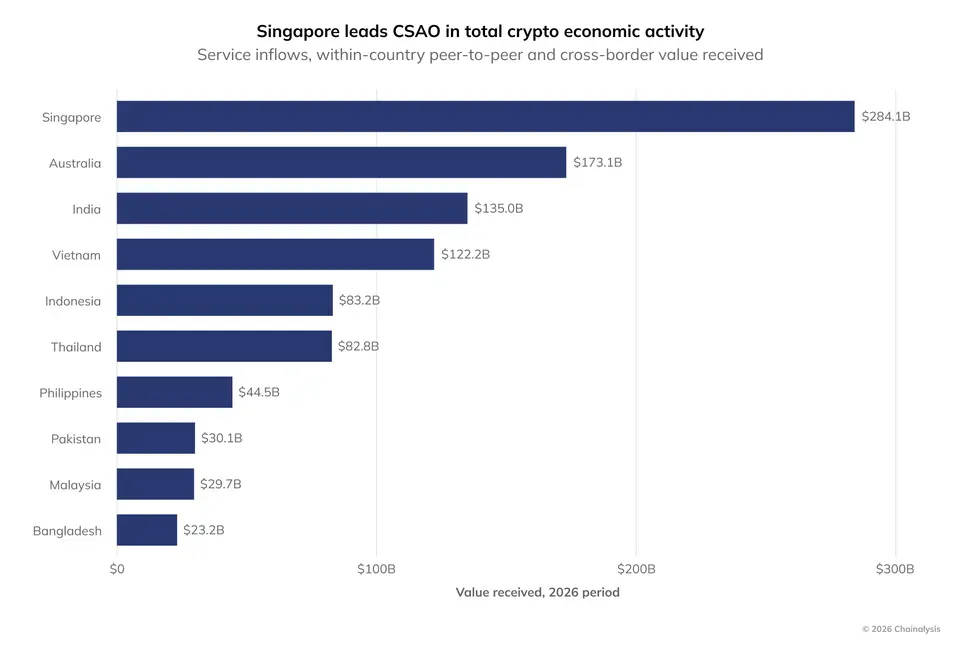
In stark contrast to China’s restrictive environment, Singapore has emerged as a resilient and growing hub for cryptocurrency activity. According to data compiled by Chainalysis, Singapore’s crypto economy experienced a significant expansion of 55.4%, reaching a valuation of $284 billion in the year concluding June 2026. This remarkable growth trajectory has allowed Singapore to reclaim its position as the preeminent cryptocurrency market within the Central and Southeast Asia and Oceania (CSAO) region.

This surge in activity is largely attributable to a substantial increase in institutional platform engagement, which saw a 94% rise to $60 billion. This institutional growth was primarily concentrated among a select group of market makers, over-the-counter (OTC) trading firms, and institutional brokerages. The broader CSAO crypto economy, however, experienced a contraction of 6.8% over the same period, underscoring Singapore’s exceptional performance. Chainalysis observed that the expansion within Singapore’s institutional platform ecosystem was highly concentrated, characterized by high-volume transactions executed by established players rather than the emergence of new services. This suggests a deepening of activity within existing robust frameworks rather than a broad-based market expansion.
South Korea Explores Market-Making Systems Amidst Stablecoin Volatility
South Korea’s financial regulatory landscape is showing signs of potential evolution regarding digital assets, with the Financial Services Commission (FSC) indicating that it is considering the introduction of a market-making system for digital assets. This contemplation follows an incident earlier this month where a stablecoin pegged to the Japanese yen, JPYC, traded at a significant premium—as much as four times its intended value—on a major South Korean cryptocurrency exchange.
The exchange, Upbit, listed JPYC, a yen-backed stablecoin, on September 17. The trading commenced at 12 Korean won per JPYC and rapidly ascended to a peak of 37.6 Korean won within an hour, far exceeding its peg. This dramatic price fluctuation was attributed to a scarcity of liquidity on the Upbit platform. In response to such market inefficiencies, Yoo Young-joon, director of digital finance policy at the FSC, stated, “We will also review the need to introduce systems such as market-making activities to increase the efficiency and stability of the digital asset landscape.”
Under the current framework of South Korea’s Virtual Asset User Protection Act, market-making activities are not explicitly exempted from provisions pertaining to market manipulation. This regulatory ambiguity has historically hindered market makers from actively contributing to liquidity within the nation’s cryptocurrency markets.
In parallel, MoonPay, a United States-based payments and infrastructure firm, has initiated operations in South Korea by establishing a local subsidiary. The company intends to collaborate with domestic financial institutions on services including remittances, payments, settlements, and the distribution of digital assets. However, this venture is contingent upon receiving the necessary regulatory approvals, which have not yet been granted.
Japan Embraces Crypto Payments Through Binance Pay Integration
Japan is witnessing a significant development in cryptocurrency adoption for everyday transactions, with Binance Pay now enabling eligible overseas visitors to spend a wide array of cryptocurrencies at merchants accepting the PayPay payment system. This new service, effective from Wednesday, supports over 100 cryptocurrencies for transactions at the vast majority of PayPay-integrated locations across Japan.
The operational framework for this integration involves HIVEX, a payment interoperability solution that bridges overseas QR payment services with merchants in Japan that support PayPay. Binance Pay utilizes Tether USDt (USDT) as its underlying settlement asset. HIVEX then facilitates settlements with PayPay, which in turn settles with merchants in Japanese yen. Binance has highlighted this initiative as a pioneering effort, marking the first cryptocurrency payment service to gain access to PayPay merchants through the HIVEX framework. A key feature of this service is that merchants are not required to undertake separate opt-in procedures.
PayPay is a ubiquitous cashless payment service in Japan, accepted at millions of locations nationwide, encompassing major retail chains, independent shops, vending machines, taxis, and public transportation systems. The platform currently supports nine other overseas payment services via HIVEX, primarily originating from China, Hong Kong, and Taiwan.
Hong Kong Enhances Regulatory Oversight of Crypto Firms
Hong Kong’s financial regulators are strengthening their oversight of licensed cryptocurrency firms through an expanded agreement on financial reporting and audits. The Securities and Futures Commission (SFC) and the Accounting and Financial Reporting Council (AFRC) have formalized a memorandum of understanding to enhance their collaborative efforts. This agreement establishes a structured framework for information sharing, case referrals, mutual assistance, and coordinated inspections and investigations specifically targeting licensed crypto firms.
In another significant development, HSBC is preparing for the phased launch of its new Hong Kong dollar-backed stablecoin, which will be known as RedCoin. The initial rollout will focus on person-to-person and merchant payments, with subsequent expansion into corporate and institutional use cases. To mitigate risks and protect consumers, HSBC is also concurrently initiating an educational campaign to inform the public about potential scams and prevent them from losing their digital assets. This proactive approach underscores the growing importance of consumer protection as stablecoin technology becomes more integrated into the financial ecosystem.