Clarissa Hana
A critical vulnerability within Tencent’s widely used Sogou Input Method for Windows has been actively exploited by a China-aligned espionage group, enabling the deployment of the sophisticated GrayRabbit backdoor. Cybersecurity firm Gen Digital has identified this flaw, a one-click remote code execution (RCE) vulnerability, as a significant threat vector. The exploitation chain, meticulously detailed by Gen Threat Labs, leverages a series of weaknesses to compromise user systems, raising concerns about the security posture of popular software applications with extensive user bases in China.
The vulnerability, designated CVE-2026-51990, was reportedly exploited in the wild by the threat actor group known as UNC3569. This group has been linked to espionage activities and operates within both the cybercrime and cyber contractor-for-hire sectors, according to previous research from Google in 2024. The initial findings of Gen Digital’s investigation were reported to Tencent on April 9th, with the company releasing a patch in version 16.3.0.3498 of the Sogou Input Method on April 21st. However, experts caution that residual risks may persist due to the underlying architecture of the application’s embedded browser.
The Anatomy of the Exploit: A Multi-Stage Attack Chain
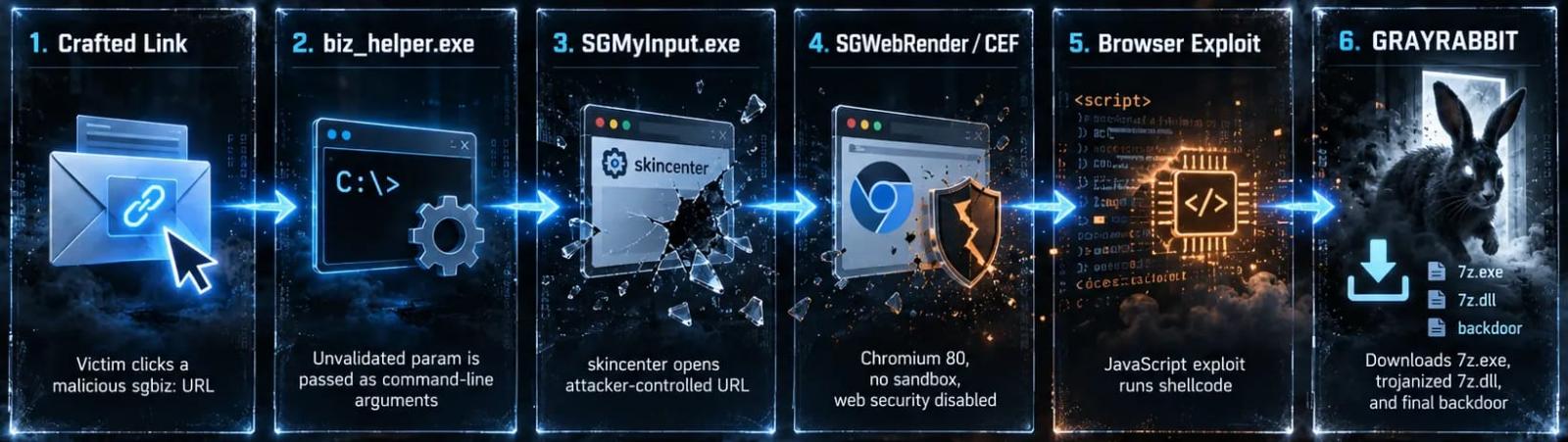
The exploitation of the Sogou Input Method vulnerability is a sophisticated, multi-stage process that chains together three distinct weaknesses within the application. This intricate attack vector begins with a deceptively simple action by the victim: clicking a specially crafted link.
Stage 1: Initial URI Handling and Argument Injection
The attack commences when a user clicks on a malicious Uniform Resource Identifier (URI) using the custom sgbiz: scheme. This triggers the Windows operating system to invoke Sogou’s biz_helper.exe protocol handler. The critical flaw lies in how biz_helper.exe processes command-line arguments. Instead of rigorously validating the data passed to it, the handler directly passes attacker-controlled arguments to the legitimate SGMyInput.exe executable. This bypasses standard security checks, allowing malicious commands to be injected into the application’s execution flow.
Stage 2: Exploiting the Skin Center and Embedded Browser
The injected arguments are designed to manipulate Sogou’s skincenter component. This component, which is responsible for managing visual themes and potentially other functionalities, is instructed to load an attacker-controlled URL. Crucially, Sogou’s implementation at the time did not impose restrictions on the URI scheme or the destination of these loaded URLs. This lack of validation provides an open door for attackers to direct the application to malicious web pages.

Stage 3: Remote Code Execution via Outdated Chromium Engine
The final stage of the attack chain involves the exploitation of a known vulnerability within Sogou’s embedded Chromium 80 engine. This version of the Chromium browser, which is part of the Sogou Input Method, is significantly outdated. Furthermore, it operates without essential security features such as sandboxing and with many critical web security protections disabled. This combination of an outdated engine and weakened security posture makes it highly susceptible to exploits. By loading a malicious page, attackers can leverage this vulnerability to achieve remote code execution on the victim’s machine. This ultimately leads to the installation of the GrayRabbit backdoor.
Gen Digital’s report explicitly states: "We observed this vulnerability actively exploited in the wild by the UNC3569 threat group to deploy the GRAYRABBIT backdoor through a crafted link." This confirmation highlights the real-world danger posed by this security flaw.
The GrayRabbit Backdoor: A Modular and Evasive Threat
The GrayRabbit malware family, as described by Google researchers in 2024, is characterized by its modular design, allowing for flexible and adaptable malicious operations. The variant analyzed by Gen Threat Labs is a more mature 64-bit iteration, showcasing enhanced capabilities and a refined command-and-control (C2) configuration. This advanced version employs RC4 encryption for its C2 communications, adding a layer of obfuscation to its network traffic and making it more challenging for security defenses to detect.
The reported functionalities of the GrayRabbit backdoor are extensive and pose a significant threat to compromised systems:
- Process Execution: The malware can initiate and manage processes on the host system, allowing attackers to run arbitrary commands and tools.
- Interactive Reverse Shells: It establishes interactive reverse shells, granting attackers direct command-line access to the compromised machine, enabling them to operate as if they were locally present.
- File Upload and Download: The backdoor facilitates the exfiltration of sensitive data by allowing attackers to download files from the victim’s system and upload malicious payloads or tools.
- System and User Information Gathering: GrayRabbit is capable of collecting detailed information about the compromised system, including hardware specifications, operating system details, user accounts, and installed software. This intelligence can be used for further targeting or espionage.
- Reflective Plugin Loading: A key feature is its ability to load plugins directly into the host’s memory without writing them to disk. This technique, known as reflective loading, makes the malware more evasive and harder to detect by traditional file-based antivirus solutions.
This comprehensive suite of capabilities underscores GrayRabbit’s potential for deep system compromise, ranging from data theft to persistent espionage.
Background: Sogou Input Method and the UNC3569 Threat Actor
Sogou Input Method, developed by the Chinese tech giant Tencent, is an extremely popular application in China, boasting hundreds of millions of installations. Its primary function is to facilitate Chinese character input using standard keyboards, a crucial tool for a vast number of users. The application’s integration of a custom link handler and an embedded web browser, even one built on an older Chromium engine, has inadvertently created attack vectors.
The UNC3569 threat actor group, previously analyzed by Google, is identified as a China-based entity with a dual operational focus. Its involvement in both cybercrime and operating as a "contractor-for-hire" suggests a broad range of motivations, from financial gain to state-sponsored espionage. This actor’s ability to leverage sophisticated techniques and target widely used software highlights a concerning trend in the evolving threat landscape.
Chronology of Events and Remediation Efforts
The discovery and subsequent disclosure of the Sogou Input Method vulnerability follow a typical cybersecurity incident response timeline:
- Prior to April 9, 2026: The UNC3569 threat group actively exploited the CVE-2026-51990 vulnerability in the wild to deploy the GrayRabbit backdoor.
- April 9, 2026: Gen Threat Labs reported their findings regarding the vulnerability and active exploitation to Tencent. This proactive disclosure is a critical step in allowing software vendors to address security issues.
- April 21, 2026: Tencent released version 16.3.0.3498 of the Sogou Input Method, which includes a patch addressing the identified vulnerability. The update aims to validate URL arguments, restrict them to HTTPS, and limit navigation to approved Sogou and Tencent domains.
While the patch addresses the immediate RCE vulnerability related to the protocol handler, Gen Digital researchers have issued a cautionary note: "However, the researchers warned that the underlying browser remains outdated and still runs without a sandbox, with many web security protections disabled." This suggests that while the direct path of exploitation used by UNC3569 has been closed, the embedded browser’s inherent weaknesses could potentially be leveraged by other threats in the future.
Broader Implications and Security Best Practices
The exploitation of a widely used application like Sogou Input Method by a sophisticated threat actor like UNC3569 has several significant implications for cybersecurity:
- Supply Chain Risk: This incident underscores the inherent risks within software supply chains. Vulnerabilities in components or dependencies, even those from reputable vendors, can have far-reaching consequences for millions of end-users.
- The Persistence of Outdated Software: The reliance on an outdated Chromium engine within Sogou Input Method highlights a common challenge in software development and maintenance. Legacy components, while functional, can become significant security liabilities over time if not actively updated or replaced.
- The Evolving Tactics of Espionage Groups: The sophistication of the UNC3569 attack chain, involving multiple steps and exploiting nuanced vulnerabilities, demonstrates the increasing technical prowess of state-aligned threat actors. Their ability to adapt and exploit common software further emphasizes the need for robust, multi-layered security strategies.
- User Awareness and Software Updates: The incident serves as a critical reminder for users to maintain vigilance and promptly apply software updates. While a patch has been released, systems that remain unpatched are still vulnerable to this specific exploit. Furthermore, educating users about the dangers of clicking on suspicious links is paramount.
From a broader analytical perspective, the incident points to a continued trend of threat actors targeting the initial access vector through seemingly innocuous applications that have deep integration into operating systems. The ease with which users interact with input methods and their potential to handle complex data streams like custom URIs makes them attractive targets.
Expert Commentary and Official Responses (Inferred)
While direct statements from Tencent beyond the patch release are not detailed in the initial report, a swift response with a patch is indicative of their commitment to addressing security vulnerabilities. A spokesperson for Tencent, if available, would likely reiterate their dedication to user security and encourage users to update their Sogou Input Method to the latest version.
Cybersecurity analysts, like those at Gen Digital, often emphasize the need for continuous security auditing and prompt patching. The warning about the outdated browser engine suggests a call to action for Tencent to address the underlying architectural weaknesses, not just the immediate exploit. Industry experts consistently advise organizations and individuals to:
- Maintain Up-to-Date Software: Regularly update all operating systems, applications, and security software to ensure that the latest patches and security enhancements are applied.
- Exercise Caution with Links and Attachments: Be skeptical of unsolicited emails, messages, or links, especially those that create a sense of urgency or promise something extraordinary.
- Implement Multi-Factor Authentication (MFA): Where possible, enable MFA on all accounts to add an extra layer of security against unauthorized access, even if credentials are compromised.
- Conduct Regular Security Audits: For organizations, performing regular security assessments of their infrastructure and software dependencies can help identify and mitigate vulnerabilities before they are exploited.
- Leverage Endpoint Detection and Response (EDR) Solutions: Advanced security solutions can provide deeper visibility into system activities and help detect and respond to sophisticated threats like GrayRabbit, even when they attempt to operate stealthily.
The ongoing cat-and-mouse game between threat actors and cybersecurity professionals necessitates a proactive and adaptable approach. The exploitation of the Sogou Input Method vulnerability by UNC3569 serves as a stark reminder that even the most widely used software can harbor critical security flaws, requiring constant vigilance and a commitment to robust security practices from both developers and users.