Lina Irawan
LinkedIn has announced a significant architectural shift in how its artificial intelligence agents manage long-term user preferences and contextual data. By moving away from traditional GraphRAG (Graph Retrieval-Augmented Generation) frameworks in favor of a specialized tree-structured memory system, the professional networking giant is addressing the dual challenges of latency and incremental updates at a global scale. This development, led by LinkedIn’s Principal AI Researcher Praveen Bodigutla, represents a fundamental change in the "agentic memory" landscape, aiming to provide a "second brain" for specialized workflows, particularly within the company’s recruitment and hiring ecosystems.
The transition comes as part of LinkedIn’s broader push into agentic AI, specifically through its "Hiring Assistant" platform. This tool is designed to assist recruiters in managing complex workflows, from refining job descriptions to evaluating candidate fit. The core innovation lies in a "Cognitive Memory Agent" that does more than simply store chat history; it manages a complex lifecycle of information ingestion, organization, and retrieval to ensure that an agent’s responses are personalized, fresh, and contextually grounded.
The Genesis of the Cognitive Memory Agent
The development of the Cognitive Memory Agent was prompted by observed behaviors among recruiters using LinkedIn’s AI-driven hiring tools. Research teams noted that recruiters frequently expressed nuanced preferences during their interactions with AI—such as specific skill weights, location requirements, or feedback on individual candidates—that remained relevant across multiple sessions and different hiring projects.
Traditional AI models often suffer from "context bloat" or "memory loss" between sessions. To solve this, LinkedIn sought to create a persistent state for its agents. This state allows the AI to recognize that a preference expressed during a search for a software engineer in San Francisco might carry over to a similar search for a DevOps lead, while still allowing for project-specific overrides. The goal was to move beyond simple retrieval to a managed "memory flywheel" that understands relevance, handles conflicts, and maintains provenance for every piece of stored information.
Architectural Deep Dive: The Four-Layered Memory Stack
LinkedIn’s memory architecture is structured as a "layered cake," designed to capture information at varying levels of granularity and temporal relevance. This four-tier system ensures that the AI can balance immediate conversational needs with long-term strategic preferences.
1. Conversational Memory
This is the most immediate layer, capturing the "here and now" of an interaction. It ensures that the agent maintains the thread of a current session, understanding pronouns and immediate follow-up questions. It is high-velocity and serves as the primary intake point for new information.
2. Episodic Memory
The episodic layer provides a temporal querying capability. It records specific activities and interactions as discrete "episodes," allowing the system to trace information back to its source. This provides essential provenance; if an agent makes a recommendation based on a recruiter’s past preference, the episodic store allows the system to cite exactly when and why that preference was established.
3. Semantic Memory
Semantic memory acts as the aggregate store of a user’s knowledge and preferences. It distills information from across multiple sessions and even different product surfaces within the LinkedIn ecosystem. If a recruiter archives certain types of profiles in the standard search interface, the semantic layer incorporates that behavior into the recruiter’s overall preference profile within the hiring agent.
4. Procedural Memory
The most complex layer, procedural memory, captures the "how" of a user’s workflow. Different recruiters prioritize different trade-offs—some may value seniority over specific niche skills, while others prioritize workplace flexibility. The procedural layer learns these implicit weighting schemes, effectively modeling the recruiter’s decision-making logic to streamline future tasks.
Technical Evolution: The Shift from GraphRAG to Tree Structures
One of the most significant technical revelations from LinkedIn’s AI research team is the decision to move away from GraphRAG. While knowledge graphs are a popular method for representing relationships in AI, LinkedIn found them insufficient for the demands of a high-scale production environment.
The Limitations of GraphRAG
Praveen Bodigutla noted that GraphRAG proved to be both slow and cost-prohibitive. The primary issue was the reliance on excessive Large Language Model (LLM) calls to identify linkages between nodes and the necessity of rebuilding the entire index to accommodate updates. At LinkedIn’s scale, where millions of interactions occur daily, the lack of efficient incremental updates became a bottleneck.
The Tree-Structured Solution
To solve the scaling issue, LinkedIn transitioned to a tree-structured memory organization. This hierarchy mirrors the natural organization of recruitment data: a company sits at the root, followed by recruiters as branches, and individual hiring projects as leaf nodes.
This structure allows for "incremental update optimization." When a recruiter changes a preference for a specific project, the system only needs to update the corresponding leaf node and percolate that change up the relevant branch. This avoids a total re-indexing of the user’s memory, significantly reducing compute costs and ensuring that the agent’s "knowledge" is always fresh.
Optimizing for Latency and Scale
In a production environment, an AI agent’s memory is only useful if it can be retrieved almost instantaneously. LinkedIn operates under a strict "latency budget," where the memory agent is allocated only 10% to 20% of the total response time. The remaining 80% to 90% is reserved for the application agent to fetch external data, reason through the prompt, and synthesize a final response.
To meet these targets, LinkedIn implemented several engineering optimizations:
- Parallel Planning: Instead of sequential reasoning, the system uses a flattened planning layer that identifies the necessary memory tools in a single parallel step.
- Selective LLM Calls: The system determines if a query can be answered using existing conversational context before invoking more complex (and expensive) reasoning processes.
- VLLM Serving Enhancements: The team utilizes prefix caching and chunk prefills to accelerate inference speeds.
- Structured Outputs: By forcing the LLM to generate responses in a fixed API-like format, LinkedIn limits the generation of unnecessary "reasoning tokens," further shaving milliseconds off the response time.
Governance, Security, and Multi-Tenancy
Given the sensitive nature of recruitment data and personal professional information, LinkedIn’s memory system is built on a foundation of strict isolation. The architecture utilizes a multi-tenant approach where every application has its own isolated data store.
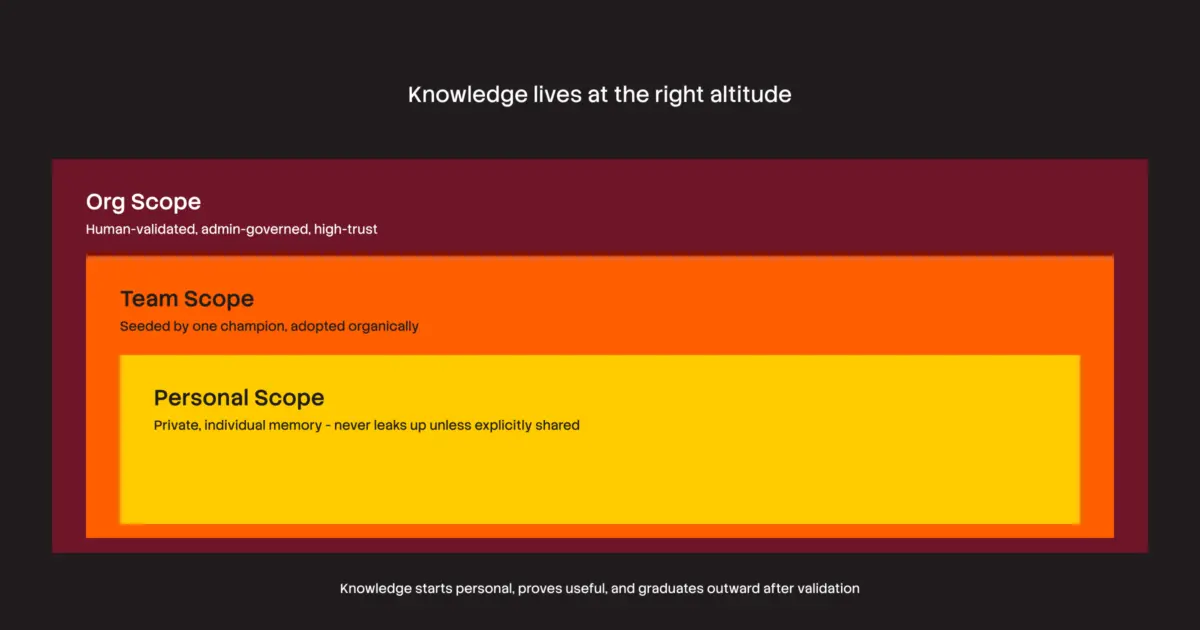
Access control is integrated at every level. Memory nodes are tagged with ownership credentials, ensuring that a recruiter can only access data they are authorized to see. However, the tree structure also facilitates "safe sharing." If a recruiter belongs to a specific cohort or hiring team, the system can allow for the sharing of "domain intelligence"—aggregate preferences that help a new recruiter bootstrap their workflow based on the established standards of their organization.
Chronology and Development Context
The transition to this cognitive memory system reflects a multi-year evolution within LinkedIn’s AI departments. Praveen Bodigutla’s background—spanning platform engineering at Yahoo, dialogue research at Amazon Alexa, and financial mathematics at Stanford—informed the "nonlinear" path toward this agentic memory solution.
The project moved from initial experimentation with standard RAG and vector databases to the realization that recruitment requires a more structured, "agentic ETL" (Extract, Transform, Load) approach. This "ETL for the agentic era" focuses on being parsimonious—capturing high-signal data while aggressively pruning noise and stale information. For example, preferences older than six months may be archived or superseded by more recent interactions to ensure the AI does not act on outdated criteria.
Broader Implications and Future Research
The shift at LinkedIn signals a broader trend in the AI industry: the move from "stateless" chat interfaces to "stateful" cognitive assistants. By treating memory as a managed service rather than a simple database, LinkedIn is setting a precedent for how enterprise-grade AI can handle personalization without compromising on performance.
Looking forward, LinkedIn is exploring even more advanced abstractions for memory persistence. One active area of research involves moving beyond standard database tools toward "virtual file systems" for memory, which could provide even greater flexibility in how LLMs discover and access stored information.
Furthermore, the team is focusing on "attribution" and "evaluation." As agents become more complex, determining exactly which piece of memory led to a specific AI decision becomes harder. Robust evaluation strategies are being developed to measure "friction"—tracking whether the memory agent actually reduces the number of turns a user takes to complete a task, which is the ultimate metric for agentic success.
In a related community milestone, the broader developer ecosystem continues to refine the tools used by these AI researchers. Recently, Stack Overflow recognized contributor Luka Ganić with a Populist badge for providing a superior solution regarding SVG image integration in Flutter—a reminder that the underlying UI and platform tools used to build these AI interfaces are constantly being optimized by the global developer community.
As LinkedIn continues to roll out these memory-enhanced agents, the professional world may soon see a shift in how talent is discovered. With an AI that remembers the nuances of a recruiter’s "gut feeling" and translates it into a structured, searchable preference tree, the gap between a job description and the perfect hire is expected to narrow significantly.