Evan Lee Salim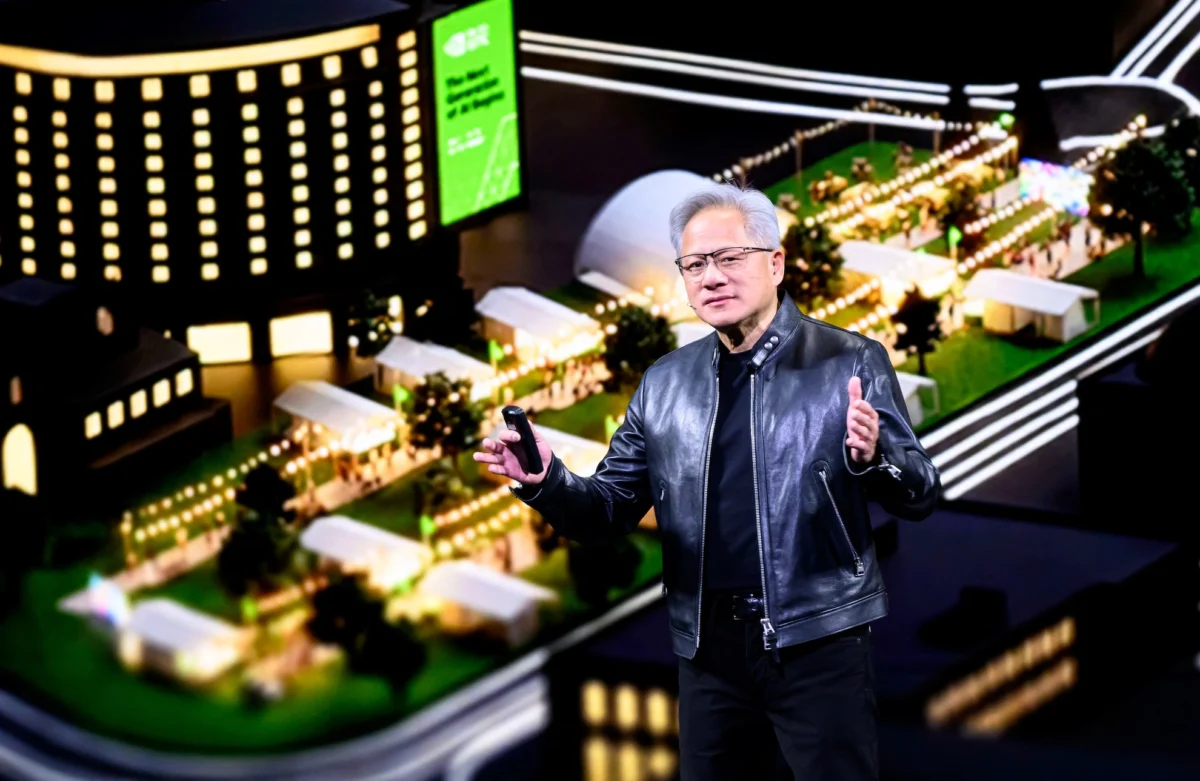
Jensen Huang, the visionary founder and CEO of Nvidia, delivered a robust and unapologetically bullish forecast for his company’s continued dominance in the artificial intelligence sector, projecting record-breaking revenue growth through the end of next year. Speaking at the prestigious Goldman Sachs Communacopia + Technology conference on Thursday, Huang addressed concerns about escalating competition, emphasizing Nvidia’s unique position as the foundational platform underpinning the global AI ecosystem. His remarks painted a picture of a company not merely selling chips, but orchestrating the very infrastructure of the AI revolution, a perspective he believes grants him an unparalleled glimpse into the industry’s future.
The Goldman Sachs Communacopia Stage: A Bullish Outlook
The Goldman Sachs Communacopia + Technology conference is a pivotal annual event, attracting top executives, investors, and analysts from across the technology and financial sectors. It serves as a crucial platform for companies to articulate their strategic visions, financial outlooks, and market positions. Huang’s appearance was particularly anticipated given Nvidia’s explosive growth and its central role in the burgeoning AI industry. His confidence was palpable as he dismissed notions of an impending slowdown, instead doubling down on previously issued guidance that forecasts an extraordinary trajectory for the chipmaker. The audience, comprising some of the most influential figures in global finance and technology, listened intently as Huang articulated the intricate web of partnerships and technological innovations that he believes will insulate Nvidia from competitive pressures and propel it to new financial heights.
From Gaming Graphics to AI’s Foundational Engine: Nvidia’s Evolution
Nvidia’s journey from a graphics card manufacturer primarily catering to PC gamers to the undisputed leader in AI infrastructure is a testament to its strategic foresight and relentless innovation. Founded in 1993, the company initially gained prominence for its groundbreaking work in 3D graphics processing units (GPUs). However, a pivotal shift began in the mid-2000s with the introduction of CUDA (Compute Unified Device Architecture), a parallel computing platform and programming model. CUDA enabled developers to harness the immense parallel processing power of GPUs for general-purpose computing tasks, extending their utility far beyond graphics rendering.
This technological pivot proved prescient. As the field of artificial intelligence, particularly deep learning, began to gain traction in the early 2010s, researchers discovered that GPUs, with their ability to perform numerous calculations simultaneously, were exceptionally well-suited for the intensive computational demands of training neural networks. Nvidia invested heavily in this emerging field, developing specialized software libraries and hardware architectures optimized for AI workloads. This early and sustained commitment allowed Nvidia to establish an insurmountable lead, creating a robust ecosystem of hardware, software, and developer tools that became the de facto standard for AI development globally. Today, its GPUs power nearly every major AI research lab, cloud provider, and enterprise AI initiative, effectively making it the "picks and shovels" provider in the AI gold rush.
Beyond the Chip: The Scale and Sophistication of Nvidia’s AI Systems
A cornerstone of Huang’s argument for sustained dominance lies in the evolving nature of Nvidia’s product offerings. He directly challenged the common perception that Nvidia simply "builds a chip," stating, "I mean, you need airplanes to ship what we build." This seemingly hyperbolic remark underscores the dramatic transformation of Nvidia’s AI solutions from discrete components to highly integrated, immensely powerful, and complex supercomputing systems.
Huang detailed how a single "GPU" in today’s context is no longer a $399 consumer-grade graphics card. Instead, he described an integrated system costing upwards of $8.5 million, comprising "2 million parts" and consuming "250,000 kilowatts" of power. He clarified that these are not individual GPUs but rather sophisticated clusters connected by NVLink, Nvidia’s high-speed interconnect technology, designed to function as a single, massive computational unit. These systems, such as the recently launched GB200 NVL72, represent the pinnacle of AI infrastructure. The GB200 NVL72, for instance, combines 36 Grace CPUs with 72 Blackwell GPUs within a single rack-scale liquid-cooled system, delivering unprecedented performance for large-scale AI model training and inference. Huang reported that orders for this singular product are currently experiencing an astounding 27% month-to-month sales growth, indicating robust demand for the most advanced AI computing platforms. This shift towards selling entire data center-scale AI factories, rather than just individual components, significantly raises the barrier to entry for competitors and deepens Nvidia’s integration into its customers’ operations.
Financial Projections: A Staggering $680 Billion Horizon
Huang’s bullishness extended directly to Nvidia’s financial outlook. He reiterated the company’s previously issued guidance, first announced during its last record-breaking quarterly earnings report, predicting a staggering 70% year-over-year revenue growth for the upcoming fiscal year. Analysts currently project Nvidia to conclude its present fiscal year with approximately $400 billion in revenue. Should Huang’s 70% growth forecast materialize, it would propel Nvidia’s annual revenue to an astounding $680 billion by the end of next year.
To put this into perspective, such a figure would place Nvidia among the very largest technology companies globally, rivaling the revenues of established giants. This projection reflects not only the insatiable demand for AI compute but also Nvidia’s unparalleled ability to scale its operations, innovate at a rapid pace, and maintain its pricing power despite increasing competition. The company’s recent earnings reports have consistently shattered expectations, driven by surging demand from hyperscale cloud providers, enterprises, and AI startups all racing to build and deploy advanced AI models.
An Ecosystem Entrenchment: Huang’s "Future Vision"
Huang attributed his extraordinary confidence and ability to "see the future" to Nvidia’s deep and pervasive entrenchment across the entire AI ecosystem. "Nvidia runs every model. Every single lab can use us," he stated, highlighting that this includes leading AI research institutions such as Anthropic and OpenAI, as well as Google, and numerous open-weight model initiatives. He firmly asserted, "We are a foundational platform of the AI ecosystem, foundational platform of the AI industry."
This foundational role extends far beyond merely supplying chips. Nvidia’s influence permeates every layer of the AI stack, from its CUDA software platform, which has become the industry standard for GPU programming, to its comprehensive libraries, frameworks, and tools. This software lock-in, often referred to as the "CUDA moat," makes it incredibly challenging for competitors to gain traction, as migrating existing AI models and development workflows to alternative hardware platforms is a complex, time-consuming, and costly undertaking.
Furthermore, Huang revealed an astonishing level of insight into global AI infrastructure development. "We’re tracking every single gigawatt of land, power, shell around the world. Literally everything on the planet," he claimed, referring to the physical shell of data center buildings before they are outfitted with computing equipment. This granular visibility into global data center construction, energy availability, and infrastructure planning provides Nvidia with an unparalleled strategic advantage, allowing it to anticipate demand, optimize its supply chain, and tailor its offerings to emerging market needs. He elaborated on the feedback loops from "neoclouds" (emerging cloud providers), OEMs (Original Equipment Manufacturers), established cloud giants, and AI-native companies, all of whom "report back to us." This vast network of partnerships and intelligence gathering grants Nvidia a panoramic view of the AI industry’s evolution, allowing it to stay several steps ahead of the curve.
Navigating the Competitive Landscape: Hyperscalers and Startups
Despite Huang’s unwavering confidence, the competitive landscape for AI chips is intensifying. The original article highlights key players vying for a share of this lucrative market, and it’s crucial to contextualize these challenges.
Hyperscale Cloud Providers: Giants like Amazon (with its Trainium and Inferentia chips), Microsoft (Maia AI Accelerator), and Google (Tensor Processing Units or TPUs) are heavily investing in developing their own custom AI silicon. Their primary motivations are multi-faceted:
- Cost Optimization: Reducing reliance on external vendors can significantly lower the operational costs of their massive data centers.
- Customization: Tailoring chips to their specific workloads and software stacks can offer performance and efficiency advantages.
- Supply Chain Security: Mitigating supply chain risks and gaining greater control over their hardware infrastructure.
- Strategic Differentiation: Offering unique, optimized hardware to their cloud customers.
While these efforts pose a long-term challenge, Nvidia’s comprehensive software ecosystem and rapid innovation cycle currently maintain its lead. These hyperscalers still heavily rely on Nvidia GPUs for the most demanding and generalized AI workloads, especially for training foundational models.
AI Labs: Even leading AI research institutions like Anthropic and OpenAI, which are massive Nvidia customers, are reportedly exploring or designing their own chips. Their motivation is similar to hyperscalers: to optimize hardware for their specific models, reduce costs associated with external compute, and potentially gain a competitive edge in model development. However, these are extremely capital-intensive and technically challenging endeavors, often requiring years to yield production-ready silicon that can compete with Nvidia’s established offerings.
Emerging Competitors: The market also sees specialized chipmakers like Cerebras and a new wave of AI chip startups such as Etched.
- Cerebras Systems: Known for its Wafer-Scale Engine (WSE), which integrates an entire computer chip onto a single silicon wafer, Cerebras targets ultra-large AI models with a focus on maximizing computational density and minimizing data movement. While impressive, its niche approach and specialized architecture mean it serves a particular segment rather than broad market competition with Nvidia.
- Etched: This startup, which reportedly hit a $5 billion valuation and $1 billion in sales for its AI chip, represents a new breed of challengers often focusing on Application-Specific Integrated Circuits (ASICs) designed for particular AI workloads, aiming for higher efficiency and lower cost for specific tasks.
Nvidia’s strategy to counter these threats is multi-pronged: continuous innovation (e.g., Blackwell, Grace-Blackwell platforms), expanding its software ecosystem, delivering complete data center solutions rather than just chips, and leveraging its immense manufacturing scale and global distribution network.
Addressing the "Circular Deals" Critique: A Strategic Investment Thesis
The discussion at the conference also veered into the contentious topic of Nvidia’s "circular deals," where the company invests in startups that subsequently become its customers. This practice evokes historical parallels to the dot-com bubble era, where companies like Lucent Technologies engaged in similar financing schemes that ultimately contributed to their downfall. Critics argue that such arrangements can inflate revenue figures and mask underlying weaknesses in demand.
Huang, however, offered a candid and somewhat cheeky defense of Nvidia’s approach. "Well, it’s not circular because we put a little bit of money in, and a lot of money comes back," he quipped. He then joked further, "I look at the spreadsheet, we put in $1 and $100 comes back in. Is that circular? If that is, let’s do more of that."
Quips aside, Huang insisted that Nvidia’s investment strategy is rigorously vetted. Before any company receives an investment, Nvidia ensures that it possesses "real contracts generating revenue from customers." He stated that he has personally reviewed some $100 billion worth of such contracts, indicating a significant volume of legitimate business activity underpinning these investments. "I’m not taking any risks… I need a sure thing," he asserted, implying a stringent due diligence process aimed at minimizing speculative investments.
Nvidia’s venture arm and strategic investments can be seen as a sophisticated mechanism to foster its ecosystem. By investing in promising AI startups, Nvidia helps accelerate their development, ensures their reliance on Nvidia’s platforms, and cultivates a new generation of major customers. This symbiotic relationship, if managed transparently and with genuine market demand, can be a powerful engine for growth, ensuring the continued expansion of the Nvidia-powered AI universe.
The Broader Implications: AI Infrastructure, Energy, and Market Dynamics
Nvidia’s projected growth and its central role in AI have profound implications for the global technology landscape. The sheer scale of anticipated revenue underscores the massive capital expenditure currently being poured into AI infrastructure. Cloud providers, enterprises, and national governments are investing billions in building new data centers and upgrading existing ones to support the insatiable demand for AI compute. This infrastructure boom benefits not only Nvidia but also memory chip makers, power supply manufacturers, cooling system providers, and construction companies involved in data center development.
However, this explosive growth also raises critical questions. Huang’s mention of "250,000 kilowatts" for a single "GPU" system highlights the immense energy consumption associated with advanced AI. As AI becomes more pervasive, the demand for electricity will skyrocket, placing significant strain on existing power grids and accelerating the need for renewable energy sources and more energy-efficient computing architectures. This challenge is already spurring innovation in liquid cooling, advanced power management, and sustainable data center design.
The Road Ahead: Sustaining the Unprecedented Trajectory
While Nvidia’s current position appears unassailable, the technology industry is famously dynamic. The "golden rule of the tech industry," as acknowledged by Huang himself, dictates that "all big things get disrupted." The long-term sustainability of Nvidia’s stronghold on AI will depend on several factors:
- Innovation Pace: Nvidia must continue to out-innovate its competitors, not just in hardware but also in software and integrated solutions.
- Ecosystem Strength: Maintaining and expanding the CUDA ecosystem will be crucial in fending off alternative platforms.
- Efficiency Gains: As the AI industry matures, companies will inevitably seek greater efficiency in how they use infrastructure and manage token consumption. This could lead to optimization techniques that reduce the raw compute demand per unit of AI output.
- Regulatory Scrutiny: Given its near-monopoly in AI accelerators, Nvidia could face increased antitrust scrutiny from governments globally, potentially leading to regulatory challenges.
- Emerging Paradigms: Future breakthroughs in AI, such as entirely new computing paradigms (e.g., neuromorphic computing, quantum computing) or highly efficient specialized hardware, could shift the competitive landscape.
For now, however, Jensen Huang’s vision for Nvidia remains one of continued, unparalleled growth. The company’s deep integration into every facet of the AI supply chain, from foundational models to global data center blueprints, provides it with a unique vantage point and strategic leverage. As the world continues its headlong rush into the AI era, Nvidia, with its "finger in every pie," appears poised for another year of unprecedented expansion, confident that its foundational role will continue to translate into extraordinary financial success.