Sonny Valindra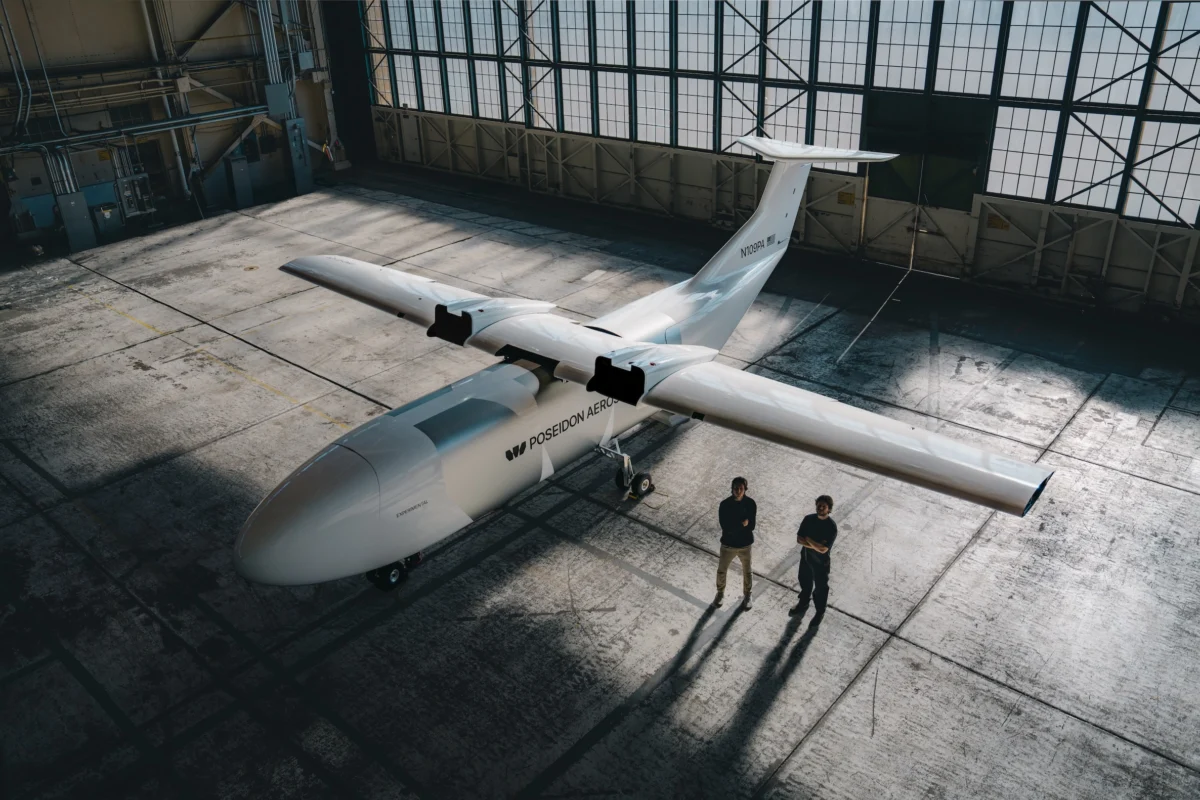
Poseidon Aerospace, a burgeoning startup focused on transforming the future of cargo transportation, has announced the successful closure of a $60 million Series A funding round. This significant investment, led by early-stage venture capital firm TQ Ventures, underscores a growing confidence in Poseidon’s pragmatic approach to advanced air mobility. The company’s ambitious goal is to make aerologistics dramatically more efficient and affordable, a stark contrast to the prevailing trend of focusing on cutting-edge, yet often unproven, technologies. The funding injection comes at a pivotal moment for Poseidon, as it prepares for the maiden test flight of its uncrewed cargo plane, the Egret, slated for completion by the end of the current year.
The genesis of Poseidon Aerospace can be traced back to late 2024, when co-founder and CEO David Zagaynov, then immersed in logistics at Amazon, and co-founder Parker Tenney, a former Lockheed Martin engineer, found themselves frequently discussing the burgeoning landscape of advanced air mobility (AAM) startups. Their observations revealed a common thread: a strong emphasis on developing novel and often complex technologies. "Philosophically, we want to build the future of aerologistics," Zagaynov articulated in an exclusive interview with TechCrunch. "Not to be a hater, but I think a lot of people who start aerospace companies get nerd-sniped by very cool technology and then want to implement it into market. For us, we want to improve cargo." This foundational principle—prioritizing the improvement of cargo delivery over the pursuit of groundbreaking but potentially impractical technologies—sets Poseidon apart in a competitive AAM sector.
The company’s strategic focus on cost reduction and operational efficiency has resonated with investors. Following a successful $11 million seed funding round last year, the $60 million Series A round saw participation from prominent new investors including Hanwha Asset Management, G Squared, and JAWS. Existing backers, such as Starship Ventures, Draper Associates, and Drover Ventures, also reaffirmed their commitment to Poseidon’s vision through their continued investment. This substantial financial backing will be instrumental in accelerating Poseidon’s development and operational plans, particularly as they move from design and simulation to physical testing.
A Pragmatic Approach to Aerologistics
Poseidon Aerospace’s core strategy hinges on a ruthless dedication to lowering the cost of air cargo transportation. This commitment is evident in their design philosophy, which deliberately sidesteps several technologies that have become de rigueur among many aviation startups. Notably, Poseidon is not pursuing vertical takeoff and landing (VTOL) capabilities, nor are they investing in hydrogen or electric powertrains. Instead, the Egret and its seaplane variant, the Heron, are fixed-wing aircraft powered by conventional combustion engines.
Zagaynov champions this approach by highlighting the inherent advantages of traditional fuels. "It’s really hard to beat the energy density of fuels of anything carbon-related," he explained. "Can I make a really good box with wings to move things for super cheap? If you do that, then abstracting the tech away, we’re left with unmanned cargo like planes that are able to operate on a much lower cost curve, and have much higher utilization." This focus on fundamental utility—creating an efficient and inexpensive aerial cargo carrier—is a testament to Poseidon’s market-driven innovation. The implications of this strategy are significant; by leveraging established engine technology and fixed-wing design, Poseidon aims to achieve economies of scale and operational efficiencies that are difficult to match with more experimental propulsion systems.
Dual Market Focus: Defense and Commercial Cargo
Poseidon Aerospace is strategically targeting two key sectors for its cargo aircraft: defense and regional commercial cargo.
Defense Applications: Enhancing Resilience and Reach
In the defense realm, Poseidon’s aircraft are designed to address critical logistical challenges. The company aims to provide air cargo services to "remote communities and underserved routes where air cargo service is constrained." A particularly compelling aspect of this offering is the ability to operate in environments with "degraded or nonexistent infrastructure." This capability is crucial for enhancing a nation’s logistical resilience, making it "harder to disrupt and more resilient to adversary denial." The geopolitical context is underscored by Poseidon’s past acknowledgments that nations like China are actively developing their own cargo drone capabilities, signaling a growing global interest in autonomous aerial logistics for strategic purposes.
The ability to deliver supplies and equipment to austere or contested environments without relying on extensive ground infrastructure offers a significant strategic advantage. This could range from delivering medical supplies to disaster-stricken areas with damaged runways to supporting forward operating bases in remote theaters of operation. The cost-effectiveness of these unmanned aircraft also allows for greater operational tempo and reduces the risk to human pilots in high-threat scenarios.
Commercial Cargo: Disrupting Regional Airfreight
On the commercial front, Poseidon’s strategy is even more disruptive. The company does not intend to sell its aircraft. Instead, Poseidon aims to operate its own regional air cargo business, directly competing with established players like UPS and FedEx. This move into direct service provision allows Poseidon to capture the entire value chain and maintain tighter control over its operational costs and service quality.
The absence of pilots is a key enabler of Poseidon’s cost advantage in the commercial sector. "What’s very nice is, logistics is a commodity, and so if you sell a commodity and do it better, faster, cheaper, the demand is all yours," Zagaynov stated. The elimination of pilot salaries, training, and associated logistical overheads can lead to substantial cost savings, allowing Poseidon to offer more competitive pricing.
Furthermore, the autonomy of the aircraft offers enhanced flexibility and responsiveness. In situations where demand surges in a particular region, Poseidon can more readily adjust its routes and schedules without the constraints of pilot availability and crew rest regulations. This agility is a significant advantage in the fast-paced logistics industry.
Zagaynov envisions a future where Poseidon’s operations can break free from the traditional hub-and-spoke model prevalent in regional air cargo. Instead, the company’s aircraft could facilitate more direct point-to-point deliveries, mirroring the operational model of low-cost passenger airlines like Breeze or Avelo. This shift could significantly reduce transit times and handling costs for regional freight.
The logistical burden associated with human pilots is a significant factor. "When you have a pilot, they have a maximum amount of hours that they can fly," Zagaynov elaborated. "So if they fly a five-hour leg in one direction, they’re not able to come back home. And unless you have a relief [pilot], then you have to pay for them to spend the night somewhere. The plane is like a very expensive asset that spends most of its life just waiting." By removing the pilot, Poseidon’s aircraft can operate continuously, maximizing utilization and further driving down per-mile costs.
Design Synergies from Autonomy
The decision to forgo human pilots also opens up significant design freedoms that contribute to reduced aircraft weight and improved efficiency. "Get rid of the cockpit; get rid of the life support systems," Zagaynov noted. This eliminates substantial structural weight and the need for complex environmental control systems. "You get to pull a ton of structured weight out, which then means that your ratio of payload to empty weight changes. Your engines can be much lighter, much more efficient, and so it’s like a virtuous cycle in the positive direction of just lighter, cheaper." This iterative design process, driven by the removal of pilot-centric requirements, leads to a more payload-efficient and cost-effective aircraft.
Operational Expansion and Regulatory Landscape
To support its ambitious development and operational plans, Poseidon Aerospace has expanded its facilities into an old Navy hangar in Alameda, California. This larger space is crucial for the construction of their full-size, 50-foot-wingspan aircraft. The company is also embarking on a significant hiring spree as it gears up for the crucial first test flight of the Egret. This expansion follows the successful development and flight of a quarter-scale prototype, dubbed Seagull, last year, which demonstrated the fundamental aerodynamic principles and control systems of their proposed aircraft.
The burgeoning regulatory environment for advanced aviation technologies is also playing a supportive role. While Poseidon is not directly developing electric vertical takeoff and landing (eVTOL) aircraft, which are currently the focus of a specific FAA pilot program, CEO Zagaynov believes the overall regulatory openness benefits his company. "There’s a path to commercialization that I don’t think existed like five to 10 years ago," he observed. This evolving regulatory framework suggests a growing willingness by aviation authorities to accommodate new and innovative aerial systems, paving the way for Poseidon’s pragmatic integration into the airspace.
The successful completion of the Egret’s first test flight by the end of this year will be a critical milestone. It will validate Poseidon’s design and operational concepts, providing tangible proof of their ability to deliver on the promise of more affordable and efficient aerologistics. The subsequent steps will likely involve scaling up production, obtaining necessary certifications for commercial operations, and gradually building out their regional cargo network.
The implications of Poseidon Aerospace’s model extend beyond the immediate logistics sector. By making air cargo more accessible and affordable, the company has the potential to stimulate economic activity in previously underserved regions, facilitate faster delivery of goods, and reduce the environmental impact associated with traditional freight transportation by shifting volume from less efficient modes. Their focused, cost-centric approach, eschewing the allure of unproven technologies for demonstrable utility, positions them as a compelling contender in the evolving landscape of aerial logistics. The $60 million Series A funding is not just an investment in an aircraft, but in a fundamental shift in how goods will move in the skies.