Sisilia Frederika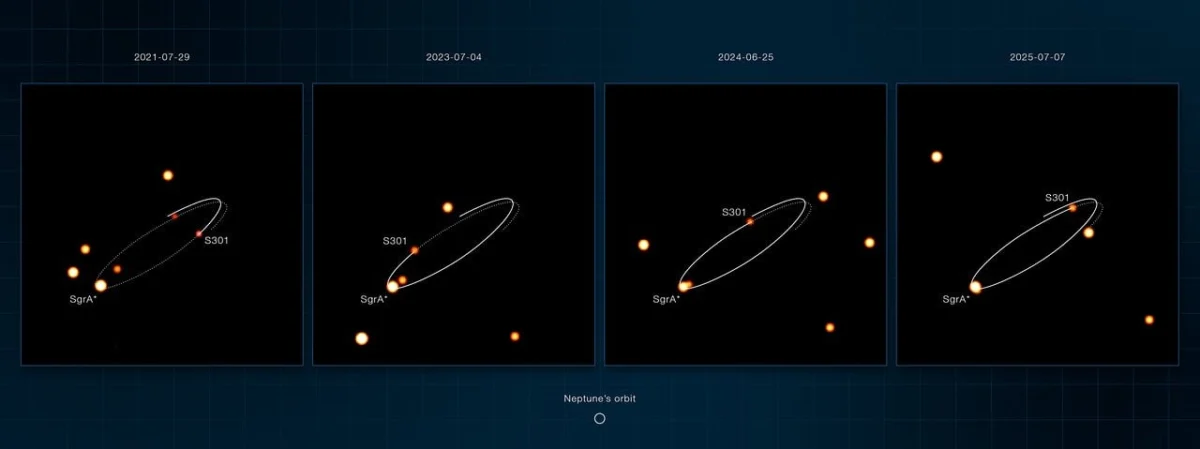
Astrophysicists at Syracuse University in New York have published a groundbreaking study that offers a new explanation for a long-standing mystery regarding the behavior of stars trapped in the gravitational influence of supermassive black holes. The research, led by doctoral student Ananya Bandopadhyay, postdoctoral researcher Benjamin Amend, and associate professor Eric Coughlin, focuses on repeating partial Tidal Disruption Events (rpTDEs). These rare cosmic occurrences happen when a star orbits a supermassive black hole at a distance that is close enough for the black hole’s immense gravity to strip away its outer layers, but far enough that the star survives the encounter. While astronomers have long understood the basic mechanics of these "near-miss" interactions, they have struggled to explain why the subsequent flares produced by some of these stars become significantly dimmer over time. The Syracuse team’s findings suggest that the internal rotation, or spin, of the star is the missing variable that determines the intensity and longevity of these periodic light shows.
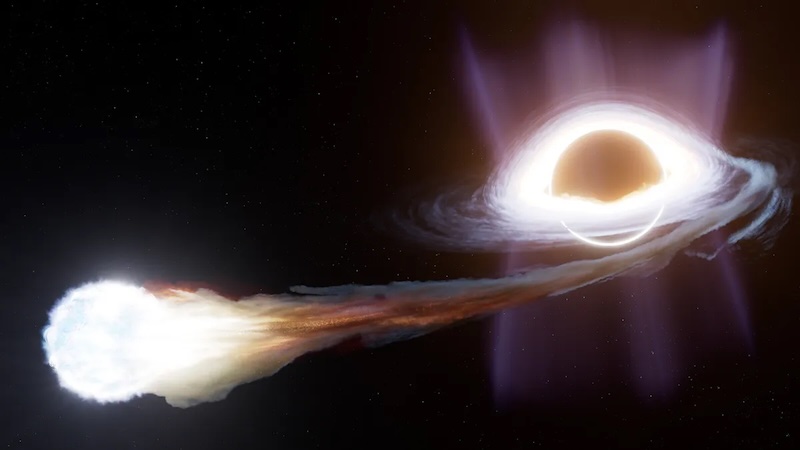
The study of Tidal Disruption Events (TDEs) has become a cornerstone of modern time-domain astronomy. Typically, a TDE occurs when a star wanders too close to a supermassive black hole—objects that can be millions or even billions of times the mass of our Sun. The gravitational tidal forces of the black hole exceed the star’s self-gravity, causing the star to be ripped apart in a process colloquially known as "spaghettification." About half of the resulting stellar debris is flung out into space, while the other half falls back toward the black hole, forming an accretion disk. As this material is consumed, it heats up to millions of degrees, releasing a massive burst of electromagnetic radiation that can be detected by telescopes across the globe. However, in a "partial" TDE, the star is not entirely destroyed. Instead, it enters an elliptical orbit, losing a portion of its mass every time it reaches its closest point to the black hole, known as the periapsis. This creates a repeating pattern of flares that can last for years.
The central puzzle that the Syracuse team sought to solve involved the inconsistent brightness of these repeating flares. In a standard model, one might expect the flares to remain relatively constant or follow a predictable decay curve based on the amount of mass lost. Yet, observations of several rpTDEs showed that while the initial flare was bright, successive flares were unexpectedly dim. This discrepancy suggests that less material was being stripped from the star in later passes than current models predicted. After two years of intensive analysis and hydrodynamical simulations, the team concluded that the star’s spin rate plays a decisive role in how much "starstuff" is sacrificed to the black hole during each pass.
The Mechanics of Tidal Stripping and Stellar Composition
To understand the discovery, it is necessary to examine the physical relationship between a star’s structure and the tidal forces it encounters. According to Bandopadhyay, the amount of mass a star loses is heavily dependent on its internal density and composition. Low-mass stars, such as red dwarfs, are characterized as being "fluffier." Their internal structures are largely convective, meaning their material is less tightly bound compared to more massive stars. When these low-mass stars encounter a supermassive black hole, they are highly susceptible to significant mass loss because their outer layers are easily pulled away by tidal forces.
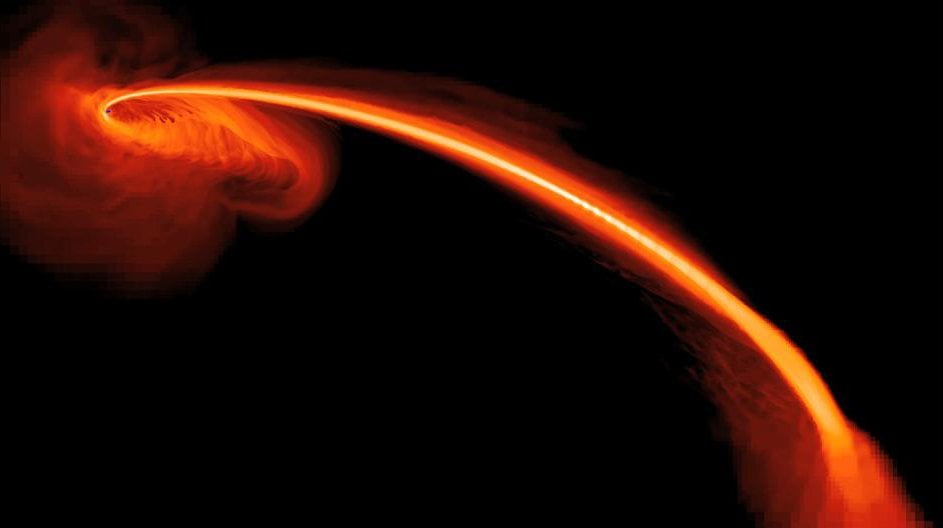
In contrast, high-mass main-sequence stars are "tougher" and more stratified. They possess a radiative core and a more structured outer shell. These stars can survive multiple close encounters with a black hole, losing only their outermost layers while the core remains intact. However, even within this category of high-mass stars, the Syracuse team noticed a pattern that defied standard logic. Out of ten identified repeating flare events, four exhibited a rapid dimming that could not be explained by mass loss alone. If the star was simply losing mass, the flares should have remained more robust for a longer period.
The team’s hydrodynamical simulations revealed that as a star passes the black hole, the tidal forces do more than just strip material; they exert a torque on the star. This torque acts like a cosmic wrench, spinning the star up to higher rotational velocities with each pass. Under normal circumstances, this increased spin would actually make it easier for the black hole to strip more material, as the centrifugal force would push the star’s outer layers further out. However, the simulations showed a counter-intuitive result: if a star is already spinning rapidly before it even begins its encounter with the black hole, the amount of mass stripped during each subsequent pass remains constant and relatively low. This leads to the "dimming" effect observed by astronomers, as the flares do not reach the peak brightness predicted by models that assume a non-spinning or slowly spinning star.
The Hills Mechanism and the Origin of Fast-Spinning Stars
A critical question arising from the Syracuse study was how these stars acquired such high spin rates in the first place. The researchers turned to a well-known astronomical concept called the Hills mechanism to provide an answer. Named after the physicist Jack Hills, the mechanism describes what happens when a binary star system—two stars orbiting each other—passes too close to a supermassive black hole. The extreme gravity of the black hole can disrupt the binary pair, essentially "capturing" one star into a tight orbit around the black hole while ejecting the other at hypervelocity into the far reaches of the galaxy.
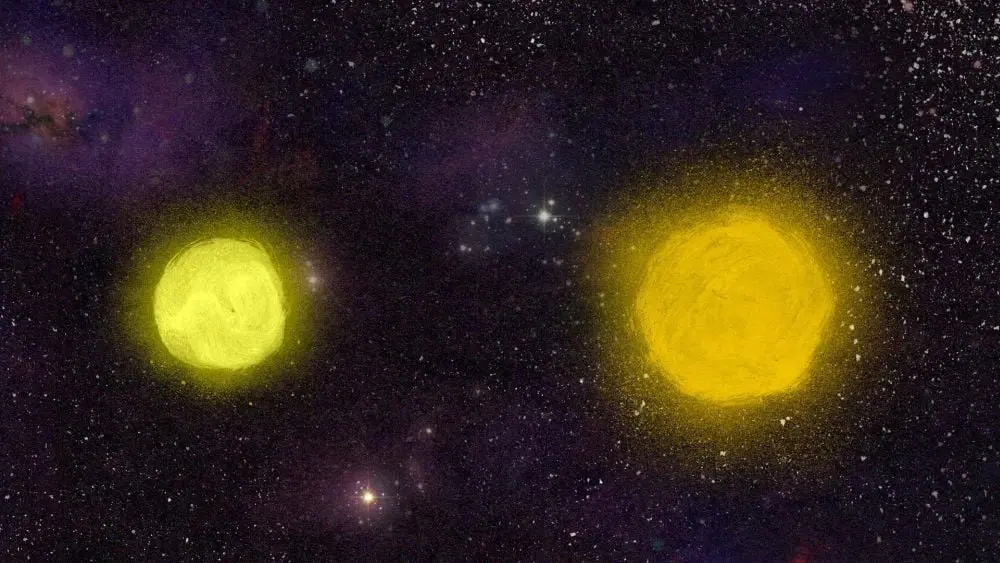
In many binary systems, the stars are tidally locked, meaning they rotate on their axes at the same rate they orbit each other, much like how the same side of the Moon always faces the Earth. Because the stars in a close binary system orbit each other very quickly, they are naturally high-spin objects. When the Hills mechanism captures one of these stars, it retains its rapid rotation. This star then begins its new life as a repeating TDE candidate, already spinning at a rate that limits the amount of material the black hole can strip during each pass. This "pre-spun" state explains why some stars produce consistently dimmer flares from the very beginning of their observed activity.
The Syracuse team’s work suggests that the captured star is "bound" to the black hole in an incredibly tight orbit, sometimes completing a full circuit in just a few months. Eric Coughlin noted the extreme nature of these orbits, stating that it is traditionally difficult to explain how a star could be bound so tightly without being immediately destroyed. The Hills mechanism, combined with the specific spin dynamics identified in the study, provides a coherent framework for understanding how these systems form and evolve.
Implications for the Galactic Center and Sagittarius A*
The findings have significant implications for our understanding of the environment surrounding Sagittarius A, the supermassive black hole at the center of the Milky Way. Astronomers have long monitored a group of stars known as the "S-stars" that orbit Sagittarius A at high speeds. One such star, S301, orbits the black hole every 8.7 years and reaches speeds exceeding 8 percent of the speed of light. While the S-stars currently observed are not undergoing tidal disruption, they represent the type of stellar population that could eventually be subjected to the processes described by the Syracuse team.
If some of the stars orbiting Sagittarius A* were originally part of binary systems disrupted by the Hills mechanism, they may possess the high spin rates necessary to produce the dimming rpTDEs observed in other galaxies. Monitoring the spin and light curves of stars as they migrate closer to the galactic center could allow future astrophysicists to predict which stars will eventually become repeating tidal disruption sources. Furthermore, this research helps refine the "census" of supermassive black holes. Since TDEs are often the only way to detect "dormant" black holes that aren’t actively consuming a large accretion disk, understanding the nuances of the flares allows for more accurate measurements of black hole mass and spin.
Future Research and Global Observation Efforts
The Syracuse study arrives at a pivotal moment for observational astronomy. With the upcoming operation of the Vera C. Rubin Observatory in Chile, which will conduct the Legacy Survey of Space and Time (LSST), the number of detected TDEs is expected to skyrocket. The LSST will scan the entire southern sky every few nights, providing a massive dataset of transient events, including thousands of potential rpTDEs.
Having a theoretical model that accounts for stellar spin will be essential for interpreting the data from the Rubin Observatory. Without this model, astronomers might misinterpret dim flares as originating from smaller black holes or different types of stellar objects. By incorporating spin into hydrodynamical models, researchers can now more accurately reconstruct the history of a star’s encounter with a black hole, including its original mass, its orbital path, and its origin as part of a binary pair.
The work of Bandopadhyay, Amend, and Coughlin serves as a reminder that even in the most extreme environments in the universe, the subtle details of a star’s internal physics—such as how fast it spins—can have a profound impact on the signals we receive millions of light-years away. As the field of time-domain astrophysics continues to expand, the Syracuse findings will likely be viewed as a vital piece of the puzzle in understanding the complex dance between stars and the gravitational titans that rule the centers of galaxies. The study not only solves a two-year-old mystery but also opens new avenues for exploring the dynamical history of our own galaxy and the wider universe.